
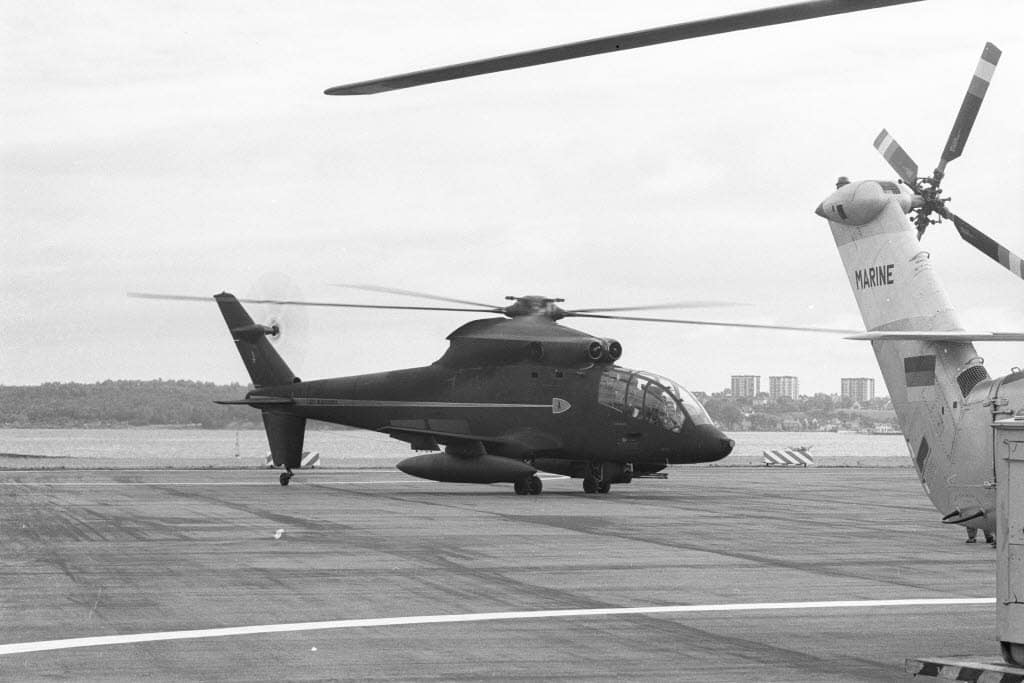
Before the UH-60 wore the name, there was another Blackhawk, and it was a snarling gunship. The Sikorsky S-67 first flew on 20 August 1970, a sleek, low-slung attack helicopter built entirely on Sikorsky's own money in a frantic nine-month sprint. Be clear from the start: this is not the UH-60 Black Hawk troop carrier. This is the original, and only one was ever built.
Sikorsky had lost the Army's big attack-helicopter contest to Lockheed's Cheyenne and was determined to prove a point. Reusing the rotor and drive system of the proven S-61 Sea King, the company wrapped them in a narrow, aerodynamic fuselage with stub wings, retractable main wheels, and the first speed brakes ever fitted to a helicopter.
FAITS RAPIDES
| Taper | Private-venture attack-helicopter demonstrator |
| Premier vol | 20 August 1970 |
| centrale électrique | 2 x General Electric T58-GE-5 turboshafts |
| Rotors | 5-blade main and 5-blade tail rotor |
| vitesse maximale | World record 220.9 mph (355.5 km/h), 1970 |
| Nombre construit | 1 |
| Destin | Crashed at Farnborough, 1 September 1974 |
Records that stood for eight years
The results were spectacular. In December 1970, test pilots Kurt Cannon and Byron Graham pushed the S-67 to 217 mph over a three-kilometre course, then to 220.9 mph over a longer run five days later. Those two world speed records stood for eight years. The five-bladed machine could roll, loop, and split-S with the poise of a fixed-wing fighter.
Under the fuselage sat a turret with a 20 mm cannon, and the stub wings could hang TOW missiles, rocket pods, or even Sidewinders. It could also swallow up to a squad of troops in a modified cabin. Two General Electric T58 turboshafts, the same engines used in the S-61, gave it its muscle.
A crowd, a roll, a tragedy
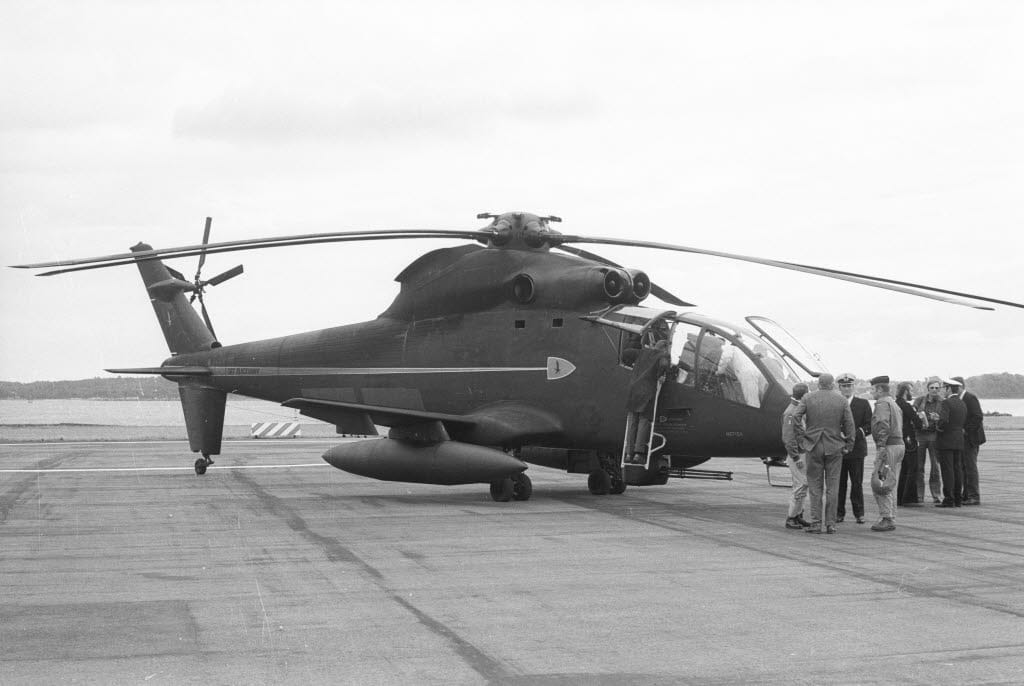
The Army flight-tested the S-67 against Bell's Model 309 KingCobra in 1972 as it weighed a replacement for the doomed Cheyenne. Neither was chosen; the Army instead launched the program that became the AH-64 Apache. Sikorsky kept touring the Blackhawk across Europe and the Middle East, hunting for buyers.
Then, on 1 September 1974, disaster. During a press-preview flight at the Farnborough Airshow, the S-67 entered a low-level roll, dropped its nose below the horizon, and struck the ground in a level attitude before bursting into flames. Test pilots Stu Craig and Kurt Cannon were both killed, and the sole prototype was destroyed.
Development died with the aircraft, but the name did not. When Sikorsky's UH-60 won the Army's utility competition in 1976, it inherited the title Black Hawk. The gunship that earned it first is too often forgotten.
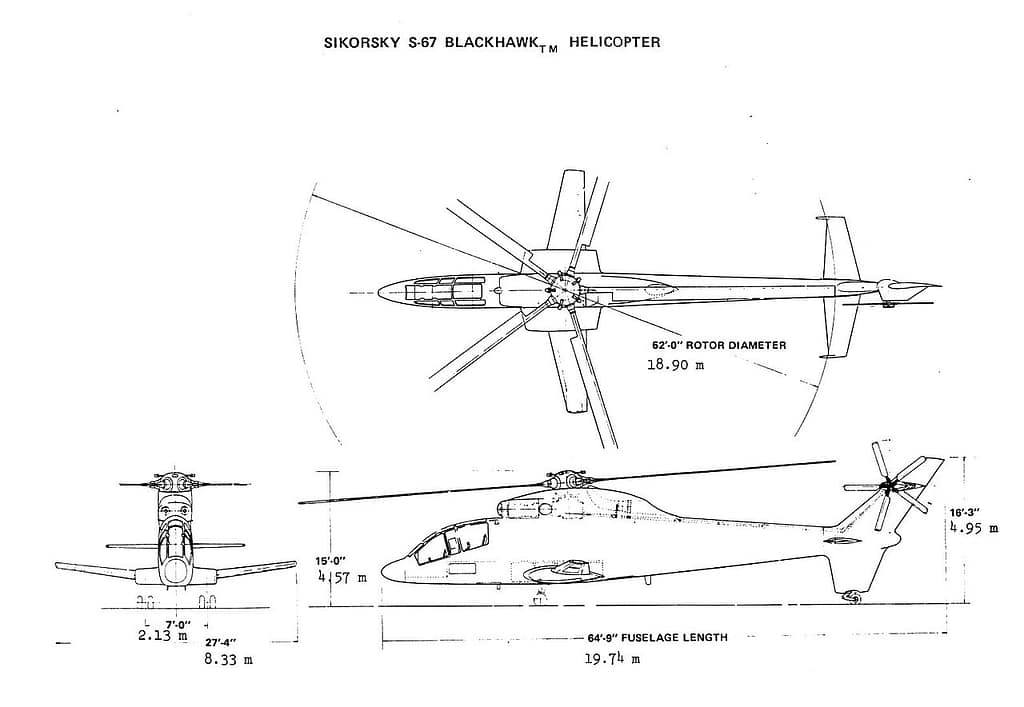
The story of the original Blackhawk, the gunship that set records and then vanished:
Sources: Vertical Magazine (Bob Petite); Wikipedia; Sikorsky fact sheet.
0 commentaire