
In a war over the Pacific, the side that sees first usually shoots first. Distances are enormous, the sky is empty, and a threat can appear from beyond the curve of the Earth long before any ship or ground radar notices.
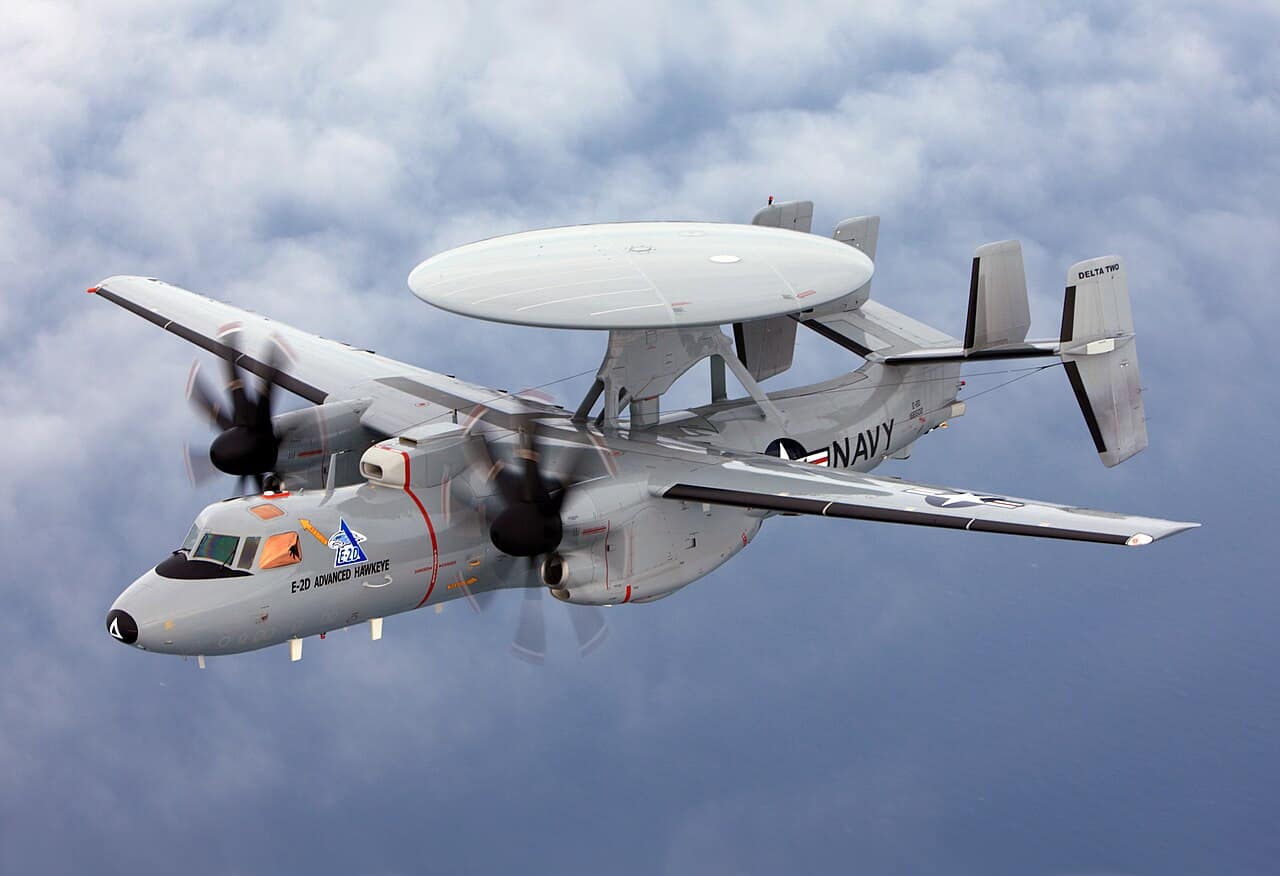
That is why a report on August 13, 2026 caught attention: Japan's E-2D Advanced Hawkeye, one of the most capable flying radars in the region, is being framed as the glue that could bind the air-defence pictures of Japan, Australia and the Philippines into a single shared view.
Informations clés
- Aéronef: E-2D Advanced Hawkeye, airborne early warning and control
- Japan's role: One of few E-2D operators outside the U.S. Navy
- The idea: Networking allied air pictures across the Indo-Pacific
- Partners in frame: Australia and the Philippines
- Signalé : August 13, 2026
- Radar: Northrop Grumman AN/APY-9
An eye in the sky for three flags
The E-2D is not a shooter. It carries no missiles and drops no bombs. What it carries is a rotating radar dome and a battle-management crew, and its entire job is to see farther than anyone below it and hand that picture to everyone who needs it.
Japan has been quietly building one of the strongest Hawkeye fleets outside the United States. The August report ties that capability to a bigger idea: using the aircraft as a node that stitches Japanese, Australian and Philippine sensors into one regional picture, so a threat spotted by one is instantly seen by all.
Why the Hawkeye matters out here
Over open ocean, ground radars run out of horizon and ships can only see so far. An aircraft orbiting at altitude pushes the detection line hundreds of kilometres outward, which is exactly the margin defenders need against fast, low-flying missiles and aircraft.
China's air and missile forces have grown enormously in reach, and the answer for its neighbours is not just more fighters but better early warning shared across borders. A single networked radar picture turns three separate national defences into something closer to one.
The alliance is a network
The hard part is not the hardware, it is the plumbing: secure data links, common standards and the political trust to let allies see through each other's eyes. Japan, Australia and the Philippines have all deepened their defence ties in recent years, and a shared air picture is the natural next step.
None of it replaces fighters or missiles. But in a theatre this size, the first and most valuable weapon is knowledge, and the aircraft that spreads it may matter more than any single jet that carries a gun.
Sources: Army Recognition, Northrop Grumman, U.S. Navy

0 commentaire