
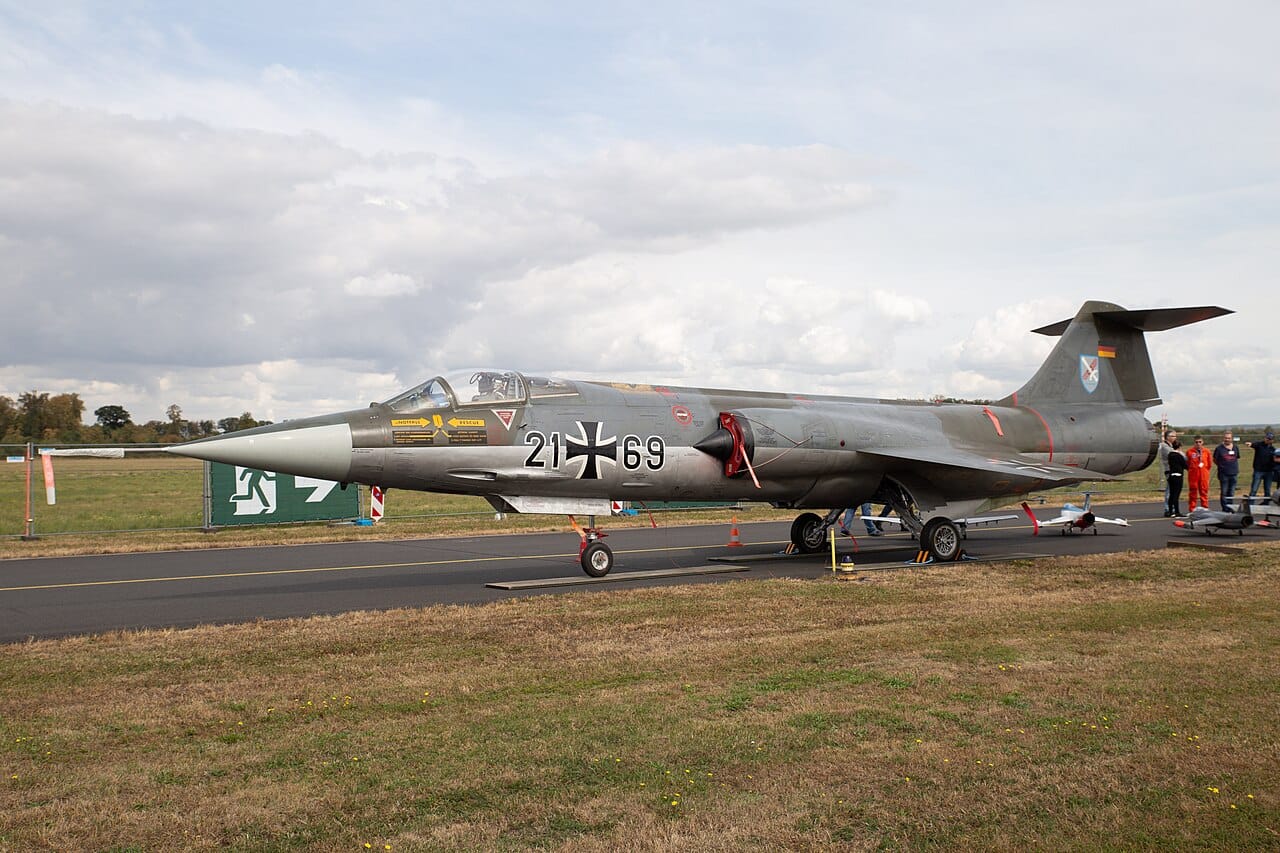
The F-104 Starfighter has one of the worst reputations in military aviation. Germany bought 916 of them, lost 292, and buried 116 pilots. The Luftwaffe called it the Witwenmacher — the Widowmaker.
On one night in January 1982, that aircraft did something no other machine in Europe could have done.
It was the worst possible weather on the worst possible day. Freezing rain had shut down nearly every airport in Germany. Helicopters sat with iced rotor blades. Trains had stopped because the points were frozen solid. And in a hospital in Cagliari, on Sardinia, a three-year-old girl called Jessica had less than 24 hours to live.
Informations clés
| Date | Friday 22 January 1982 |
| Aéronef | Lockheed F-104G Starfighter, Jagdbombergeschwader 34 “Allgäu”, Memmingen |
| Pilote | Oberleutnant Jürgen Gundling, flying as a volunteer |
| Callsign | Rescue One |
| Cargaison | An experimental antiviral drug, available only from its manufacturer in Munich |
| Itinéraire | Memmingen to Decimomannu, Sardinia, overflying neutral Austria |
| Airborne | 01:50; touchdown at Decimomannu around 03:00 |
| Conditions | Runway de-iced only in a central strip; destination had no approach or runway lighting |
| Résultat | Jessica survived |
A Paediatrician Makes a Phone Call
Jessica’s doctor in Cagliari had run out of options. He remembered reading in a medical journal about a new antiviral drug being developed in Germany — something that might save her, if it existed in a bottle somewhere and if it could reach Sardinia in hours rather than days.
So he did something slightly improbable. He rang the German Luftwaffe detachment at Decimomannu, the four-nation air base on the island, and asked for help.
It was Friday evening. Almost every German on the base had gone. The one duty officer who took the call could have logged it and gone home. Instead he phoned his parent command in Germany and made the case.
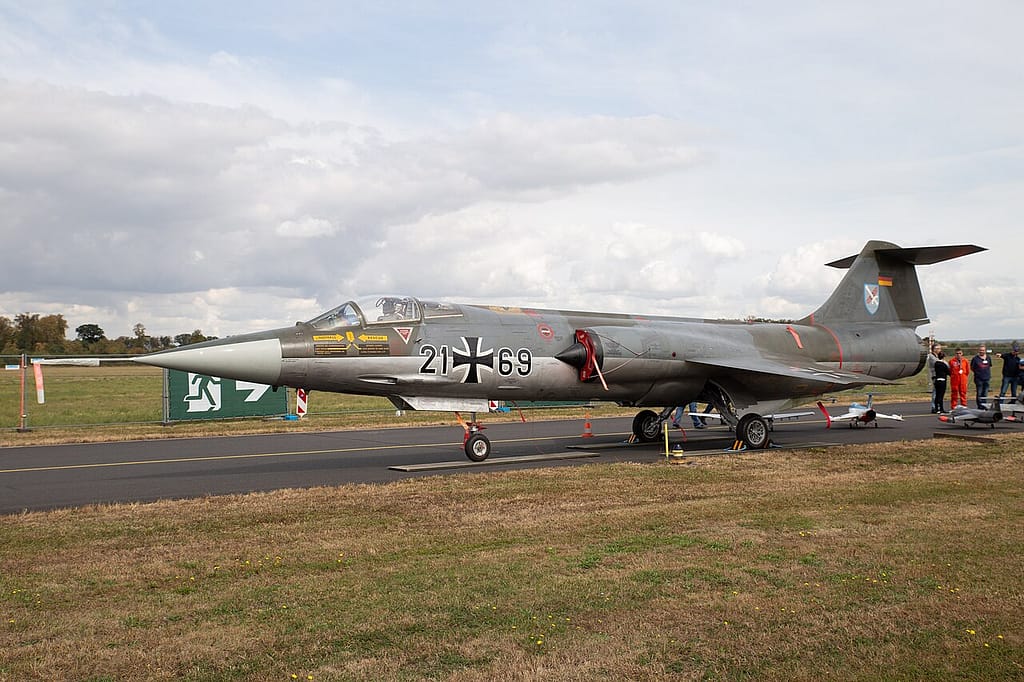
The Machine That Started Moving
What happened over the next few hours involved, by one estimate, around a thousand people.
The Bundeswehr central pharmacy was checked to find where the drug was held. It turned out to exist only at the manufacturer, a pharmaceutical company in Munich. Police went to find the company’s authorised signatory — and pulled him out of an opera performance. They drove him to the premises, collected the medicine, and then ran it 130 kilometres through freezing rain on iced country roads by police relay.
Meanwhile the Luftwaffe had to find somewhere it could actually launch from. The choice fell on Jagdbombergeschwader 34 at Memmingen, on the grounds that they had the best chance of beating the ice. The snow and ice crews were called back in. A volunteer pilot was needed and found immediately: Oberleutnant Jürgen Gundling.
There was not time to clear the airfield. They de-iced a single strip down the middle of the runway and gave up on the taxiways entirely — so the Starfighter and its starter units were towed out onto the runway itself.
The German military attaché in Vienna was woken up and told to obtain diplomatic clearance for a military aircraft to cross neutral Austria in the middle of the night. Austria granted it as an exceptional case. Down the route, the Italian air force kept Trapani, Sigonella, Grosseto, Grazzanise and Gioia del Colle open all night, in case a fault or the weather forced Gundling down somewhere else.
F-104 night operations — the environment Gundling launched into.
Rescue One, Cleared for Takeoff
At 01:35 the police convoy came through the main gate at Memmingen. At 01:50 the medicine was handed up into the cockpit.
The runway was still too slick for a normal engine run-up. At idle power, the aircraft was already trying to slide.
The tower’s clearance has been preserved, and it is worth reading in the original.
The chocks went, the afterburner lit, and Gundling held the Starfighter on the centre of a de-iced strip with his fingertips until it reached rotation speed. Gear up, flaps up, and five seconds later he was in cloud.
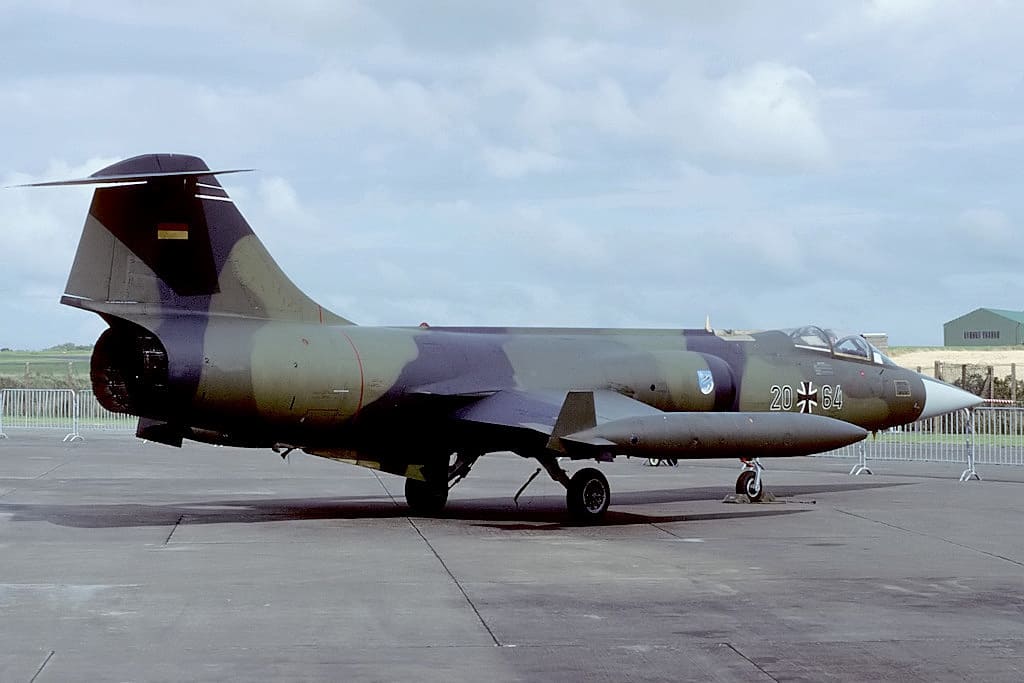
No Lights at the Other End
Decimomannu had its own problem. Days of torrential rain had put the buried cables for the approach and runway lighting under water. There was no power and no light — on a night of low cloud and heavy rain, at a field on an island in the middle of the Mediterranean.
A captain on the base solved it the direct way. He rounded up everybody who could drive anything, and positioned civilian and military vehicles along the runway to light it with their headlamps.
A radar controller had been called in from home. At around three in the morning, in driving rain, he talked an aircraft approaching at 380 km/h down the glidepath onto a runway lit by car headlights — and did it, in the words of the account, as calmly as if it were the most natural thing in the world.
Inside the F-104G cockpit — the instruments Gundling flew that approach on.
A Carabinieri car was waiting. It took the medicine to the paediatric hospital in Cagliari and handed it to the doctor who had made the phone call.
Half a Column in the Local Paper
Jessica lived.
The following week, the Sardinian daily newspaper carried a short piece — half a column — noting that the German air force had been helpful in obtaining a medicine.
That was it. No ceremony, no medals in the reporting, no name. The story survives largely because the aviation journalist and author Andreas Fecker wrote it down and published it, decades later.
Fecker makes a point in his account that is easy to miss. Almost every decision that night was taken by duty officers, deputies and mid-ranking personnel — people who were not senior enough to be authorising international military flights, diplomatic clearances and the emptying of a pharmaceutical company at midnight. They did it anyway, on their own responsibility, knowing they might have to answer for it.
The J79 howl of a surviving Starfighter — the sound Memmingen heard at ten to two in the morning.
The Widowmaker’s Best Night
There is an irony in all of this that is worth sitting with.
Le Chasseur stellaire F-104 is remembered in Germany as a scandal. The variant the Luftwaffe bought was a heavier all-weather strike aircraft built on an airframe designed as a lightweight clear-weather interceptor, flown in European weather by a rebuilt air force with limited experience of it. The accident rate became a political crisis with its own name, the Starfighter-Krise, and the nickname stuck for good reason.
But the qualities that made it dangerous were the same ones that made it useful on 22 January 1982. It was very fast, it climbed like almost nothing else of its generation, and it could be flown alone by one man who volunteered on a few hours’ notice. There was no transport aircraft in Germany that night that could have got airborne off a single de-iced strip and been over Sardinia before dawn.
The aircraft that killed 116 German pilots saved a three-year-old girl in Cagliari, and hardly anybody heard about it.
Sources: Andreas Fecker, originally published on airportzentrale.de and republished by Austrian Wings for the 40th anniversary; L’Unione Sarda; Jagdbombergeschwader 34 unit histories; Bundeswehr archive material.


0 commentaire