
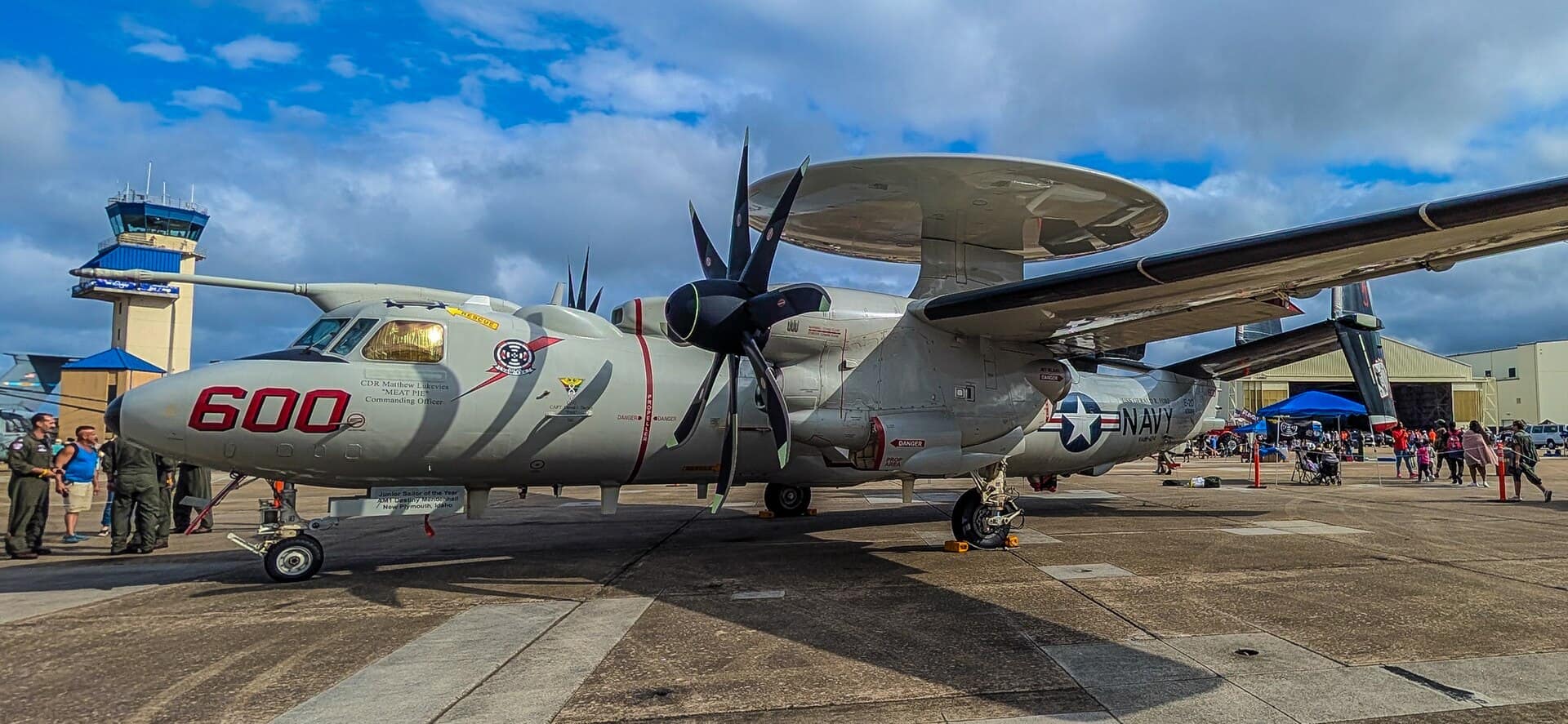
The most consequential upgrade the E-2D Advanced Hawkeye has ever received will not change how the aircraft looks. No new wing, no new rotodome, no obvious external clue. What changes sits behind the fuselage skin: the computers, the software, the cockpit and the architecture that ties them together. On 18 August 2026, Northrop Grumman and the U.S. Navy announced that this package, designated Block II, had cleared its government-led Critical Design Review (CDR). The review itself was completed in May; the milestone was made public only now.
A CDR is not a first flight and not a delivery. It is the point at which a design is judged mature enough to leave the drawing board and enter build, integration and test. For the E-2D, it clears the path toward flight testing in Fiscal Year 2029 and delivery of the first Block II aircraft by the end of the decade. The upgrade will be cut into the active production line for new airframes and retrofitted to aircraft already in the fleet.
Informations clés
- Jalon: E-2D Advanced Hawkeye Block II upgrade passed its government-led Critical Design Review; announced 18 August 2026 (review completed May 2026)
- Flight testing: Scheduled to begin in Fiscal Year 2029; first Block II aircraft due by the end of the decade (~2030)
- What Block II adds: Open Mission Systems architecture, new cockpit architecture, more computing power, robust cybersecurity, modular COTS interfaces (part of DSSC-6)
- Primary sensor (unchanged): AN/APY-9 UHF-band AESA radar in a 7.3 m (24 ft) rotodome, 360-degree coverage over land and sea
- Flotte: Operational in 8 of the Navy’s 9 deployable VAW squadrons; 62 delivered by end-2024 against an 86-aircraft requirement; planned service into the 2040s
- Recent contract: ~US$1.19 billion awarded July 2026 for three Block II E-2Ds, first delivery ~2030; six more requested in the FY2027 budget
- Crew / power: Five (two pilots, three mission-system operators); two Rolls-Royce T56-A-427A turboprops; wingspan 24.56 m (80 ft 7 in); max ~648 km/h (350 kn)
What the E-2D actually does
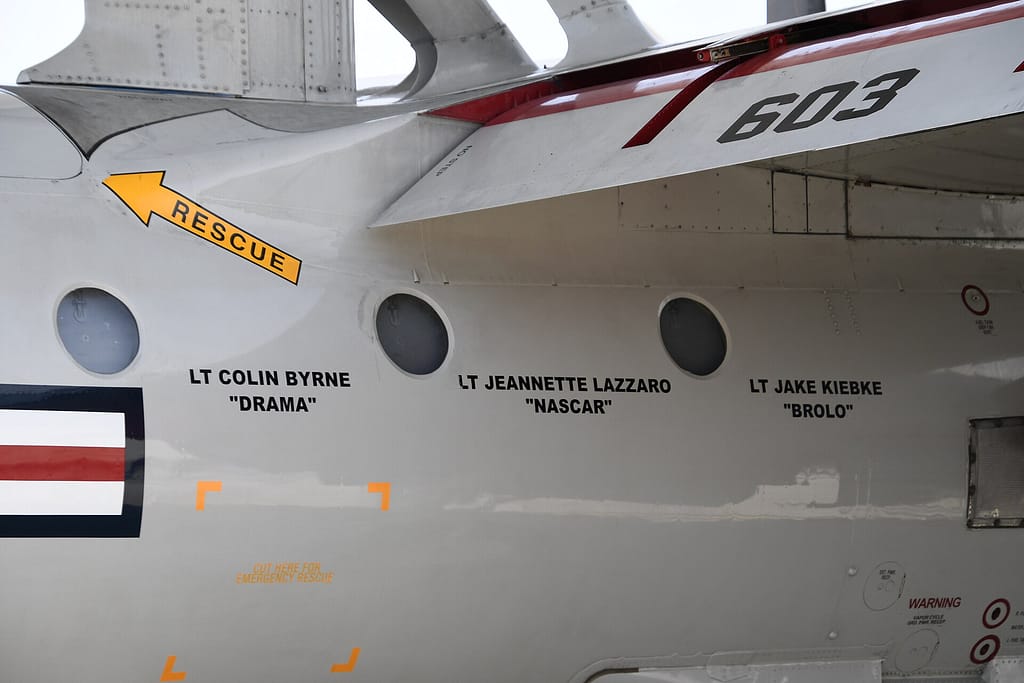
The E-2D Advanced Hawkeye is the U.S. Navy’s carrier-based airborne early warning and control (AEW&C) aircraft. Externally it is a modest twin-turboprop with a five-person crew, two pilots and three mission-system operators, powered by two Rolls-Royce T56-A-427A engines. Its purpose is disproportionate to its size. Flying high above the carrier strike group, it extends the fleet’s radar horizon by hundreds of kilometres and builds a single, shared picture of the airspace and sea surface below.
That picture is what makes the aircraft the quarterback of the carrier air wing. Through Cooperative Engagement Capability and Naval Integrated Fire Control-Counter Air (NIFC-CA), the Hawkeye can detect a target, then hand it off so that a ship or a fighter fires on it without ever seeing it on its own radar. In practice, this extends the reach of the F-35C and the F/A-18E/F Super Hornet: the shooter no longer has to find the target itself.
The radar stays, the architecture changes
The E-2D’s primary sensor is the AN/APY-9, an active electronically scanned array (AESA) radar working in the UHF band and housed in the 7.3 m (24 ft) rotodome above the fuselage. It provides 360-degree surveillance and simultaneous air and surface tracking. Block II does not replace it. Instead, the upgrade rebuilds everything the radar feeds into.
According to the Navy and Northrop Grumman, Block II introduces an Open Mission Systems framework, a new cockpit architecture, increased computing power and cybersecurity improvements. It forms the next step of Delta System Software Configuration 6 (DSSC-6), described by the E-2/C-2 programme office as the software foundation for rapid capability insertion. The Navy states that the open architecture resolves current and future parts obsolescence and enables rapid, non-proprietary technology insertion.
The engineering logic here is sober rather than glamorous. By moving to a modular, open-systems design built partly on commercial off-the-shelf components, the Navy intends to add future capabilities, including artificial-intelligence and machine-learning tools, as containerised software rather than as fresh hardware programmes. The modernised cockpit is expected to reduce pilot workload so crews can concentrate on battlespace management.
Why the timing matters
The CDR lands amid a reversal of fortune for the programme. The Navy had planned to end E-2D procurement after the Fiscal Year 2024 budget, then resumed buying the aircraft in FY2026, with Congress funding three. In July 2026, Northrop Grumman received a contract worth roughly US$1.19 billion for the first three Block II aircraft, with first delivery expected in 2030. The FY2027 request adds six more. As of late 2025 the fleet stood at 62 E-2Ds delivered against a stated requirement of 86, and the type is planned to serve into the 2040s. France is scheduled to transition from the E-2C to the E-2D in 2027.
The renewed commitment is grounded in recent operational experience. U.S. officials have credited the E-2D with a central role in detecting drone and missile threats during operations in the Middle East, precisely the low, slow and small targets that strain conventional air defences.
The takeaway
Block II will not make the E-2D faster or give it a longer radar range on day one. Its value is structural. An open, modular architecture with modern computing and cybersecurity is what keeps a six-decade-old design family relevant against threats that evolve faster than any single hardware programme can. Passing the Critical Design Review is a paperwork milestone, but it is the paperwork that decides whether the carrier’s most important set of eyes can keep up. Flight testing in FY2029 will show whether the design holds.
Sources: Northrop Grumman, The Aviationist, USNI News, Seapower Magazine.

0 commentaire