
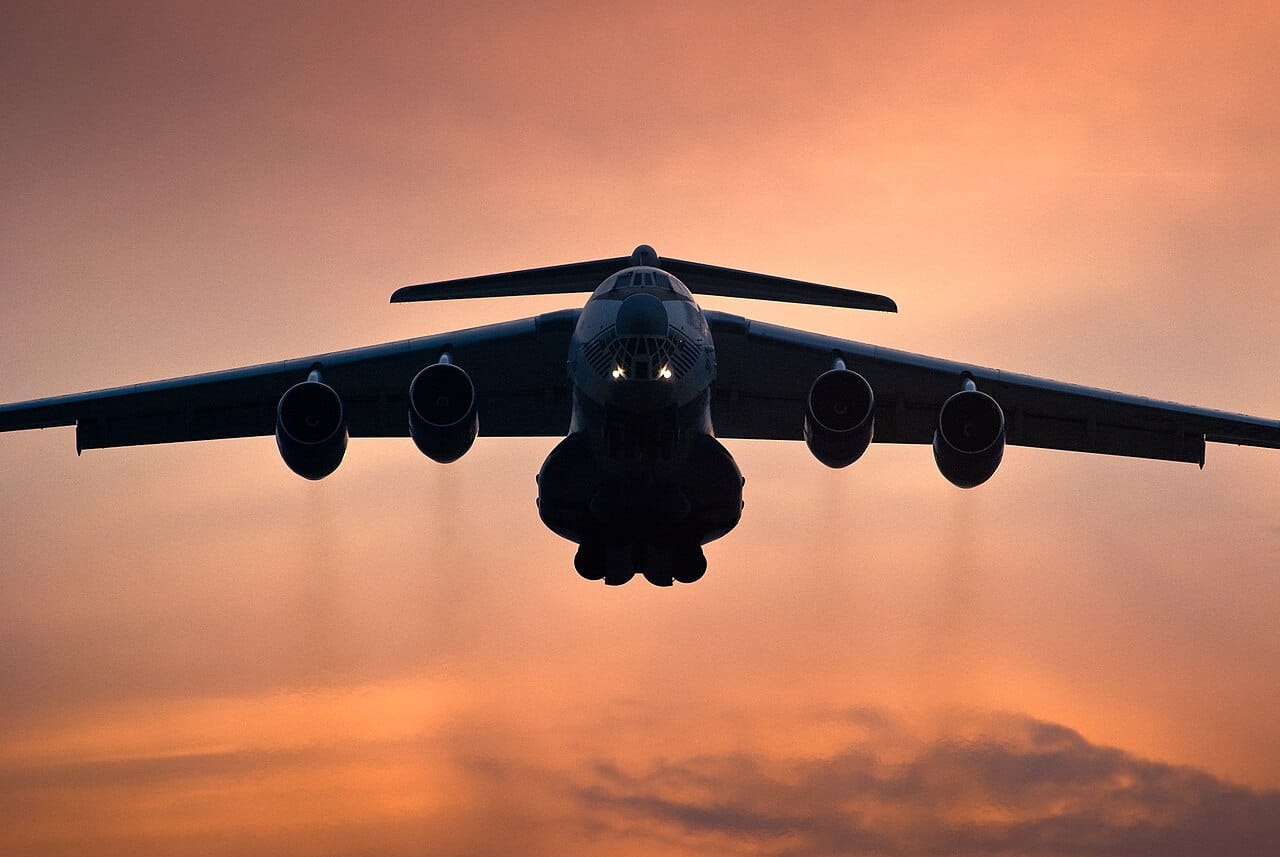
In 1967 the Soviet Union asked for an aeroplane that could carry forty tonnes five thousand kilometres in under six hours, land on an unprepared strip five hundred metres long, and do it in Siberian winter.
Fifty-five years later, that aeroplane is still in production.
The Ilyushin Il-76 has outlived the country that ordered it, the airline that first flew it and most of the people who designed it. It has dropped paratroopers, water-bombed wildfires, carried the Soviet space shuttle’s spare parts, flown UN food into South Sudan and been hijacked by the Taliban. It is not elegant. It is nearly unkillable.
Informations clés
| Taper | Four-engine strategic and tactical airlifter |
| NATO reporting name | Candid |
| Premier vol | 25 March 1971 |
| Entrée de service | June 1974, Soviet Air Force; Aeroflot from 1976 |
| Construit par | Tashkent Aviation Production Association; now Aviastar-SP, Ulyanovsk |
| Nombre construit | ~860 basic transports (higher totals are unsourced) |
| Charge utile | Il-76M 42 t · Il-76MD 48 t · Il-76MD-90A 60 t |
| Max takeoff weight | 210,000 kg |
| Moteurs | 4 × Aviadvigatel PS-90A-76, 156.9 kN each (originally Soloviev D-30) |
| Gamme | 5,000 km with 52 t payload |
| Major derivatives | Il-78 tanker (53 built), Beriev A-50 AEW&C (~42), A-60, A-100, Shaanxi KJ-2000 |
Designed Around Dirt
Most transport aircraft are designed for runways and then adapted, reluctantly, to rough fields. The Il-76 was designed the other way round, because the Soviet Union had a great deal of territory and very little of it was paved.
That produced the tall multi-wheel undercarriage, the high wing keeping the engines out of the debris, the glazed navigator’s nose, and a rear ramp that could take vehicles straight off a frozen strip. The intended replacement for the An-12 turned into something considerably more capable, and a parallel 250-seat double-deck airliner project was quietly cancelled.
The man who flight-tests them for Ilyushin is unsentimental about why it lasted.
The Aircraft Underneath the Other Aircraft
The Il-76’s real significance is as a platform. Strip out the cargo hold and you have a fuselage big enough to carry almost anything.
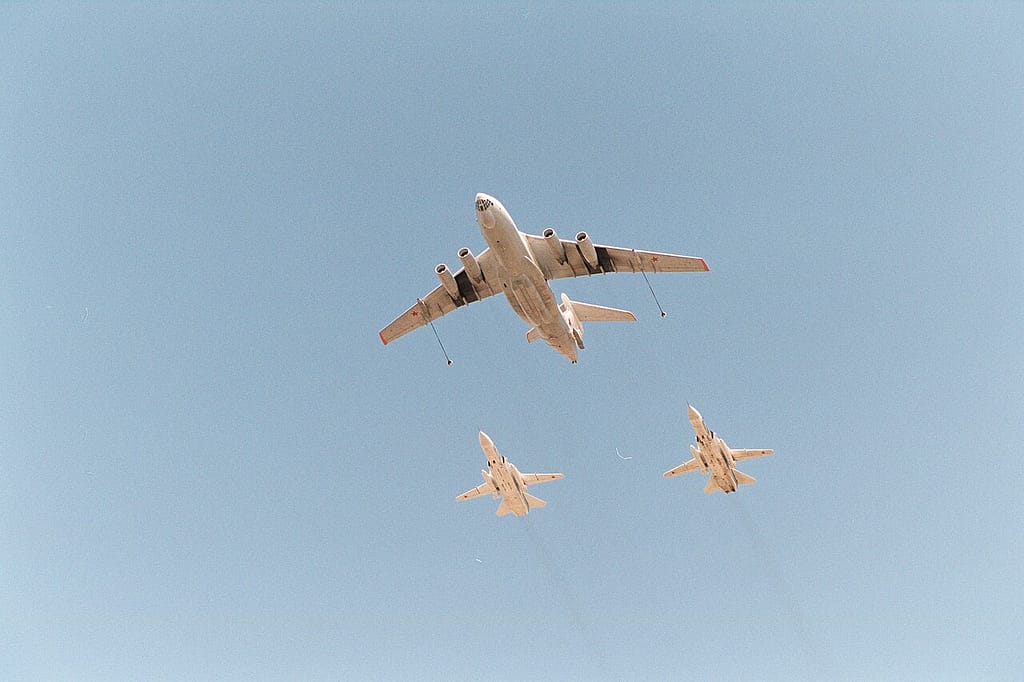
The Il-78 tanker first flew in June 1983. Fifty-three were built, the tail turret replaced by a refuelling operator’s station and three hose-drum pods added. The Il-78M can transfer over a hundred tonnes of fuel. India flies six with British pods so they can also refuel Western aircraft.
Then the Beriev A-50 Mainstay, which first flew in December 1978 with a nine-metre rotodome housing the Liana radar. About forty-two were built before the Soviet collapse ended production. Detection range is quoted at 650 km against air targets, and it can control ten fighters at once.
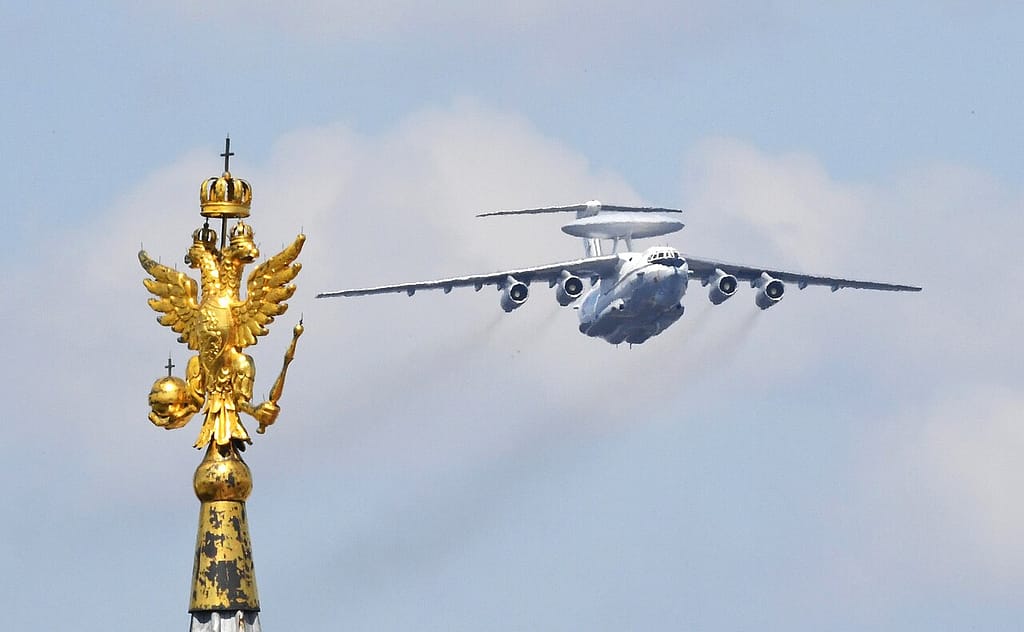
The West knew about the A-50 before it appeared. In 1978 the Soviet engineer Adolf Tolkachev, spying for the CIA, identified a twenty-tonne radar called Shmel destined for a modified Il-76. Satellites did the rest.
There is also the firefighting fit, which is the cleverest of them. The VAP-2 is a roll-on, roll-off tank system installable in about ninety minutes, meaning any Il-76 can become a water bomber and then stop being one. It carries roughly 49,000 litres, about three and a half times a C-130’s load. Russian aircraft have fought fires as far away as Chile.
Kandahar, 1995
On 3 August 1995 Taliban fighters forced down an Airstan Il-76TD carrying ammunition and held its seven-man Russian crew at Kandahar.
They were captive for 378 days. On 16 August 1996, allowed to run maintenance on their own aircraft during a lapse in guard rotation, they started the engines and flew it out under fire to the United Arab Emirates. The commander, Vladimir Sharpatov, was made a Hero of the Russian Federation.
That episode captures the aircraft’s second life. When the Soviet Union dissolved, hundreds of Il-76s went onto the open market cheap. Their combination of rough-field capability, ramp loading and thin registry oversight made them the workhorse of opaque cargo operations across Africa and Central Asia — and, equally, of United Nations and World Food Programme airdrops into places nothing else could reach.
Production continues at Ulyanovsk as the Il-76MD-90A, with PS-90A engines fitted partly because European noise rules were shutting the older aircraft out of Western airports. Deliveries run at six or seven a year — modest, but more than half a century after the first flight, they are still coming off the line.
Both Sukhar quotations here are English renderings of a Russian-language interview, and are presented as translations rather than his own English words.
Sources: TASS interview with Sergey Sukhar, 9 February 2026; Butowski, Russian production figures; Hoffman, The Billion Dollar Spy (2016); Ilyushin/PJSC Il; United Nations World Food Programme.
0 commentaire