
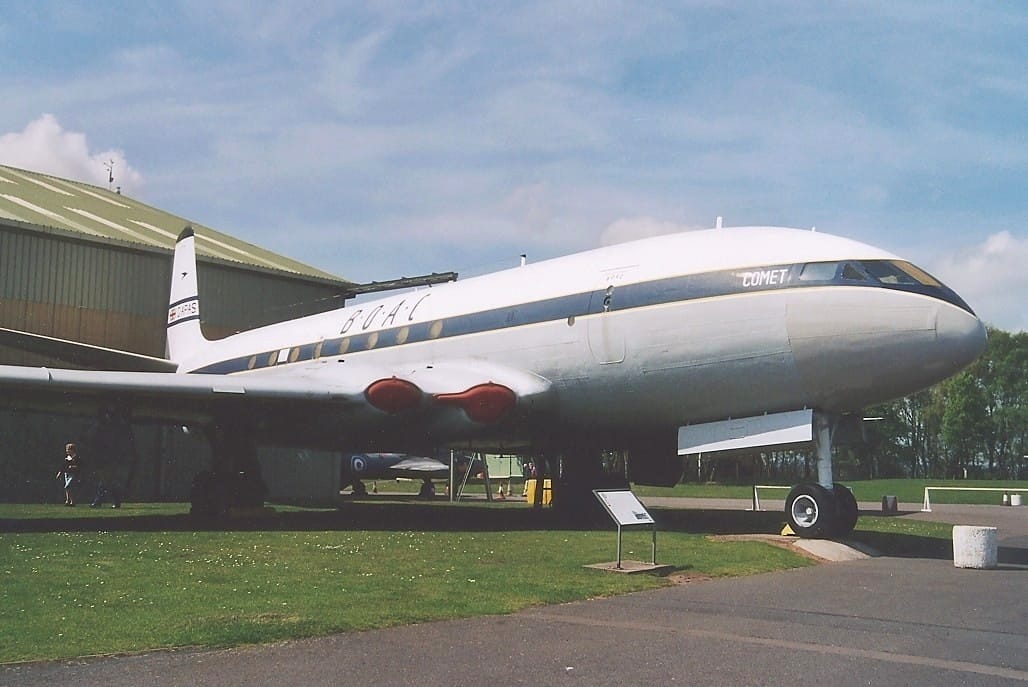
Trois comètes perdues
Le 10 janvier 1954, le vol 781 de la BOAC se désintégra en altitude, à 8 230 mètres (27 000 pieds), peu après son décollage de Rome. Les 35 personnes à bord périrent. L’épave s’abîma en Méditerranée, près de l’île d’Elbe. La flotte de Comet fut immobilisée. Les ingénieurs inspectèrent chaque appareil, ne trouvèrent aucune cause concluante et remirent le type d’avion en service. Moins de trois semaines après cette remise en service, le 8 avril 1954, le vol 201 de South African Airways – un Comet affrété auprès de la BOAC – se désintégra en altitude près de Naples. On dénombra 21 morts. Le Comet fut définitivement immobilisé. Un troisième Comet avait déjà été perdu : le vol 783 de la BOAC s’était écrasé au décollage de Calcutta en mai 1953, lors d’une violente tempête. Cet accident fut attribué à une surcharge structurelle due aux turbulences – un problème de conception, certes, mais différent.La comète s'écrase
- Vol 783 de la BOAC : 2 mai 1953, Calcutta — 43 morts (effondrement de structure lors d'une tempête)
- Vol 781 de la BOAC : 10 janvier 1954, Méditerranée près de l'île d'Elbe — 35 morts (fatigue des métaux)
- Vol SAA 201 : 8 avril 1954, Méditerranée près de Naples — 21 morts (fatigue du métal)
Les catastrophes du Comet ont donné lieu à l'une des enquêtes les plus importantes et les plus vastes de l'histoire de l'aviation. Tous les avions de ligne modernes volent plus sûrement grâce à l'accident du Comet.
L'enquête qui a tout changé
Le Royal Aircraft Establishment de Farnborough a lancé l'enquête la plus approfondie jamais réalisée sur un accident d'avion. Des ingénieurs ont récupéré des débris au fond de la Méditerranée – une opération de sauvetage sous-marine pionnière – et ont minutieusement reconstruit le fuselage du vol 781. Ils ont ensuite entrepris une expérience inédite : ils ont placé un fuselage complet de Comet dans un bassin d'immersion et l'ont soumis à des cycles de pressurisation répétés, gonflant et dégonflant la cabine des milliers de fois pour simuler des années de service. Après l'équivalent de 3 057 vols, le fuselage d'essai a éclaté, la rupture se produisant près de l'ouverture de la trappe d'évacuation avant. Dans l'épave récupérée du G-ALYP, les enquêteurs ont localisé la fissure fatale au niveau d'un trou de rivet dans l'ouverture du hublot du radiogoniomètre automatique (ADF) arrière, sur le toit. Sous l'effet des charges de pressurisation répétées, des fissures microscopiques se sont formées aux points de concentration de contraintes autour des ouvertures à angles droits. Après environ 1 000 cycles de vol, ces fissures se sont propagées à travers le revêtement jusqu'à ce que le fuselage cède de manière catastrophique.J'ai appris aujourd'hui que le premier avion de ligne à réaction commercial au monde, le De Havilland Comet, a connu de nombreux accidents mortels dans les années 50 à cause de la forme carrée de ses fenêtres.
Square Windows tue
La découverte fut dévastatrice par sa simplicité. Les angles droits concentrent les contraintes, tandis que les angles arrondis les répartissent. Depuis, tous les avions de ligne, sans exception, ont adopté des hublots ovales ou ronds. Les hublots carrés du Comet n'étaient pas le seul facteur (le revêtement du fuselage était également plus fin que nécessaire et les trous de rivets créaient des concentrations de contraintes supplémentaires), mais ils sont devenus un symbole fort. Plus largement, l'enquête sur le Comet a instauré la discipline de l'analyse de la fatigue des métaux dans l'aéronautique. Avant les crashs du Comet, la fatigue était mal comprise et rarement testée. Après ces accidents, chaque constructeur aéronautique a été tenu de démontrer que ses conceptions pouvaient résister à des dizaines de milliers de cycles de pressurisation sans défaillance. La philosophie de conception « à sécurité intégrée » – concevoir des structures de sorte qu'une fissure dans un élément ne provoque pas de défaillance catastrophique – est devenue la norme.L'ironie amère
De Havilland a repensé le Comet en lui attribuant des hublots ovales, un revêtement plus épais et des améliorations structurelles. Le Comet 4, entré en service en 1958, était parfaitement sûr. Mais il était trop tard. Boeing avait profité des années d'immobilisation du Comet pour développer le 707, plus grand, plus rapide et plus économique. Le 707 a marqué l'avènement de l'ère du jet. Le Comet, qui aurait dû le dominer, est tombé dans l'oubli. Ses trois accidents mortels ont coûté la vie à 99 personnes. L'enquête qu'ils ont déclenchée a permis d'en sauver des centaines de milliers. Depuis, aucun avion de ligne n'a subi de défaillance par fatigue de la pressurisation comme celle qui a détruit les vols 781 et 201. C'est là le véritable héritage du Comet : ce magnifique jet qui a révélé au monde entier les mécanismes de la défaillance des avions.“ Le Comet a repoussé les limites de la technologie de pointe. ”Sources : Leçons apprises de la FAA, Musée de la RAF, Amiral Cloudberg, Plane and Pilot, New Atlas
— Bill Withuhn, historien de l'aviation
Questions connexes
Qu'était-ce que la comète de Havilland ?
Le de Havilland Comet fut le premier avion de ligne à réaction au monde, entrant en service chez BOAC le 2 mai 1952. Il volait environ deux fois plus vite et deux fois plus haut que les avions de ligne à hélices, dans une cabine lisse et quasiment sans vibrations – une révolution dans le transport aérien qui fit brièvement de la Grande-Bretagne le leader du transport à réaction.
Pourquoi le de Havilland Comet s'est-il écrasé ?
Entre 1953 et 1954, plusieurs avions Comet se sont désintégrés en vol en raison de la fatigue du métal. Les cycles répétés de pressurisation de la cabine ont fissuré la structure de l'appareil aux points de tension — notamment aux angles des ouvertures des hublots — provoquant une désintégration catastrophique en plein vol.
Qu’a appris la comète aux ingénieurs sur la fatigue des métaux ?
Les catastrophes du Comet ont révélé au monde de l'aviation comment les cycles de pressurisation répétés fragilisent la structure d'un avion. Les enquêteurs ont établi un lien entre les défaillances et la propagation des fissures à partir des angles vifs des hublots, ce qui a conduit à l'utilisation de hublots arrondis, à l'amélioration des tests de fatigue et à l'élaboration de normes de conception qui rendent chaque avion de ligne moderne plus sûr.
Quand le de Havilland Comet est-il entré en service ?
Le Comet 1 entra en service chez BOAC le 2 mai 1952 ; il s’agissait du premier avion de ligne à réaction commercial. Il fut immobilisé au sol après les accidents de 1954, puis remis en service sous une forme repensée et considérablement renforcée, sous le nom de Comet 4.
Pourquoi les hublots des avions ont-ils des coins arrondis ?
À cause du Comet. Ses premiers hublots presque carrés concentraient les contraintes aux angles, où des fissures de fatigue apparaissaient et entraînaient des ruptures fatales. Arrondir les angles répartit les contraintes, et tous les avions pressurisés depuis lors utilisent des hublots arrondis.


Good morning, cargo doors nowadays are still squared: not oval, not rounded.
It was a matter of metal fatigue stressed over its limits due to multiple pressurisation cycles.
Not due to the shape of windows itself.
After Comet’s incidents, aviation industry as a whole discovered how to make safer hulls: ticker metal and reinforced airframes.
Without the Comet’s tragedy the next company to suffer the same fate would have been Boeing or McDonnell-Douglas, or whoever was the next one to produce a commercial jet.
De Havilland pioneered before everybody else this concept, but payed the toll given that back then metal fatigue was almost unknown and just esteemed based on calculations on paper.
For every air company unfortunately.
The real pity is that we still have bad cases like Boeing 737 Max (and not only) that are consequencies of bad commercial-finance choices, design and production despite all the know-how we have today.
A know-how started exactly with Comet’s experiences more than 70 years ago.