
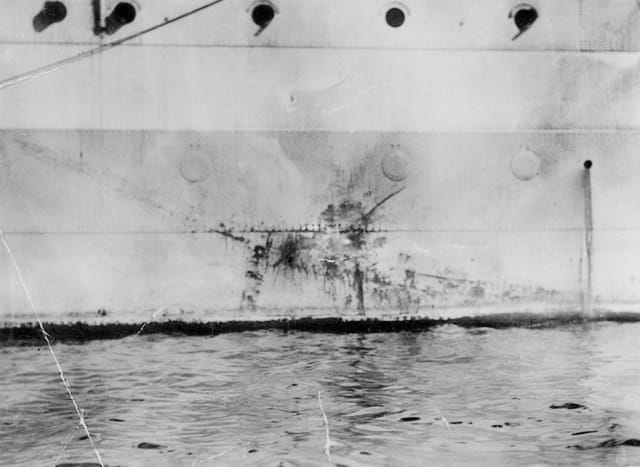
Look at the side of the ship and you can see it: the ghost of an aeroplane. Two wings, a fuselage, even the struts of a fixed undercarriage — a full-size silhouette of an aircraft, printed onto grey naval steel. It is one of the strangest and most haunting photographs of the Second World War, and it is entirely real.
26 July 1945
By the summer of 1945 the war in Europe was over, but in the Pacific it was reaching its most desperate phase. Japan had turned to the kamikaze — pilots deliberately crashing their aircraft into Allied ships. On 26 July, the task force of the Royal Navy heavy cruiser HMS Sussex, then covering operations off the Netherlands East Indies, was attacked by two aircraft flying as suicide weapons.
One of them, a Mitsubishi Ki-51 — an obsolescent army light bomber the Allies code-named “Sonia” — dived on the cruiser. Instead of striking the deck, it hit the ship's side just above the waterline. At that angle, and against the armoured hull of a County-class cruiser, the aircraft simply disintegrated. It failed to penetrate and caused little significant damage.
The imprint
What it left behind was extraordinary. Smeared across the paintwork in oil, fuel and scorch marks was a near-perfect outline of the aircraft itself — the wings, the fuselage, and, below them, the imprint of the Sonia's distinctive fixed landing gear. The silhouette was so clean that naval observers could identify the exact type of aircraft from the mark alone. Someone photographed it, and that photograph has travelled the world ever since.
A ship with a long war
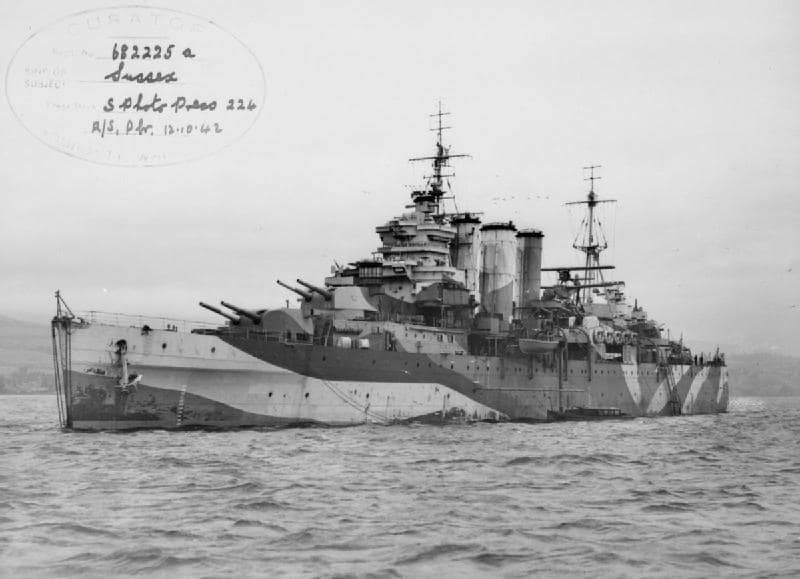
HMS Sussex was no stranger to danger by then. Commissioned in 1929, she had hunted the German raider Admiral Graf Spee, dodged a spread of four torpedoes from a U-boat in 1943, and sunk a German tanker off Cape Finisterre. The kamikaze that stamped its shape into her hull barely slowed her down.
Just weeks later came the bookend to the story. On 5 September 1945, HMS Sussex steamed into Singapore Harbour, and it was aboard her that the Japanese commander of the Singapore garrison came to sign the surrender. The cruiser that a suicide pilot had failed to sink in July was, by September, hosting the enemy's capitulation.
Why the picture endures
Most records of the kamikaze campaign are statistics and wreckage. This one is different. It is the outline of a machine — and of the man flying it — caught in the last fraction of a second of its existence and printed, like a shadow, onto the thing it was trying to destroy. Eighty years on, it remains one of the most quietly chilling images the Pacific war produced.
Related Questions
What happened to HMS Sussex in July 1945?
On 26 July 1945, the Royal Navy heavy cruiser HMS Sussex was attacked by two kamikaze aircraft off the Netherlands East Indies. One, a Mitsubishi Ki-51 "Sonia," dived on the ship but struck its armoured side just above the waterline instead of the deck. The aircraft disintegrated, causing little damage but leaving a haunting imprint on the hull.
What is the kamikaze shadow on HMS Sussex?
The kamikaze shadow is a near-perfect silhouette of an aircraft left on HMS Sussex's hull after a suicide attack on 26 July 1945. When a Mitsubishi Ki-51 disintegrated against the cruiser's armoured side, it smeared oil, fuel and scorch marks in the exact outline of its wings, fuselage and fixed landing gear, clean enough for observers to identify the aircraft type.
What was a kamikaze?
A kamikaze was a Japanese pilot who deliberately crashed an explosive-laden aircraft into Allied ships during the Second World War, a tactic born of desperation late in the Pacific war. Not every Japanese airman flew such missions; aces like Saburo Sakai fought conventional dogfights, and the Pacific air war also saw precision Allied strikes like Operation Vengeance.
What was the Mitsubishi Ki-51 Sonia?
The Mitsubishi Ki-51 was a Japanese army light bomber and ground-attack aircraft, given the Allied code name "Sonia." By 1945 it was obsolescent and, like many Japanese aircraft late in the war, was pressed into kamikaze service. One struck HMS Sussex on 26 July 1945, leaving its distinctive fixed landing gear imprinted on the hull.
Why didn't the kamikaze sink HMS Sussex?
The kamikaze failed to sink HMS Sussex because it hit the ship's armoured side just above the waterline rather than the deck. Against the thick hull of a County-class heavy cruiser, and at that shallow angle, the lightweight Mitsubishi Ki-51 simply disintegrated without penetrating, causing little significant damage.
What was HMS Sussex?
HMS Sussex was a County-class heavy cruiser of the Royal Navy, commissioned in 1929. Before 1945 she had hunted the German raider Admiral Graf Spee, survived a spread of four U-boat torpedoes in 1943, and sunk a German tanker off Cape Finisterre. In September 1945 she hosted the Japanese surrender of the Singapore garrison.
Where did the Japanese surrender aboard HMS Sussex?
On 5 September 1945, HMS Sussex steamed into Singapore Harbour, where the Japanese commander of the Singapore garrison came aboard to sign the surrender. The cruiser that a kamikaze had failed to sink just weeks earlier instead hosted the enemy's capitulation.
Are kamikaze tactics still used today?
Not by crewed aircraft, but the kamikaze concept echoes in modern one-way attack drones. Navies now test expendable drones, including drones launched from Royal Navy warships. The original kamikaze campaign of the Second World War, however, relied on human pilots deliberately crashing aircraft into ships.
0 Comments