
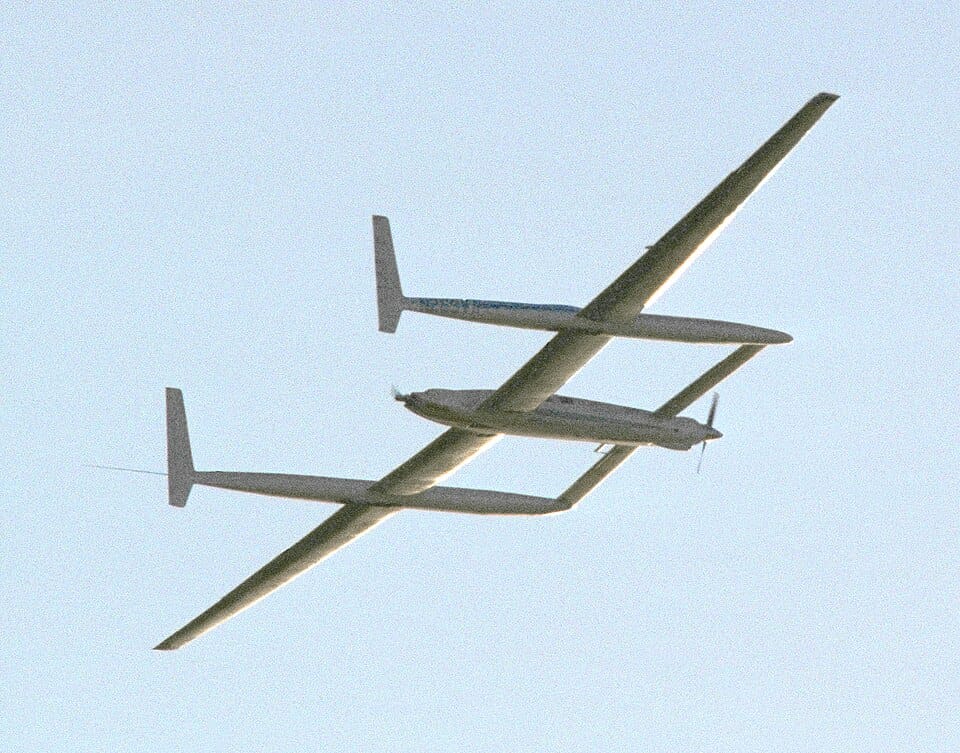
On December 14, 1986, a strange-looking aircraft — long, thin, with two fuselages, a pusher engine, a puller engine, and wings so flexible they bent visibly under their own weight — rolled down a runway at Edwards Air Force Base in California and lifted off. It was carrying so much fuel that the wingtips scraped the runway on takeoff, snapping off the winglets. Nobody turned back. Nine days, three minutes, and forty-four seconds later, it landed back at Edwards. It had circumnavigated the globe without stopping and without refuelling — the last major aviation "first" remaining to be achieved.
The aircraft was the Rutan Voyager. The pilots were Dick Rutan, a former Vietnam combat pilot with 325 combat missions, and Jeana Yeager, a pilot, record-setter, and co-designer of the project. Dick's brother Burt Rutan had designed the aircraft. Together, over five years, they had built the machine, raised the money, trained for the flight, and argued constantly about everything — the cockpit was 7.5 feet long and 3.5 feet wide, barely big enough to change position, and one of them was flying while the other tried to sleep in it for nine straight days.

The Last Great Aviation First
By 1986, aviation records were becoming increasingly specialised. The major firsts — first flight, first transatlantic, first round-the-world, first supersonic — had all been claimed. One remained: a non-stop, non-refuelled circumnavigation. No aircraft had ever been able to carry enough fuel to go around the world without stopping or being topped up in flight.
Burt Rutan's design solution was radical. The Voyager was built almost entirely from graphite-epoxy composite — a material that was still exotic in the mid-1980s. It was extraordinarily light: the empty aircraft weighed just 2,250 pounds. Its two engines — a Teledyne Continental IOL-200 pusher in the rear and an IOPC-200 puller in the front — were small, fuel-efficient, and derated to extend their lifespan for a nine-day flight. The aircraft carried 1,489 gallons of fuel — enough to fill the wings, the twin booms, and the centrebody to the point where fuel comprised 72% of the maximum takeoff weight. The wings, deliberately flexible to reduce stress, bent nearly five feet at the tips during the heavily loaded takeoff run.
“This flight was not just about going around the world. It was about proving what composite aircraft could do — and what people could endure.”
— Burt Rutan, designer of the VoyagerNine Days in a Coffin-Sized Cockpit
The Voyager's cockpit was, by any normal standard, uninhabitable for nine days. One pilot flew while the other lay in a 5.5-foot bunk and tried to sleep through vibration, noise, turbulence, and the constant anxiety of flying a fragile aircraft over oceans at 11,000 feet. The bunk was lined with foam and a sleeping bag. There was no toilet — waste was managed with plastic bags. The food was freeze-dried. The temperature swung between cold nights over the Pacific and tropical heat over the equator.
They encountered a tropical storm over the Pacific that forced them to descend to 500 feet above the ocean at night, unable to climb high enough to fly over it and unable to go around it without running out of fuel. They flew through it. At one point, a propeller control malfunctioned and the front engine had to be restarted in flight — a procedure that had never been tested. Dick Rutan nursed the engine back to life. They continued.
The Record That Still Stands
The Voyager landed at Edwards on December 23, 1986, after covering 24,987 miles — essentially the circumference of the Earth at the equator — in 9 days, 3 minutes, and 44 seconds. They had 106 pounds of fuel remaining. The margin was tiny: had the Pacific storm been any worse, or the route any longer, they wouldn't have made it.
The Voyager now hangs in the Smithsonian National Air and Space Museum in Washington, next to the Wright Flyer and the Spirit of St. Louis — the three aircraft that most clearly mark the boundaries of what human aviation has achieved. First flight. First Atlantic. First non-stop circumnavigation. Burt Rutan would go on to design SpaceShipOne, the first private spacecraft to reach space. But the Voyager remains his defining achievement: a machine built to do one specific thing, which did it, which will never be forgotten.
Sources: Jeana Yeager and Dick Rutan, Voyager (1987); Wikipedia, "Rutan Voyager"; Smithsonian National Air and Space Museum
Questions connexes
What was the Rutan Voyager?
The Rutan Voyager was an experimental aircraft that in December 1986 became the first to fly around the world non-stop without refuelling. Designed by Burt Rutan and flown by his brother Dick Rutan and Jeana Yeager, it completed the 24,987-mile journey in 9 days, 3 minutes and 44 seconds — the last great 'first' in aviation. It now hangs in the Smithsonian.
How did the Voyager fly around the world without refuelling?
The Voyager flew non-stop on a single fuel load by being extraordinarily light and efficient. Built almost entirely of graphite-epoxy composite, the empty aircraft weighed just 2,250 pounds, yet it carried 1,489 gallons of fuel — about 72% of its takeoff weight. Two small, fuel-sipping engines and long, flexible wings let it cover nearly 25,000 miles on that single load.
Who flew the Rutan Voyager?
The Voyager was flown by Dick Rutan, a former Vietnam combat pilot, and Jeana Yeager, a pilot and co-designer of the project. They spent more than nine days in a cabin smaller than a bathtub, with no toilet, freeze-dried food, and 20-minute naps. The aircraft was designed by Dick's brother Burt Rutan, who later created SpaceShipOne.
How long did the Voyager flight take?
The Voyager flight lasted 9 days, 3 minutes and 44 seconds, from 14 to 23 December 1986, taking off and landing at Edwards Air Force Base in California. The crew flew through a Pacific tropical storm at 500 feet and restarted a failed engine in flight. They landed with just 106 pounds of fuel remaining — a razor-thin margin.
Why were the Voyager's wings so flexible?
The Voyager's wings were deliberately built to flex — bending nearly five feet at the tips when fully loaded — to reduce structural stress during the long, heavy flight. On takeoff the fuel-laden wingtips actually scraped the runway, snapping off the winglets, but the crew pressed on. This radical lightweight composite design was key to carrying enough fuel for the whole circumnavigation.
What other record flights pushed aviation's boundaries?
The Voyager completed one of aviation's last great firsts, but the pursuit continued. In 2004 SpaceShipOne, by the same designer Burt Rutan, became the first private craft in space, and in 2016 Impulsion solaire 2 circled the globe powered only by the sun. Each aircraft was purpose-built to achieve a single milestone.
0 commentaire