
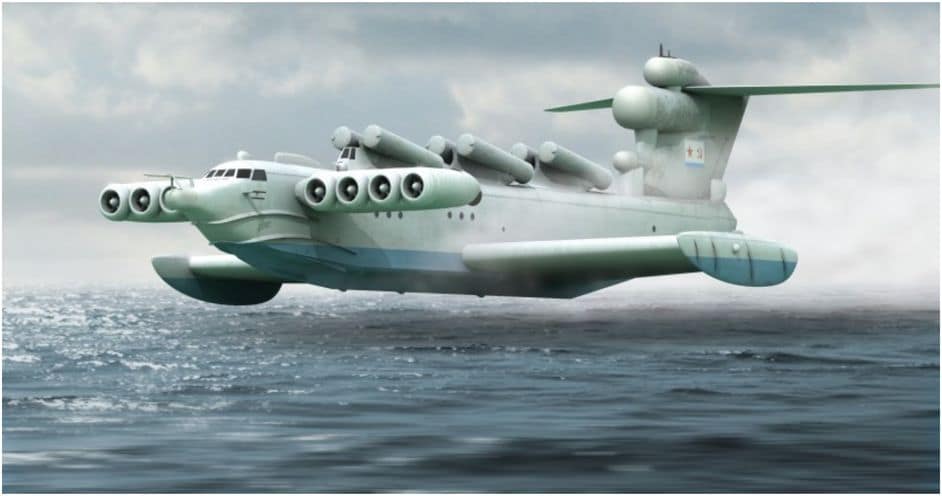
1. KM Ekranoplan - The Caspian Sea Monster
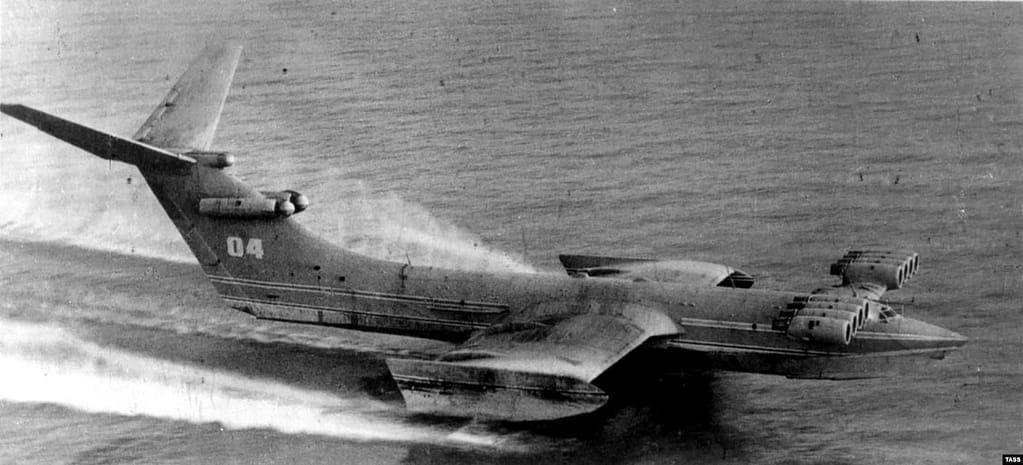
KM Ekranoplan, nicknamed "Caspian Sea Monster" by the CIA
When Boats Learned to Fly (Sort Of)
Imagine a vehicle so bizarre, so utterly out there, that it makes a submarine riding a unicycle look normal. That's the KM Ekranoplan, or as the CIA dramatically dubbed it, "The Caspian Sea Monster." This wasn't your run-of-the-mill plane or boat; it was a glorious, gravity-defying hybrid, a "boat that flies," and it debuted in the Soviet Union in 1966 with a ceremonial champagne smash. So, how did this beast of a machine pull off its aerial acrobatics? It harnessed the "ground effect," a nifty little trick where air gets squished under low-flying wings, creating a high-pressure cushion. Think of it like a hovercraft, but way, way cooler. Seabirds use it, airplanes use it (just before landing), and the Soviets decided to weaponize it. When the CIA's satellites spotted this monstrosity skimming across the Caspian Sea, they freaked out. Seriously. They were so spooked, they cooked up a plan to strap a camera to a robotic bird to get a closer look. (Spoiler: the robotic bird kept face-planting, proving that even spies have bad days.)
Speed, Stealth, and a Potential San Francisco Surprise
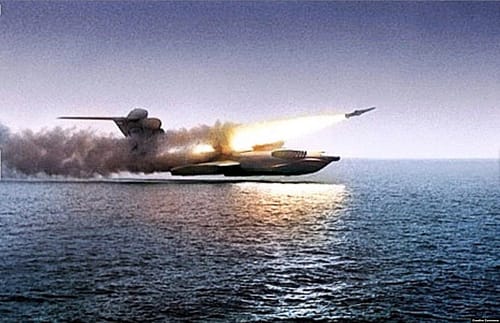
The Lun - able to fire six nuclear-capable Moskit missiles
Why the panic? Well, the Caspian Sea Monster could hit a blistering 650 kilometers per hour (that's 400mph), skim over minefields like they were daisies, and fly so low that most radar systems couldn't even see it coming. One analyst even suggested that the Soviets could invade San Francisco in three hours, and nobody would know until they were sipping vodka on the Golden Gate Bridge.
From Monster to Missile Platform to Demise (Sort Of)
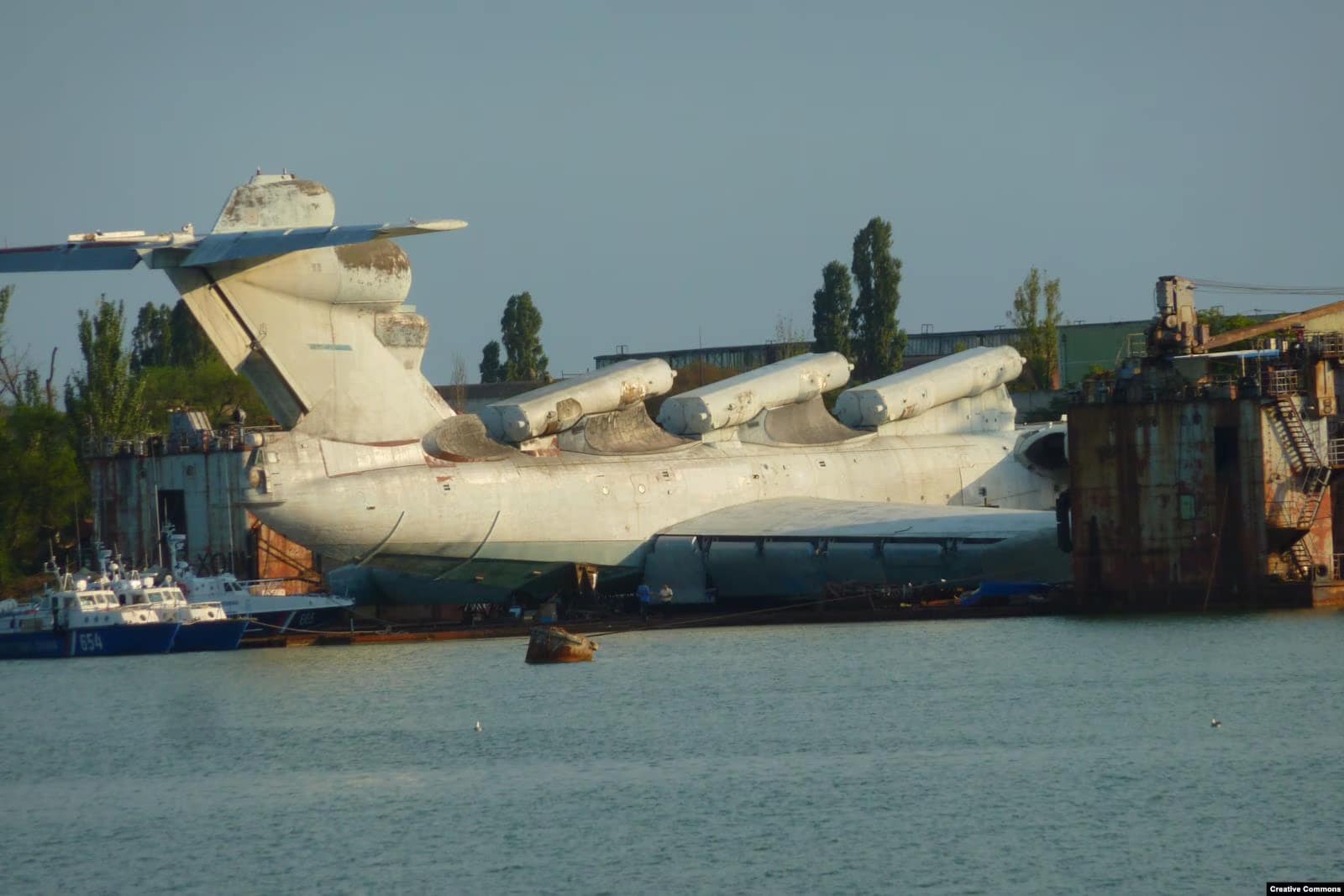
The Lun in 2010
And if that wasn't terrifying enough, the Soviets decided to upgrade their monster. After the original Ekranoplan crashed in 1980 due to pilot error (oops!), they unveiled the Lun in 1987. This bad boy wasn't just fast; it was armed to the teeth with six nuclear-capable Moskit missiles, turning it into a flying battleship straight out of a Cold War fever dream. Sadly, the Ekranoplan project was shelved as the Soviet Union crumbled and the money dried up. But here's the kicker: one of these beasts, the Lun, is still out there, rusting away on a barge along Russia's southern coastline. It's a relic of a bygone era, a reminder of a time when the Soviets were pushing the boundaries of technology to truly wild extremes. In July 2020, the massive Lun-class ekranoplan, destined for a Russian military theme park in Derbent, was towed from its naval base. However, its journey hit a snag when it got stuck on a sandy beach, just short of its destination. Despite attempts to free it, the "monster" remained beached, attracting curious onlookers and media attention. Concerns arose about hull damage from waves. Finally, in December 2020, it was successfully pulled further ashore, and by December 2021, fully onto dry land.
So if you're ever near the Caspian Sea, keep an eye out. You might just spot a monster lurking.
2. Mil V-12: The Unreal Giant

A Giant Takes Flight
Picture this: a helicopter so colossal it resembles a praying mantis showing off its might. This isn't a scene from a sci-fi film, but the real deal—the Mil V-12 helicopter. Unveiled by the Mil Moscow Helicopter Plant in 1968, this behemoth of the skies was poised to make history.Stats and Stature
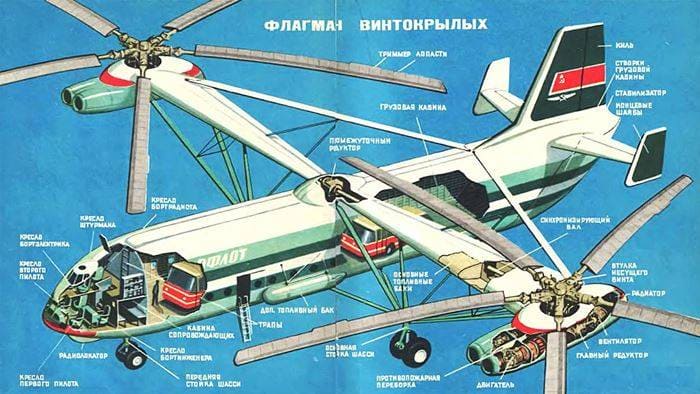
Aeroflot Mil V-12 - Western observers could only guess the purpose of this giant helicopter. By the 1970s the Soviets did not have a purpose for that monster (other than impressing crowds).
Breaking Records
The Mil V-12 wasn't just about looks. In 1969, a courageous test crew flew this giant carrying a jaw-dropping 40,000-kilogram load to an altitude of 2.25 kilometers. This feat set a helicopter-weightlifting record that remains unbeaten even today.The Shift in Strategy
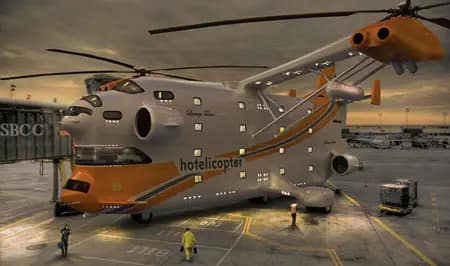
In 2009, the Mil V-12 made a comeback as "World’s first Hotelicopter", an April Fool's joke with photoshopped images.

The Mil V-12 in the Central Airforce Museum in Monino, near Moscow. Having been there several times in the early days of MiGFlug, let us assure you that this beast is rather impressive.
3. Zveno Project: The Flying Aircraft Carrier
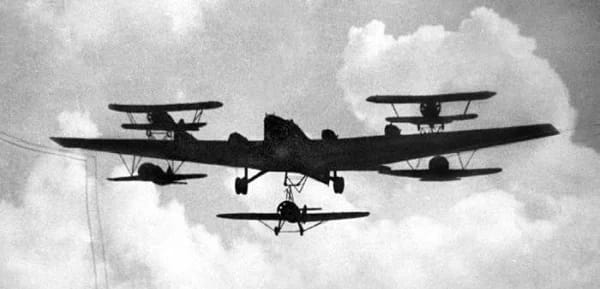
The Zveno Project - a TB-1 or a TB-3 heavy bomber as mothership, carrying two to five fighter aircraft.
Development and Design
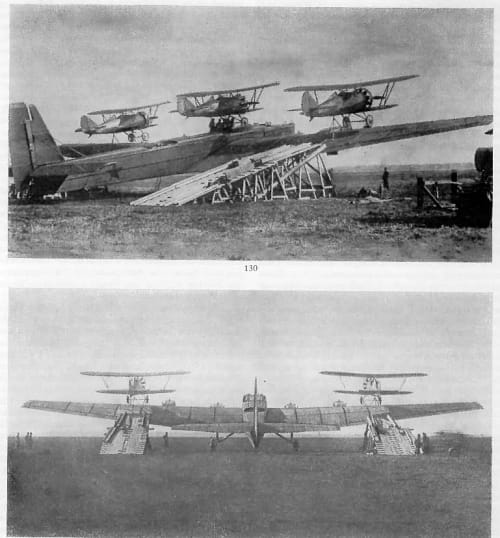
The Zveno-2: Tupolev TB-3 and three Polikarpov I-5, with the ramp for loading the fighters.
The Genesis of the Zveno Project
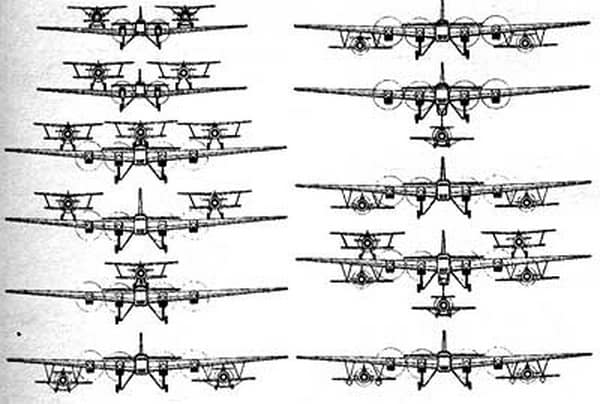
All variants of the Zveno project
Questions connexes
What was the Soviet "Caspian Sea Monster"?
The "Caspian Sea Monster" was a giant Soviet ekranoplan — a ground-effect vehicle that flew just metres above the water on a cushion of air. Spotted by US spy satellites in the 1960s, the huge, ship-sized craft baffled the CIA, hence its monstrous nickname. Read more about the Caspian Sea Monster.
What is an ekranoplan?
An ekranoplan is a vehicle that uses the "ground effect," skimming low over water or flat terrain on a trapped cushion of high-pressure air for extra lift and efficiency. The Soviets built several, blurring the line between aircraft and ship. Modern versions still appear, such as China's Bohai Sea Monster.
What was the Lun-class ekranoplan?
The Lun-class was a massive Soviet military ekranoplan armed with anti-ship missiles, designed to skim over the sea at high speed below radar coverage and strike enemy vessels. Only one was completed, and it became one of the most striking machines of the Cold War.
Why did the Soviet Union build such unusual aircraft?
Soviet engineers were encouraged to pursue bold, unconventional designs to leapfrog Western technology, producing everything from ground-effect giants to record-breaking interceptors and rocket-powered prototypes — daring machines that were often as dangerous as they were innovative.
What made the MiG-25 Foxbat so remarkable?
The MiG-25 "Foxbat" was a Soviet interceptor capable of roughly Mach 2.8, built to chase high-flying spy planes and bombers. Its blistering speed alarmed the West, and a related record flight set the absolute altitude record for a jet.
Did any of these Soviet machines enter wide service?
Most of the wildest designs, like the giant ekranoplans, were built only in tiny numbers and never saw mass service due to cost, complexity and limited usefulness. Yet they remain fascinating glimpses of Soviet ambition and engineering daring during the Cold War.
0 commentaire