
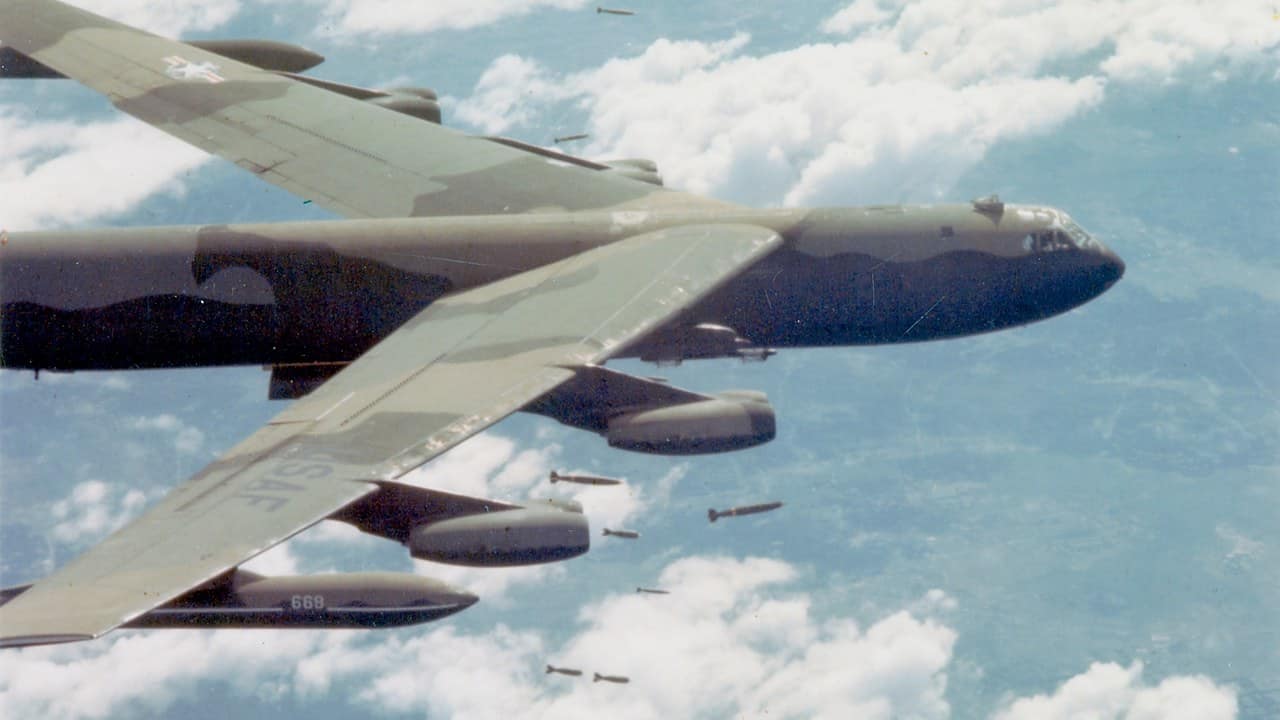
At a quarter to three in the afternoon on 18 December 1972, the concrete at Andersen Air Force Base, Guam, began to shake. The first Boeing B-52 Stratofortress released its brakes, eight engines trailing black smoke from water-injected takeoff power, and lumbered toward an eleven-hour night. Then the next. Then the next. It took nearly two hours for 87 bombers to get airborne — a departure stream so long that the first aircraft were levelling at cruise before the last had left the ground.
Over the Gulf of Tonkin they joined 42 more B-52Ds out of U-Tapao in Thailand: 129 heavy bombers on a single night's target list, the largest bomber force assembled since the Second World War. A B-52D in the "Big Belly" configuration could lift roughly 27 tonnes (60,000 lb) of conventional bombs. The crews called the aircraft the BUFF. Their destination was the most heavily defended airspace on earth.
Quick Facts
- Dates: 18-29 December 1972, with a one-day stand-down on Christmas Day — hence "the Eleven-Day War"
- 741 B-52 sorties dispatched against North Vietnam; 729 completed their missions
- 15,237 tons of bombs dropped by B-52s; over 20,000 tons including tactical aircraft
- 15 B-52s destroyed by SA-2 missiles: 10 fell over North Vietnam, 5 crashed in Laos or Thailand
- SAM expenditure: US crews logged about 1,240 launches; Vietnamese records state 266
- Civilian deaths: at least 1,624, per official North Vietnamese figures
- Paris Peace Accords signed 27 January 1973; 591 American POWs released within 60 days
When the Talks Collapsed
The campaign began at a negotiating table. In October 1972 Washington and Hanoi had essentially agreed peace terms in Paris, but the deal stalled — Saigon objected, positions hardened, and on 16 December the talks broke down with no date set for resumption. Henry Kissinger, back from Paris, sent Hanoi an ultimatum: return within 72 hours or face "grave consequences". President Nixon then ordered the only escalation he had left: the B-52 force, against Hanoi and Haiphong themselves.
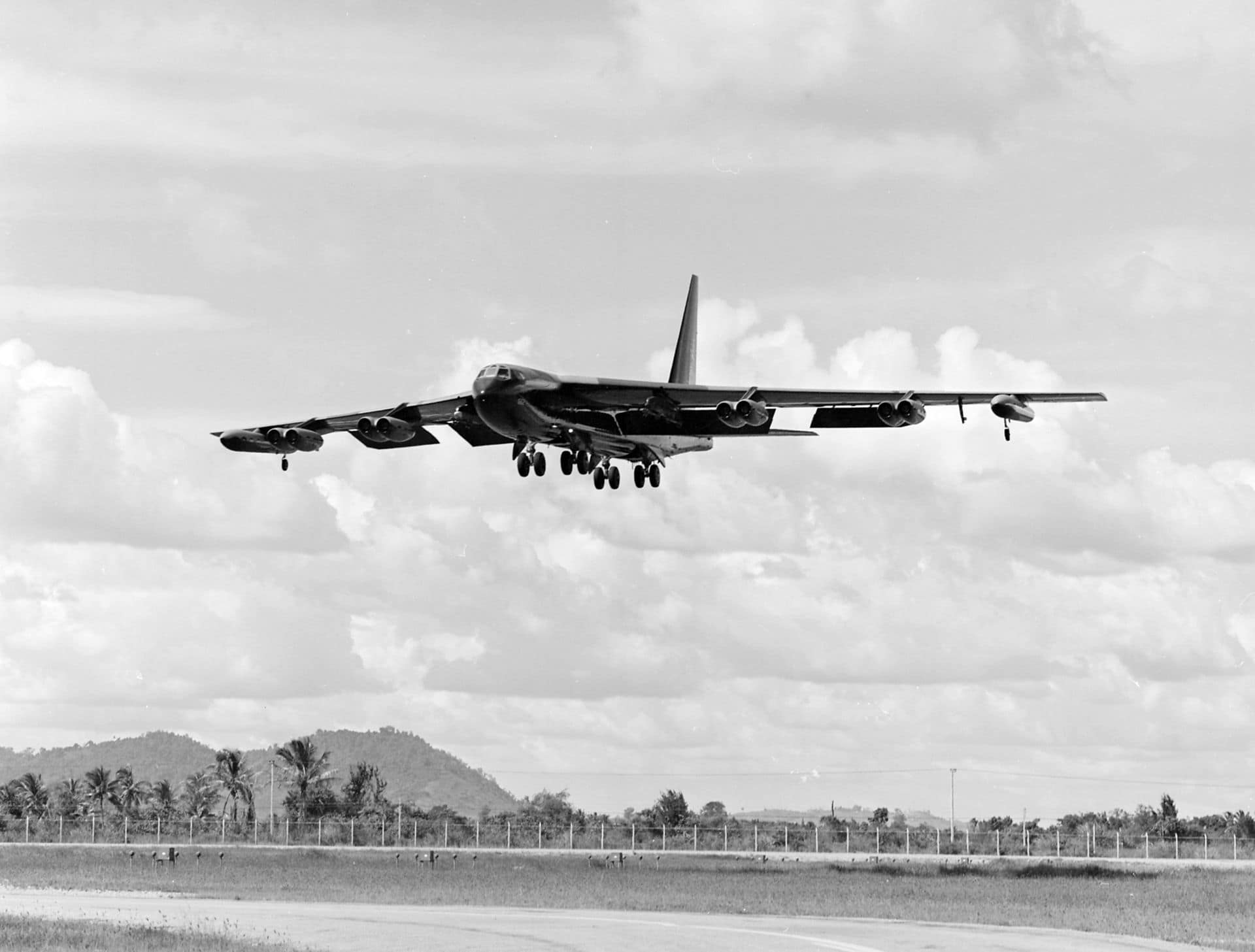
Operation Linebacker II was different from every bombing campaign that preceded it in Southeast Asia. The target list was the enemy's heartland: rail yards, airfields, power and radio stations, storage complexes. B-52s and F-111s would strike by night in monsoon weather; tactical aircraft pressed the daytime attacks. Strategic Air Command's rules were rigid — three-ship cells at 10,000 to 10,700 metres (33,000 to 35,000 ft), no evasive action on the bomb run, so that each cell's overlapping electronic countermeasures stayed intact.
Against them stood an integrated defence built up over seven years: 26 SA-2 sites, some 145 MiG fighters, massed anti-aircraft artillery and an overlapping radar net. On the first night the defenders fired more than 200 missiles and destroyed three B-52s. The bombers gave an answer of their own — SSgt Samuel Turner, tail gunner of Brown 03, shot down a MiG-21, the first kill by a B-52 gunner in history.
The Operations Room animates the B-52s' battle over Hanoi, night by night.
A Duel of Electrons and Missiles
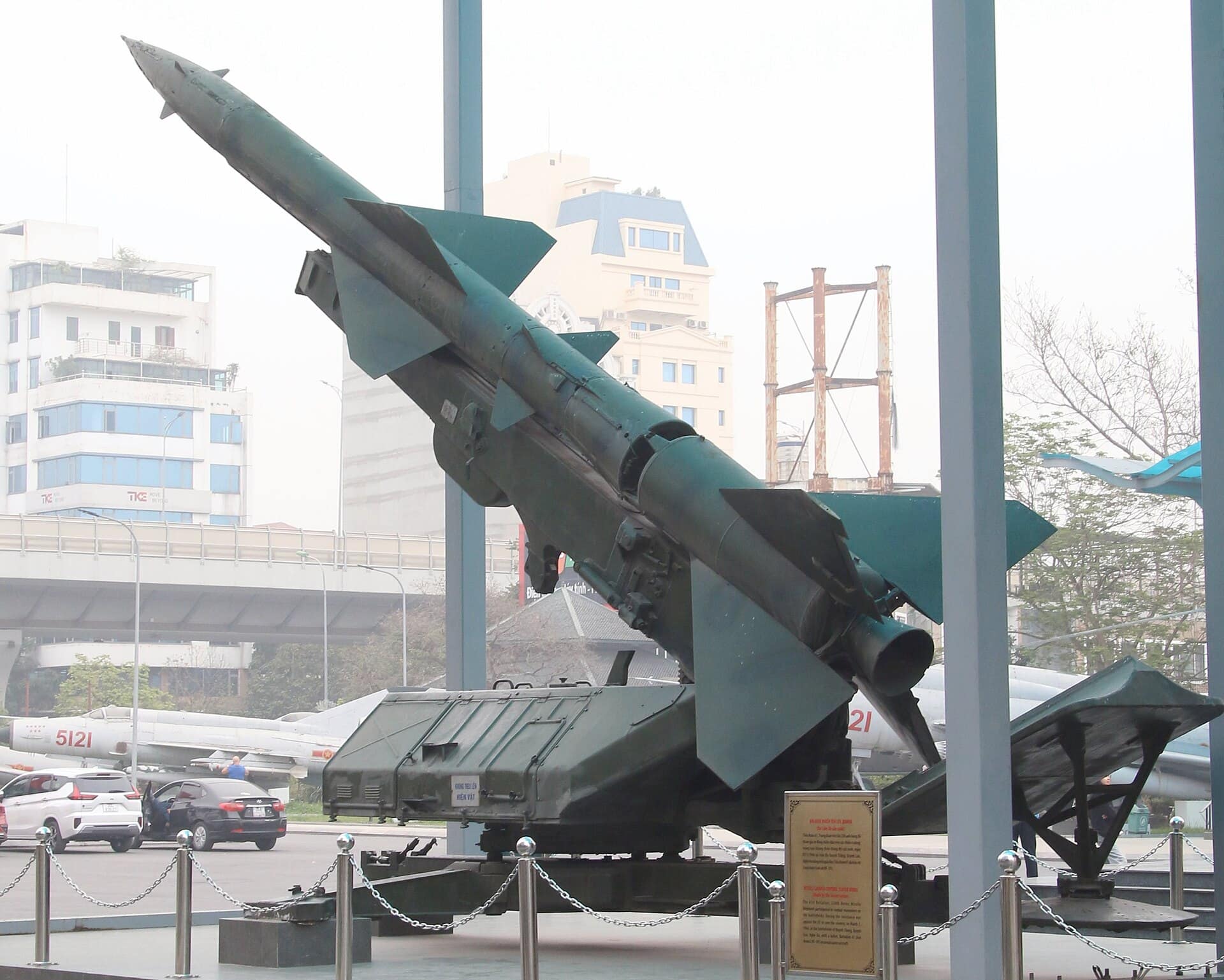
The contest over Hanoi was, at its core, an engineering duel. The S-75 Dvina — SA-2 Guideline to NATO — was a two-stage missile roughly 10.6 metres (35 ft) long, carrying a fragmentation warhead of about 195 kg (430 lb) and guided by the Fan Song radar. Its crews had studied American tactics for years. The B-52's defence was not agility but electrons: jammers designed to blind Fan Song's tracking beam.
Not all BUFFs were equal in that fight. Every B-52D in theatre carried the latest countermeasures fit; only about half the B-52Gs had been modified. The G model had more efficient engines and greater range, but fewer jammers with appreciably less output power. The difference proved fatal: of the early losses, unmodified Gs were heavily over-represented, and planners soon kept them away from the worst of Hanoi's missile belt.
The geometry of the attack made things worse. After bomb release, each cell executed a steep post-target turn. Banking presented a larger radar cross-section, broke the careful jamming overlap, and turned a 185 km/h (100-knot) jet-stream tailwind into a headwind that pinned the bombers over the defences. Five of the first nine B-52s lost were hit in that turn.
On the third night, 20 December, the pattern collapsed into crisis: six of 99 bombers shot down, a loss rate no force could sustain. SAC's commander, General John C. Meyer, made the hard call to press on — but the tactics had to change. How many missiles came up in those eleven nights depends on whom you ask: American crews logged around 1,240 launches, while Vietnamese records state 266 were actually fired. The gap itself tells you what those nights looked like from a cockpit.
The Revision of 26 December
Mission planning passed to Eighth Air Force on Guam, and the revision was thorough. Time over target compressed from hours to minutes. Approach axes multiplied, altitudes varied, the steep post-target turns were abolished, and exit routes ran straight out over the Gulf of Tonkin. Electronic warfare officers were cleared to jam the SA-2's guidance downlink. For three nights, smaller forces of 30 U-Tapao D-models probed the new methods without loss.
After the Christmas Day stand-down, the full weight came back. On 26 December, 120 B-52s — 78 launched from Andersen in a single block, the largest combat launch in SAC's history — struck ten targets in seven streams, all in and out of the Hanoi and Haiphong areas within about 20 minutes. More than 110 support aircraft flew that night, laying a dense chaff blanket rather than narrow corridors, hunting SAM sites, and screening the force.
The defence cracked. Some 250 SAMs had been fired between 18 and 24 December; on the 26th, only 68 came up, and on the final night, 29 December, just 23 — single shots where volleys of six had once risen. Air Force historians called it missile exhaustion; the historian Herman Gilster later argued the tactical revision mattered more than empty launch rails. Either way, one B-52 fell that night, and Hanoi signalled it was ready to talk.
Wings over Vietnam: archival footage from the Linebacker II campaign.
Beneath the Bombs
Precision, in 1972, was a relative term, and the people of Hanoi paid for the difference. According to official North Vietnamese figures, at least 1,624 civilians were killed. On the night of 26 December, bombs fell across Kham Thien street, killing 278 people by Vietnamese count. Four days earlier the Bach Mai hospital, which stood a kilometre from a military airfield, was largely destroyed; Vietnamese accounts record around 30 medical staff killed in its basement shelters. Whatever one concludes about intent, those numbers belong in any honest account of these eleven days.
A few kilometres away, in the cells of Hoa Lo prison, several hundred American prisoners of war listened to the same explosions and understood them differently. Colonel Robert Certain — navigator of Charcoal 01, the first B-52 shot down, and a prisoner from the first night — later described what the long-held POWs told him.
The cost to the bomber force was precise and heavy: 15 B-52s destroyed, ten falling in North Vietnam and five crashing in Laos or Thailand, with more damaged. Of the 92 crewmen aboard the lost aircraft, 26 were rescued, 33 captured, 25 listed missing and eight killed or dead of wounds. Twelve supporting aircraft were also lost. Against 729 completed sorties, the B-52 loss rate came to about two percent — bearable by the arithmetic of air campaigns, brutal by any other measure.
On 8 January 1973 Kissinger and Le Duc Tho met again in Paris. The agreement signed on 27 January differed little from the October draft, which is why the campaign's necessity is still argued half a century later. What is not argued: within 60 days, 591 American prisoners came home, and the B-52 never again flew into a defence like Hanoi's.
Linebacker II remains the most intense battle ever fought between heavy bombers and surface-to-air missiles — eleven nights in which electronic warfare, tactics and raw persistence were tested against each other at 10,000 metres. The aircraft that fought it, remarkably, still serves. The lessons it wrote in December 1972 are studied in every air force that expects to fight its way through modern air defences.
Sources: Air & Space Forces Magazine (Walter J. Boyne), Wikipedia, Task & Purpose
Related Questions
What was Operation Linebacker II?
Operation Linebacker II was an intensive US bombing campaign against North Vietnam from 18 to 29 December 1972, nicknamed the "Eleven-Day War" for its single Christmas Day pause. Waves of B-52 Stratofortress bombers struck rail yards, airfields, power stations and storage complexes around Hanoi to force North Vietnam back to the Paris peace talks.
Why did the US launch the Christmas bombing of Hanoi in 1972?
The campaign followed the collapse of the Paris peace talks. In October 1972 Washington and Hanoi had essentially agreed terms, but the deal stalled and on 16 December negotiations broke down. Henry Kissinger issued an ultimatum to return within 72 hours or face "grave consequences"; when Hanoi refused, the bombing began.
How many B-52s were lost during Linebacker II?
Fifteen B-52 bombers were destroyed by SA-2 surface-to-air missiles during the eleven days — ten fell over North Vietnam and five crashed in Laos or Thailand. US crews logged roughly 1,240 SAM launches against them, though Vietnamese records state 266. The heavy early losses forced Strategic Air Command to change its rigid tactics.
How many bombs were dropped during Linebacker II?
B-52s dropped about 15,237 tons of bombs on North Vietnam during the campaign, with total tonnage including tactical aircraft exceeding 20,000 tons. The US dispatched 741 B-52 sorties, of which 729 completed their missions, making it the largest concentrated bomber effort since the Second World War.
Did a B-52 ever shoot down a fighter?
Yes. On the first night of Linebacker II, Staff Sergeant Samuel Turner, the tail gunner of a B-52 called Brown 03, shot down a MiG-21 — the first aerial kill by a B-52 gunner in history. The bombers defended themselves with radar-directed tail guns while holding rigid formations.
What air defenses did North Vietnam have over Hanoi?
Hanoi was protected by one of the most concentrated air-defense networks ever built: around 26 SA-2 missile sites, roughly 145 MiG fighters, massed anti-aircraft artillery and an overlapping radar net assembled over seven years. On the first night alone the defenders fired more than 200 missiles, downing three B-52s.
What is a B-52 Stratofortress?
The Boeing B-52 Stratofortress is a long-range American strategic bomber that first flew in 1952 and still serves in the US Air Force today. Crews nicknamed it the "BUFF." During Linebacker II the "Big Belly" B-52D could carry roughly 27 tonnes (60,000 lb) of conventional bombs.
How did Linebacker II end the Vietnam air war?
The bombing pushed North Vietnam back to negotiations. The Paris Peace Accords were signed on 27 January 1973, and 591 American prisoners of war were released within sixty days. The campaign remains controversial: official North Vietnamese figures record at least 1,624 civilian deaths from the raids.
0 commentaire