
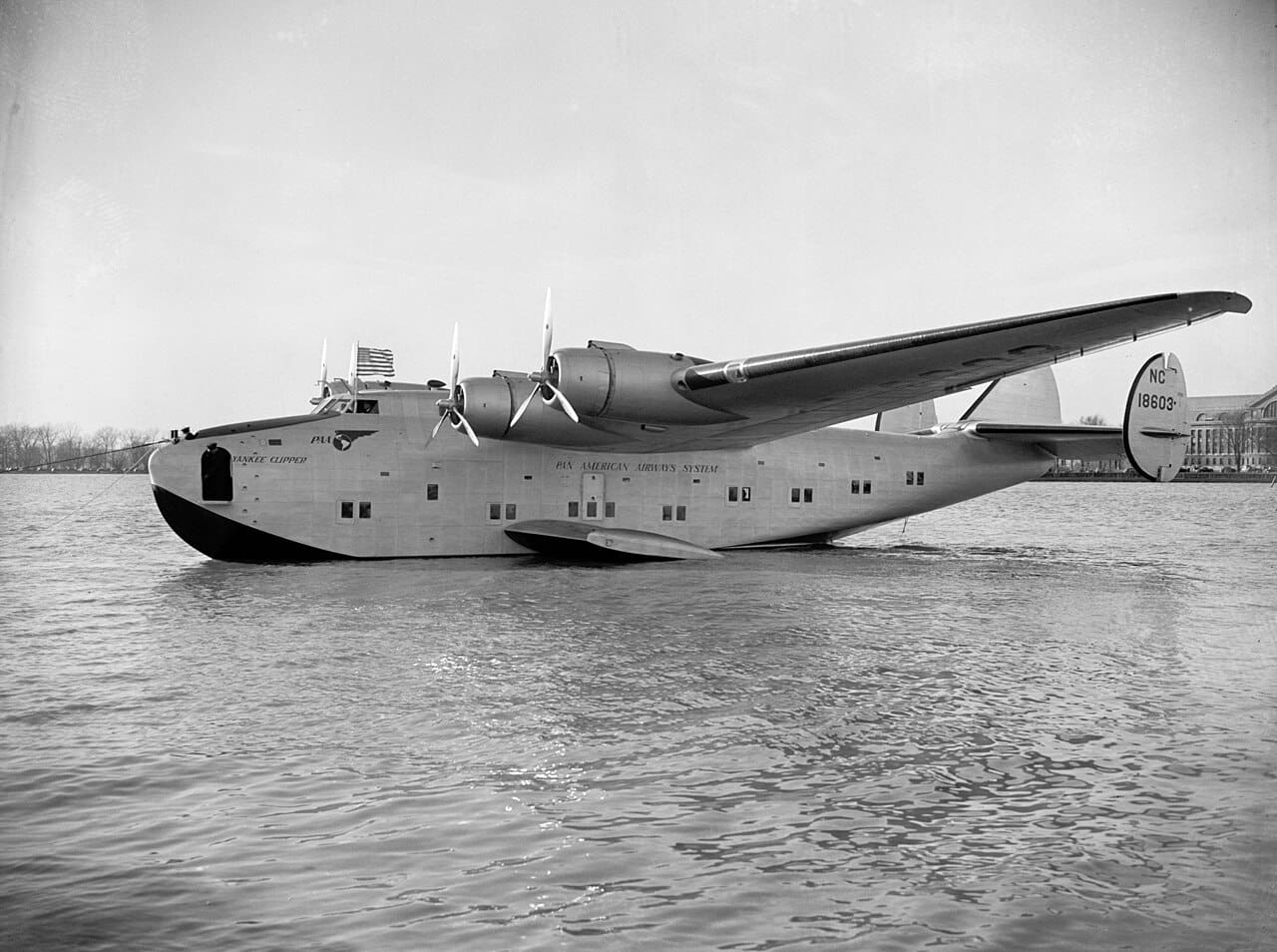
On the morning of 7 December 1941, a Pan American Boeing 314 flying boat was two hours out of Auckland, New Zealand, gliding across the South Pacific in luxury — dining lounge, sleeping berths, white-jacketed stewards. Then the radio operator handed the captain a message: Japanese aircraft had just attacked Pearl Harbor. In an instant, the entire ocean between the aircraft and its home in San Francisco had become a battlefield.
Le Pacific Clipper could not go back the way it came. So Captain Robert Ford took it home the other way — westward, right around the world, becoming the first commercial airliner ever to circle the globe.
Informations clés
- Aéronef: Boeing 314 flying boat Pacific Clipper (NC18602), Pan American
- Captain: Robert Ford
- Déclenchement: the attack on Pearl Harbor, 7 December 1941
- Itinéraire: Auckland westward via Asia, Arabia, Africa and South America to New York
- Distance: about 31,500 miles in 209 flying hours
- Arrived: LaGuardia, New York, 6 January 1942
Stranded on the wrong side of a war
The Clipper landed safely at Auckland, and there Ford received an extraordinary set of orders from Pan American headquarters: do not attempt to fly back across the Pacific. Instead, strip every marking and identification from the aircraft, and bring it home to New York by heading west — across territory none of the crew had ever flown, without proper charts, and scrounging fuel wherever they could find it.
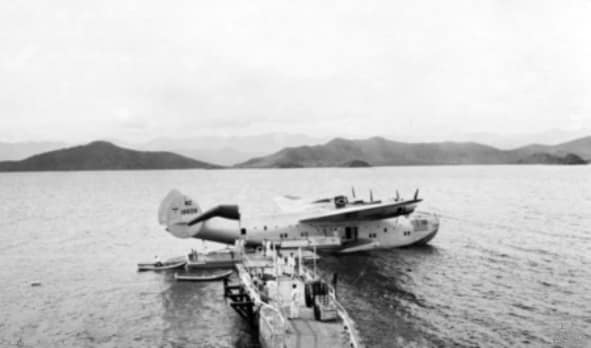
With a crew of about a dozen and a handful of stranded Pan Am staff aboard, the huge flying boat set off into the unknown.
The story of the Pacific Clipper’s accidental circumnavigation.
Improvising across the world
What followed was five weeks of pure improvisation. Navigator Roderick Brown found his way with celestial navigation and little more than the coordinates of the next stop. At Surabaya, in the Dutch East Indies, there was no aviation fuel, so the crew filled the tanks with 76-octane automobile petrol; the engines backfired but kept turning. At Darwin they hand-pumped fuel from cans. Near Ceylon they descended through cloud straight over a surfaced Japanese submarine, which fired a shot and missed.
They set the flying boat down on the Nile at Khartoum and on the Congo River at Léopoldville, muscled it back into the air ahead of waterfalls and rapids, and then droned for nearly two days non-stop across the South Atlantic to Brazil. It was aviation by nerve and guesswork.
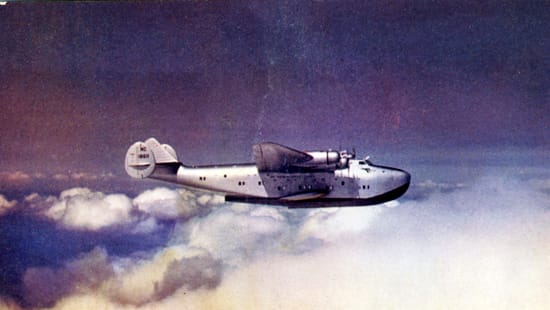
Pan Am’s Boeing 314, the flying boat that made the trip.
Home the long way
Just before dawn on 6 January 1942, after 209 hours in the air and some 31,500 miles, the Pacific Clipper settled onto the water at the Marine Terminal in New York. It was the first time a commercial aircraft had ever flown all the way around the world. And Captain Ford, who had just pulled off one of the great feats of improvised airmanship in history, announced it with the calm of a man arriving five minutes late for work.
No fanfare, no drama — just a routine position report at the end of the most roundabout homecoming in aviation. The Pacific Clipper went on to serve through the war before being lost to a storm in 1951. But for five weeks in the winter of 1941, a luxury airliner turned itself into an explorer, and flew home the very long way.
More on the golden-age Boeing 314 flying boats.
Sources: Pacific Clipper (Wikipedia); Robert van der Linden, Smithsonian National Air and Space Museum; Ed Dover, The Long Way Home; Pan Am Historical Foundation; The Seattle Times.
0 commentaire