
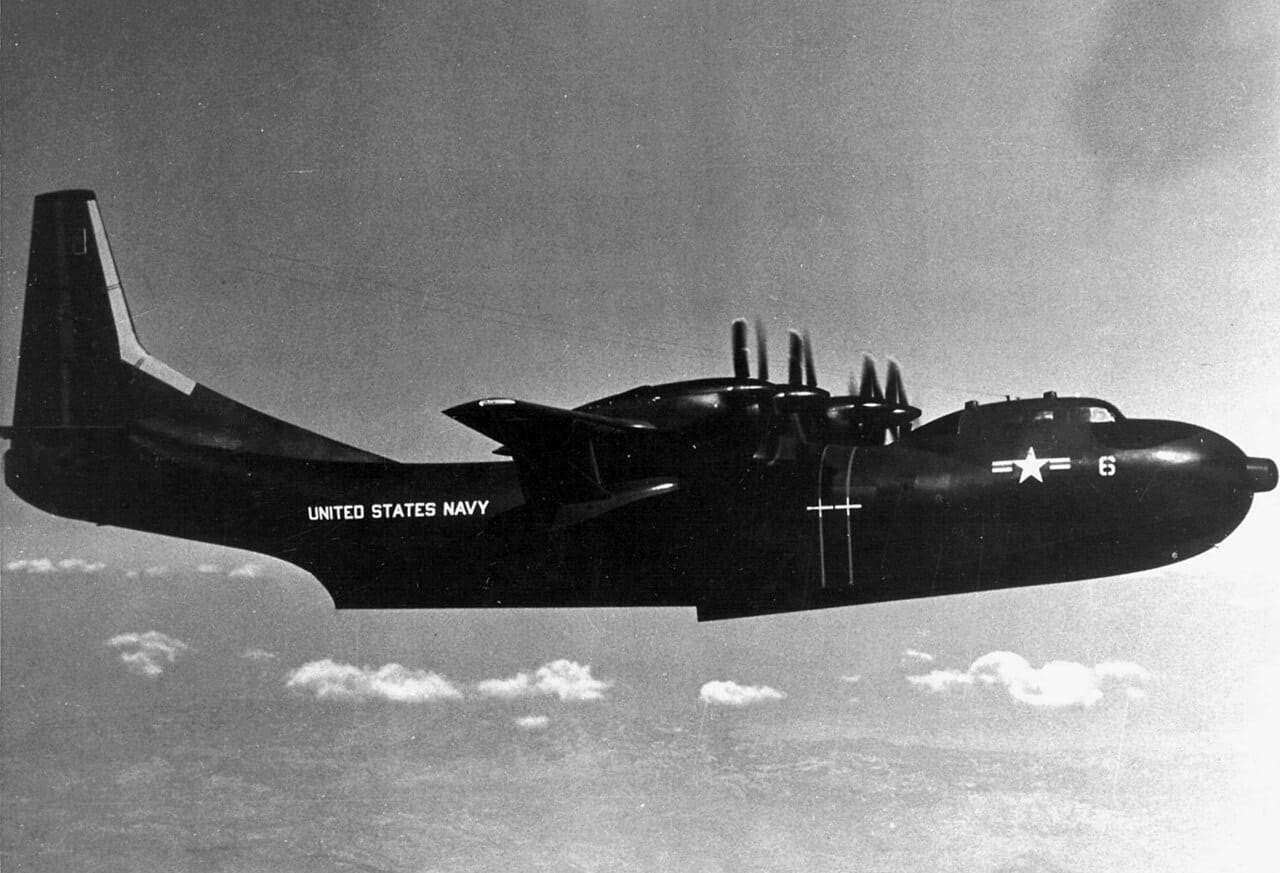
Pendant quatre courtes années, au milieu des années 1950, l'US Navy a exploité le ravitailleur en vol le plus étrange qu'elle ait jamais possédé. Il s'agissait d'un hydravion quadrimoteur à turbopropulseurs. Il pouvait amerrir, embarquer des véhicules par l'avant et ravitailler simultanément quatre avions de chasse à réaction grâce à des paniers de ravitaillement déployés depuis chaque aile. Sa vitesse de croisière était d'environ 560 km/h, supérieure à celle de tous les hydravions précédents. Il effectuait également des vols cargo transpacifiques réguliers entre la base aéronavale d'Alameda et Hawaï.
L'appareil était un Convair R3Y Tradewind. La Marine en avait commandé 13, dont 11 furent construits. Ils restèrent en service opérationnel moins de 36 mois. Fin 1958, les derniers appareils gisaient dans le désert de Litchfield Park, en Arizona, en attente de démolition. Le R3Y fait partie de ces avions dont le monde a cessé de vouloir juste avant son arrivée sur le marché.
Informations clés
- Aéronef: Convair R3Y Tradewind — variante de transport du bombardier de patrouille P5Y
- Premier vol : 25 février 1954 (R3Y-1) / 22 octobre 1954 (R3Y-2)
- Longueur / Envergure : 42,6 m / 44,4 m
- Moteurs : 4 turbopropulseurs Allison T40, hélices contrarotatives
- Vitesse de croisière : 560 km/h (350 mph) — soit environ la vitesse maximale d'un Boeing B-29
- Gamme: 4 500 km avec charge utile maximale
- Rôle: Transport, ravitaillement en vol, livraison de véhicules aux bases avancées
- Construit: 11 cellules — retirées du service en 1958 suite à des problèmes de fiabilité du moteur Allison T40
Le dernier grand hydravion de l'US Navy
En 1950, l'US Navy décida que la prochaine génération de bombardiers de patrouille et de transports à long rayon d'action devait pouvoir atterrir sur l'eau. Les pistes terrestres étaient vulnérables en cas de guerre dans le Pacifique. Les pistes des îles coralliennes étaient courtes. Les porte-avions étaient saturés de chasseurs. Un hydravion à long rayon d'action – suffisamment rapide pour distancer la plupart des chasseurs et assez grand pour transporter des chars – serait un atout précieux. Convair, qui avait construit le Catalina et le PB2Y Coronado, remporta le contrat.
L'hydravion livré par Convair était le plus moderne jamais construit. Sa coque, optimisée sur le plan hydrodynamique, permettait un déjaugeage précis à des vitesses de décollage supérieures à 220 km/h. Son aile cantilever à fort allongement optimisait le rendement en croisière. La configuration quadrimoteur utilisait les turbopropulseurs les plus puissants jamais spécifiés par l'US Navy. La structure, entièrement en magnésium-aluminium, était si légère que son poids à vide n'atteignait que 35 tonnes.
Le R3Y pouvait embarquer des véhicules par l'avant. Toute la partie avant du fuselage s'ouvrait vers le haut, dévoilant une trappe de chargement de 4 mètres carrés. Camions, jeeps, palettes de munitions – tout ce dont une garnison avancée de Marines avait besoin – pouvait être chargé à bord depuis une plage ou une rampe d'hydravion. La Marine prévoyait d'utiliser le R3Y pour assurer le ravitaillement des bases avancées du Pacifique en cas d'interruption des livraisons depuis les porte-avions pendant un temps de guerre.
Le moteur qui l'a tué
Le talon d'Achille du R3Y était le turbopropulseur Allison T40. Sur le papier, le T40 était une solution élégante : deux turboréacteurs T38 couplés à une seule boîte de transmission à hélices contrarotatives, développant plus de 5 000 chevaux par moteur. En pratique, le T40 s'avéra un véritable cauchemar mécanique. La boîte de transmission connut des défaillances répétées. Les hélices s'emballèrent et perdirent des pales. Trois appareils furent perdus suite à des pannes moteur au cours du programme.
Une carrière utile, en bref
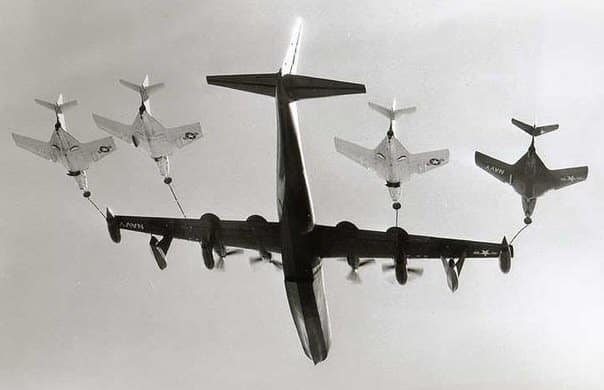
Les performances du R3Y en vol furent extraordinaires. L'escadron VR-2 de la NAS Alameda assura des vols cargo réguliers vers Hawaï, l'île de Wake et le Japon de 1956 à 1958. Les R3Y participèrent aux premiers essais de ravitaillement en vol entre turbopropulseurs. Lors d'une démonstration publicitaire en 1956, un Tradewind ravitailla simultanément quatre chasseurs à réaction F9F Cougar en un seul passage – un exploit qu'aucun autre avion de l'époque ne put égaler. Un autre Tradewind établit un record de vitesse transcontinental en reliant Alameda à la NAS Patuxent River en moins de six heures.
L'US Navy mit fin aux opérations du Tradewind en avril 1958, invoquant le manque de fiabilité du moteur Allison T40. La réalité était plus complexe : le passage aux avions de transport à réaction basés à terre (le nouveau C-130 Hercules) et la fiabilité opérationnelle croissante de l'aviation embarquée à long rayon d'action avaient rendu obsolète le concept d'hydravion de transport. Le R3Y fut le dernier hydravion de l'US Navy à entrer en service. Après son retrait du service, la Marine n'introduisit plus jamais de nouveau type d'hydravion.
Le Tradewind était un avion arrivé un peu trop tard pour trouver sa place. Il a connu des performances exceptionnelles pendant à peine deux ans, avant de disparaître discrètement dans le désert. Aucun Tradewind R3Y n'a survécu. Les derniers exemplaires ont été démantelés à la base aéronavale de Litchfield Park. Il ne reste que peu de traces matérielles, hormis des plans, des manuels et des photographies conservés dans les archives. Ce sont les seuls témoignages physiques de cet appareil qui, durant une brève période de la Guerre froide, fut l'hydravion le plus rapide jamais construit.
Sources : Archives du Musée national de l'aviation navale, Putnam Aeronautical — Convair Aircraft Since 1916, Naval Aviation News (numéro d'avril 1958), archives d'Aviation Week.
Questions connexes
Qu'était-ce que le Convair R3Y Tradewind ?
Le Convair R3Y Tradewind était un hydravion américain à turbopropulseurs des années 1950, développé pour l'US Navy comme avion de transport rapide et ravitailleur. Propulsé par quatre turbopropulseurs Allison T40, il était à la pointe de la technologie pour son époque, mais fut discrètement retiré du service après seulement quelques années en raison de problèmes moteurs chroniques.
Pourquoi le R3Y Tradewind a-t-il été retiré du service si rapidement ?
Ses moteurs turbopropulseurs Allison T40, dotés d'hélices contrarotatives complexes, étaient peu fiables et dangereux. Les pannes moteur persistantes ont compromis les performances de cet hydravion pourtant performant, et la Marine a retiré les 11 appareils du service en 1958, quelques années seulement après leur mise en service.
Quelle était la vitesse du R3Y Tradewind ?
Il croisait à environ 560 km/h (350 mph), soit à peu près la vitesse maximale d'un bombardier B-29, et était très rapide pour un hydravion de cette taille. Avec une autonomie de 4 500 km, cela en faisait, sur le papier, un appareil de transport aux performances impressionnantes.
À quoi servait le R3Y Tradewind ?
Il servait d'avion de transport, de ravitailleur en vol et d'appareil de livraison de véhicules et de matériel aux bases avancées, capable d'amerrir près des côtes. Ses missions variées ont démontré le potentiel de l'hydravion avant que des problèmes de moteur ne mettent fin à sa carrière.
Combien de R3Y Tradewinds ont été construits ?
Seuls 11 exemplaires furent construits. Malgré les performances prometteuses de l'appareil, ses moteurs défectueux contraignirent la Marine à retirer du service l'ensemble de la petite flotte en 1958.
Articles similaires
PBY Catalina : L'hydravion qui ne meurt pas
0 commentaire