
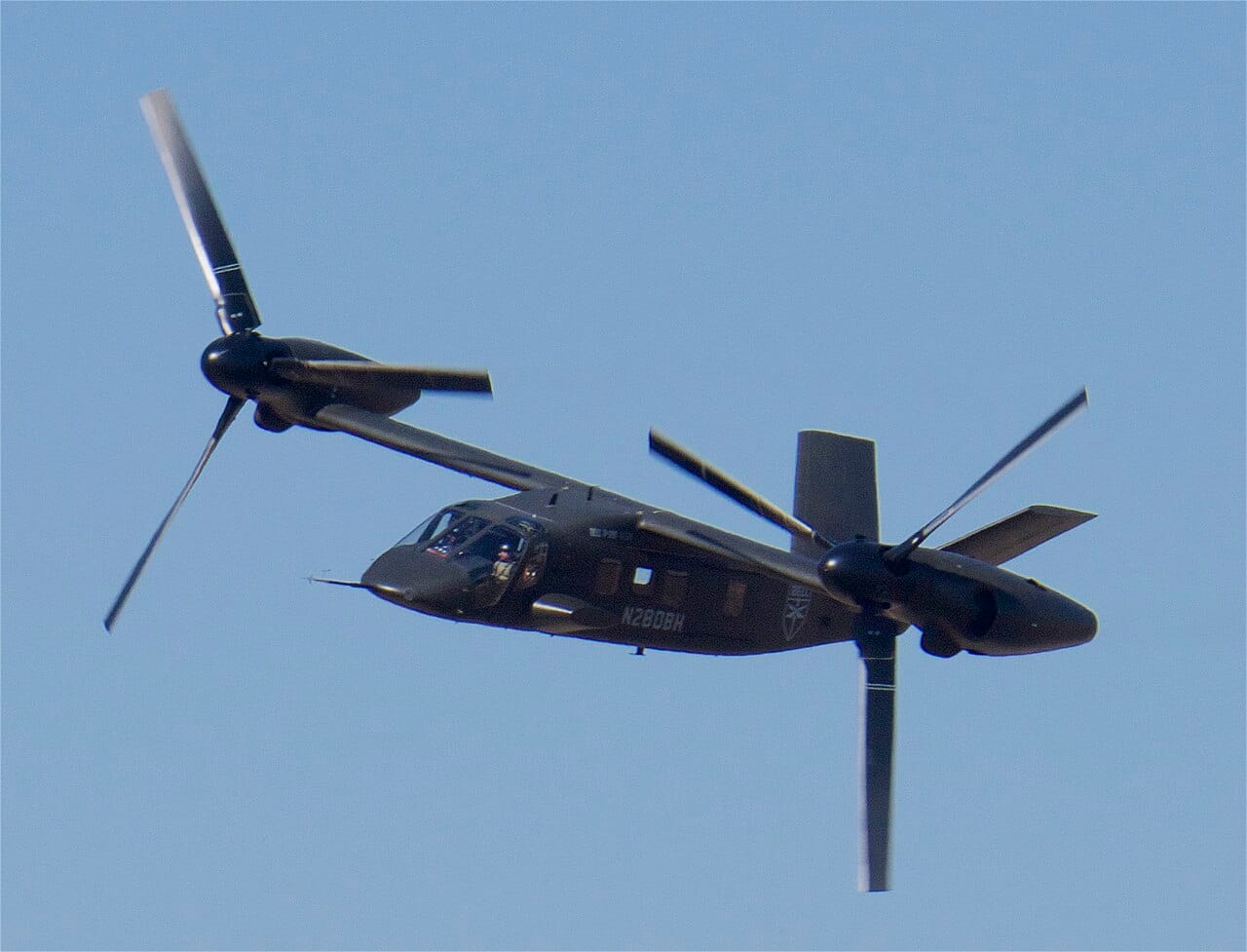
Helicopters do something fixed-wing aircraft cannot. They land on rooftops, in jungles, on the back of a destroyer, on a forest road, on a Pacific atoll smaller than a basketball court. The price they pay is speed. A helicopter that cruises at 150 knots is unusual. One that cruises at 200 is exceptional. One that cruises at 400 knots — like a jet — has never existed. Until, perhaps, 2028.
That is the year DARPA's X-76 is scheduled for its first flight. Built by Bell Textron under the agency's Speed and Runway Independent Technologies (SPRINT) programme, the X-76 is the most ambitious attempt in fifty years to break the speed-versus-runway-independence trade-off that has defined rotorcraft design since the Sikorsky R-4 in 1942. The aircraft is designed to take off vertically, like a helicopter, then accelerate to 400-450 knots — nearly twice the speed of conventional rotorcraft and roughly the cruise speed of a regional jet — by folding its rotors away and switching to turbofan propulsion mid-flight.
Why Special Operations Command Wants It
The X-76 has two customers. DARPA funds the technology development. U.S. Special Operations Command pays attention because the operational implications are enormous. SOCOM's current high-speed insertion problem is solved by C-17s, V-22s and CV-22s, MC-130 Talons, and CH-47 Chinooks — all aircraft with different speed and runway requirements. Combining a long-range V-22 transit with a CH-47 final approach in austere terrain requires multiple aircraft, multiple crews, and multiple refuelling points.
An aircraft that flies 400-450 knots to a target area and then lands vertically on an unprepared site is a single-aircraft answer to the entire mission set. The reach extends. The signature shrinks. The number of moving parts in a special-operations infiltration drops dramatically.

For the rest of the U.S. military, the X-76 is at least equally interesting. Carrier-based logistics support — currently handled by C-2 Greyhounds and CMV-22B Ospreys — could move at jet speeds without requiring catapult or arresting gear. Combat search-and-rescue, the mission that pulled eleven Bahamian survivors out of the water in May, could extend its reach by hundreds of miles. Casualty evacuation in the Indo-Pacific, where distances are vast and runways are few, becomes geographically simpler.
The 1776 Connection
The X-76 designation is not random. DARPA chose it deliberately to mark the country's 250th anniversary, evoking 1776 in an experimental-aircraft designation the way the X-1 once marked the dawn of supersonic flight. The intended symbolism is unmistakable: a piece of revolutionary American aerospace engineering at a moment when the country is taking stock of two and a half centuries of technological reinvention.
Whether the X-76 actually fulfils that promise depends on the next three years of engineering, manufacturing and flight test. Bell Textron has completed Critical Design Review. The prototype is now being built. First flight is scheduled for early 2028 — about 81 years after the Bell XS-1 broke the sound barrier in the Mojave Desert. The same company, in roughly the same business, attempting roughly the same kind of technological leap.
If it works, the next generation of vertical-lift aircraft will land where helicopters land and fly where jets fly. If it doesn't, the X-76 will join the long, expensive list of X-planes that pushed the envelope and didn't quite get there. Either outcome is what experimental aviation is for.
Sources: DARPA press release (March 2026); The Aviationist (Parth Satam, 9 March 2026); New Atlas; Overt Defense; AvGeekery; The National Interest; Simple Flying; AIAA; Aerospace Global News; AirGuide.
Questions connexes
What is the DARPA X-76?
The DARPA X-76 is an experimental high-speed VTOL aircraft built by Bell Textron under the agency's SPRINT (Speed and Runway Independent Technologies) programme. Scheduled to first fly in 2028, it is designed to take off vertically like a helicopter, then fold its rotors away and switch to turbofan propulsion to cruise at 400 to 450 knots.
How fast can the X-76 fly compared to a helicopter?
The X-76 aims to cruise at 400 to 450 knots, nearly twice the speed of conventional rotorcraft and close to a regional jet. Most helicopters cruise around 150 knots, and 200 is exceptional. By folding its rotors and switching to jet propulsion in flight, the X-76 seeks to break the long-standing trade-off between speed and vertical landing.
Why does the military want a high-speed VTOL aircraft?
The military wants high-speed VTOL aircraft to combine long-range, fast transit with the ability to land on unprepared sites such as rooftops, jungle clearings, or ship decks. US Special Operations Command sees it as a single-aircraft answer to missions that today need several platforms, extending reach while shrinking the operation's footprint and signature.
What is the difference between a tiltrotor and a folding-rotor aircraft?
A tiltrotor like the V-22 Osprey rotates its engines and rotors to transition between vertical and forward flight, while a folding-rotor design like the X-76 stows its rotors entirely and relies on separate jet propulsion for cruise. Decades of VTOL experiments, such as the Bell X-22 ducted-fan craft, explored these competing approaches.
Have other VTOL jet-speed aircraft been attempted?
Yes. Engineers have chased jet-speed vertical flight for decades. Bell alone explored radical concepts like the XF-109, an eight-engine Mach 2 VTOL fighter design from around 1961. Most never reached production because of complexity and weight, which is why the X-76's rotor-folding approach, due to fly in 2028, is so ambitious.
Articles similaires
First Look at What a Night Stalker MV-75 Cheyenne Will Look Like
The Dornier Do 31 — The Only Jet VTOL Transport That Ever Flew
0 commentaire