
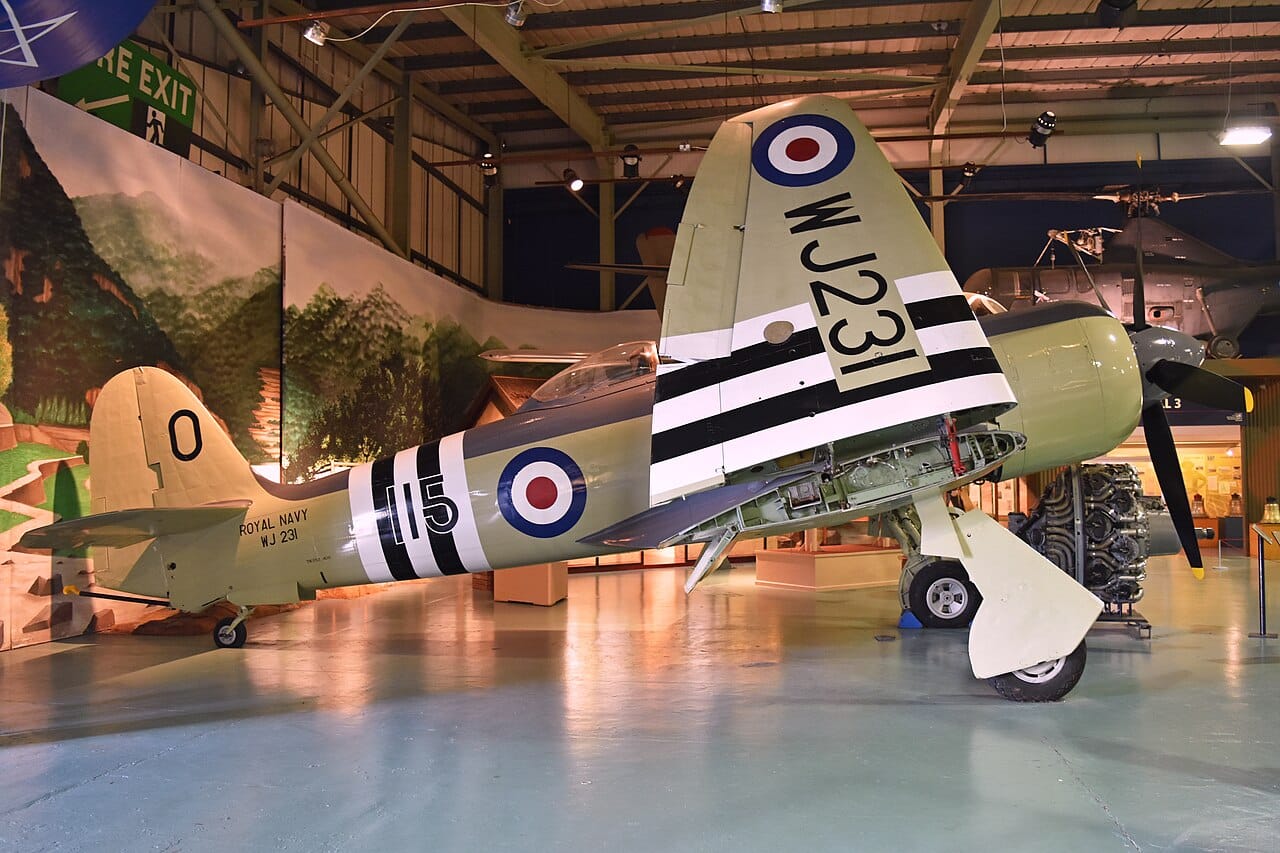
By 1952 the jet age had well and truly arrived. Swept-wing MiGs and Sabres were tearing across the skies of Korea at close to the speed of sound, and the propeller-driven fighter looked like a museum piece. Nobody told the Hawker Sea Fury.
On a August morning over North Korea, a flight of these big British radial-engined fighters was jumped by eight MiG-15 jets. What happened next became one of the most improbable air-combat stories of the twentieth century: a piston fighter, a generation out of date on paper, shot a jet out of the sky.
Informations clés
- Aéronef: Hawker Sea Fury, designed by Sydney Camm, developed from the Hawker Tempest
- Distinction: the last piston-engine fighter to serve with the Royal Navy
- Moteur: Bristol Centaurus 18 sleeve-valve radial, about 2,480 hp; top speed roughly 460 mph
- Service: entered Royal Navy service in 1947; 864 built; exported to Australia, Canada, the Netherlands, Cuba and more
- Famous kill: 9 August 1952, a Sea Fury of 802 NAS is credited with downing a MiG-15 over Korea
- Second act: today, tuned Sea Furys are among the fastest piston racers alive
A Fighter That Arrived Too Late for Its War
The Sea Fury was born from a wartime requirement, a lightened and refined descendant of the mighty Hawker Tempest. The RAF ordered it, then cancelled as the Second World War ended. The Royal Navy, needing a modern carrier fighter, took it up instead — and got a superb one: fast, beautifully balanced, and hauled along by the enormous Bristol Centaurus radial swinging a five-blade propeller.
It was, by any measure, one of the finest piston-engine fighters ever built — and one of the last. Even as it entered service in 1947, the jet was rendering its whole class obsolete. The Sea Fury should have been a footnote, a graceful full stop at the end of the propeller era. Korea gave it a far louder ending.
The Day a Propeller Beat a Jet
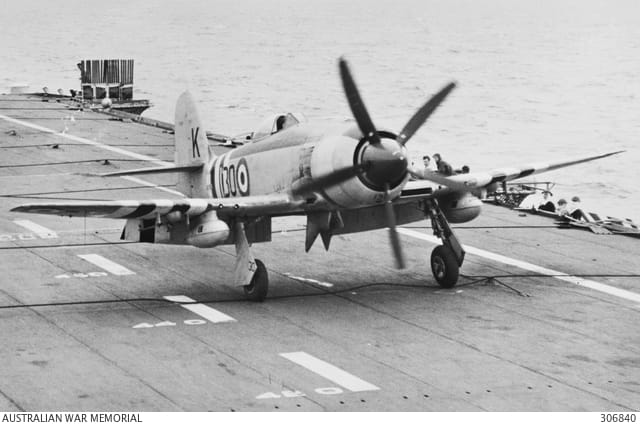
On 9 August 1952, four Sea Furys of 802 Naval Air Squadron, flying from the carrier HMS Ocean, were patrolling inland when eight MiG-15 jets bounced them out of the sun. The British pilots did the only sensible thing against a faster enemy: they turned hard into them, weaving in tight defensive scissors that a jet, for all its speed, simply could not follow.
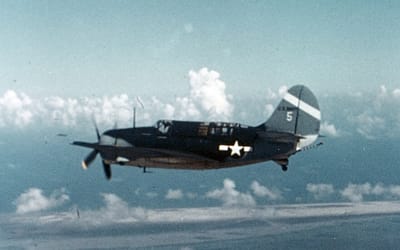
In the swirling fight, Lieutenant Peter “Hoagy” Carmichael got his guns on a MiG and fired. The jet went down. All four Sea Furys returned safely to Ocean. It was the only air-to-air kill credited to a British aircraft in the entire Korean War — and one of a mere handful of jets ever downed by a piston fighter. In fact, only two propeller types are credited with killing a MiG-15: the Sea Fury and the American Corsair.
Honesty compels a footnote. The victory was officially logged to Carmichael, but all four pilots were firing that day, and members of the flight — Brian “Schmoo” Ellis among them — have long argued over whose burst actually killed the MiG. What nobody disputes is the essential fact: a nimble old prop fighter tangled with jets and came home the winner.
The Long Afterlife
The Sea Fury left front-line British service in the 1950s, but it refused to fade. Cuban Sea Furys flew in anger during the 1961 Bay of Pigs invasion. And decades later the type found an unlikely second career on the American air-racing circuit, where heavily modified examples — some with even bigger engines bolted on — became some of the fastest piston-driven aircraft ever to round a pylon.
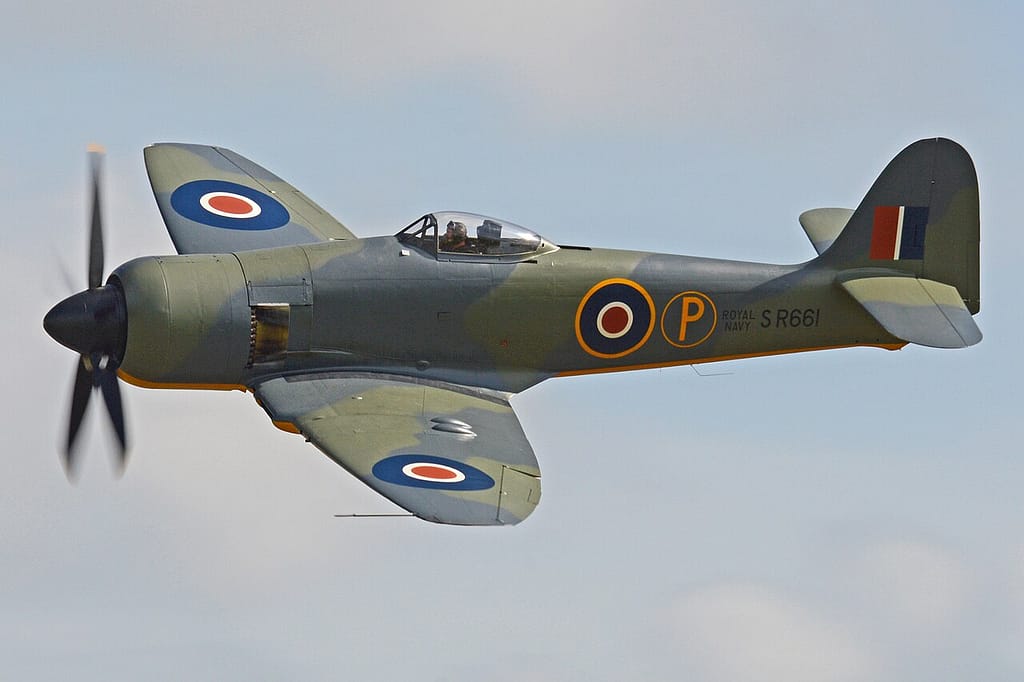
That is the strange magic of the Sea Fury. It was the end of a line, the last of the great naval propeller fighters, delivered just as history moved on without it. And yet it went out not with a whimper but with a MiG in its gunsight — proof that in the right hands, an old design with a big heart can still surprise the future.
Sources: Wikipedia; Royal Aeronautical Society; Britain’s Small Wars; Fleet Air Arm records.
0 commentaire