
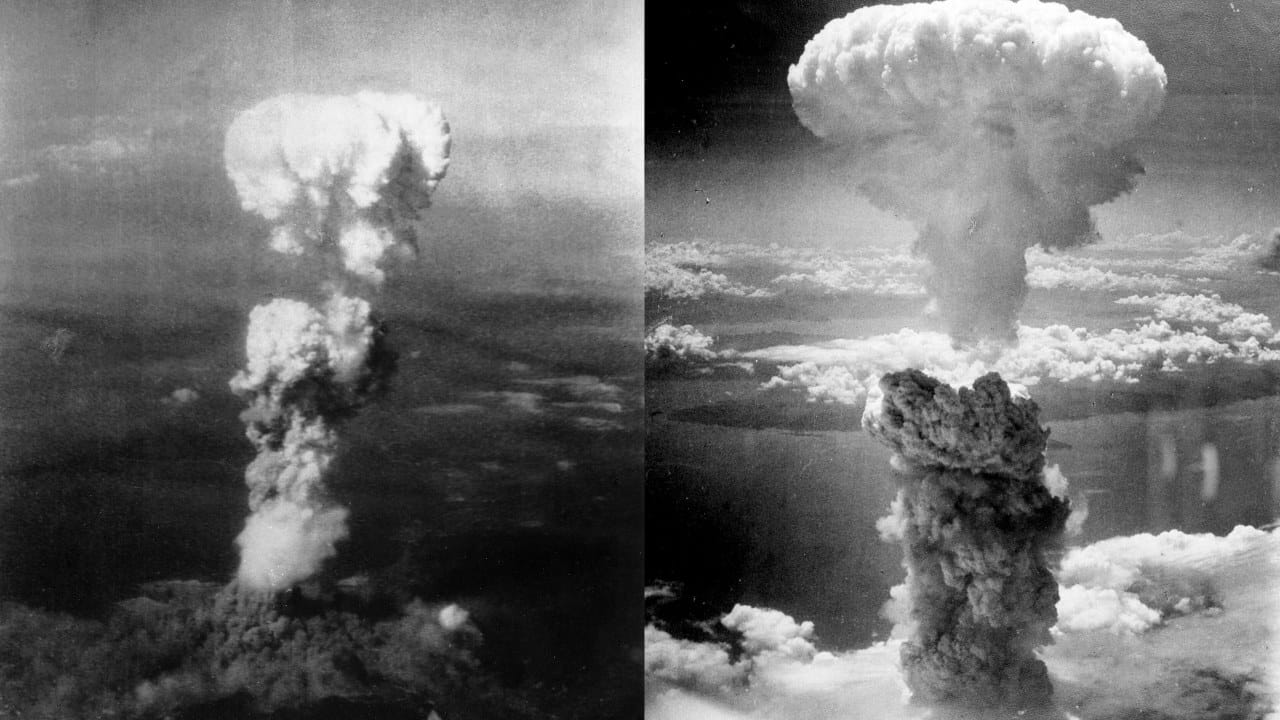
Part 9 of The Race for the Bomb, an Afterburner focus series. Everything in this series converges here: the physics of Part 1, the exiles of Part 2, the bomb of Part 5, the aircraft of Part 7, the fire doctrine of Part 8. Two missions, four days, one surrender.
Tinian, the Mariana Islands, around two o’clock in the morning of 6 August 1945. On a coral hardstand at North Field — four parallel 8,000-foot runways, in that summer the largest airfield on Earth — a stripped silver B-29 stands ringed by floodlights, cameras and something like a hundred photographers and officers. The name Enola Gay was painted under the pilot’s window only yesterday. Its commander, Colonel Paul Tibbets, is baffled by the crowd; he later wrote that it was full-scale Hollywood premiere treatment, and that he half expected to see MGM’s lion walk onto the field.
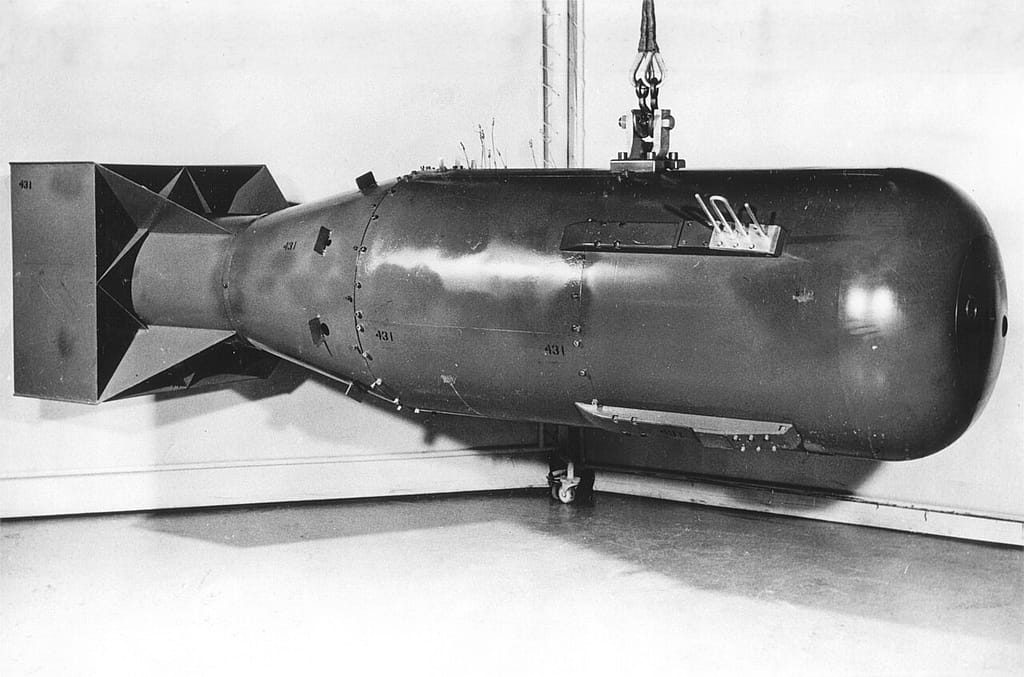
The floodlights have a reason. Inside the forward bomb bay hangs a four-and-a-half-ton object the crews call Little Boy, containing most of the uranium-235 that K-25 and the Calutron Girls of Part 5 spent two years separating, atom by atom. It is a gun-type bomb of a design that has never been tested. Nobody worried much about that; the physics was considered certain. What worried Navy Captain William Parsons, the weaponeer, was arithmetic of a different kind: four B-29s had crashed on takeoff from these runways in the past week, and a crash with this cargo could remove North Field, and every aircraft and man on it, from the map.
So Parsons made a decision that gives the mission its first white-knuckle scene: he would arm the bomb in flight, in the bomb bay, a procedure he had never performed. Asked by his general whether he had ever done it, he answered: no sir, I don’t know how — but I’ve got all afternoon to learn. He practised in the dark, cramped bay until his hands bled.
Quick Facts: The Atomic Missions
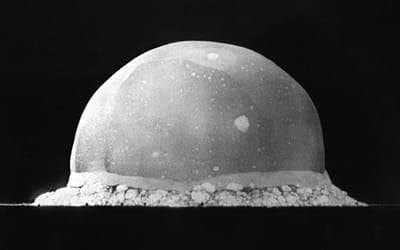
- 21 days — from the Trinity test to Hiroshima
- About 43 seconds — Little Boy’s fall from 31,060 feet to its burst point ~580 m over the city
- ~15 and ~21 kilotons — yields of Little Boy (untested gun design) and Fat Man (Trinity’s implosion design)
- Less than 1 kg of Little Boy’s 64 kg of uranium actually fissioned
- 3 bomb runs, about 50 minutes — Bockscar’s futile attempts over cloud-covered Kokura on 9 August
- Under 5 minutes of fuel — what remained after Bockscar’s emergency landing on Okinawa
- 90,000–166,000 and 60,000–80,000 — estimated dead in Hiroshima and Nagasaki by the end of 1945
The Outfit That Couldn’t Say What It Did
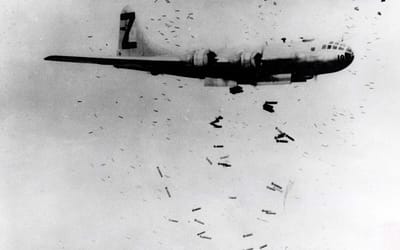
The 509th Composite Group had been built for exactly one job, and built strangely. Activated in December 1944 at Wendover, a salt-flats base on the Utah-Nevada line, it was handed to Paul Tibbets — chosen at 29, already the man who had led the first American heavy-bomber raid on occupied Europe and test-flown the B-29 through its worst teething. His unit flew the stripped Silverplate aircraft of Part 7 and practised a single manoeuvre obsessively: release one large bomb from 31,000 feet, then wrench the aircraft into a diving 155-plus-degree turn, calculated by the Los Alamos scientists as the only geometry that put enough miles between a B-29 and a nuclear shockwave. Through 1945 the group dropped huge orange practice bombs the crews called pumpkins — including 49 live ones on Japanese targets in late July, combat rehearsals flown to make lone high-flying B-29s an unremarkable sight over Japan.
Target selection, meanwhile, had produced history’s strangest reprieve. The committee’s first-choice city, untouched and militarily plausible, was Kyoto — until Secretary of War Henry Stimson, who had visited the ancient capital as a tourist in 1926 and understood what its destruction would mean, struck it from the list personally and held the line with Truman at Potsdam. The persistent legend that Kyoto was spared because Stimson honeymooned there is just that, a legend — he married in 1893 — but the sparing itself is documented fact. Hiroshima, an army headquarters city on a river delta, moved to the top of the list.
Six Hours to Hiroshima
Enola Gay lifted off at 2:45 a.m. with twelve men, Parsons arming his bomb in the bay as the Marianas fell behind. Over Iwo Jima the strike force formed: two escort B-29s with instruments and cameras, a weather aircraft an hour ahead. The weather plane’s report sealed the choice: Hiroshima clear. At 8:15:15 local time, from 31,060 feet, bombardier Thomas Ferebee released on the T-shaped Aioi Bridge; the aircraft leapt, suddenly five tons lighter, and Tibbets threw it into the practised turn. Little Boy fell for about 43 seconds and detonated some 580 metres above a clinic courtyard, 250 metres from the aiming point, with a yield around 15,000 tons of TNT. Of its 64 kilograms of uranium, less than one actually fissioned; a fraction of a gram of matter became energy, and a city of a quarter-million people ceased to function in a breath.
The only man aboard looking straight at it was the tail gunner, Bob Caron, whom Tibbets had told to describe everything over the intercom like a radio reporter. His words, and the two shockwaves that slapped the fleeing bomber, are the mission’s cockpit record.
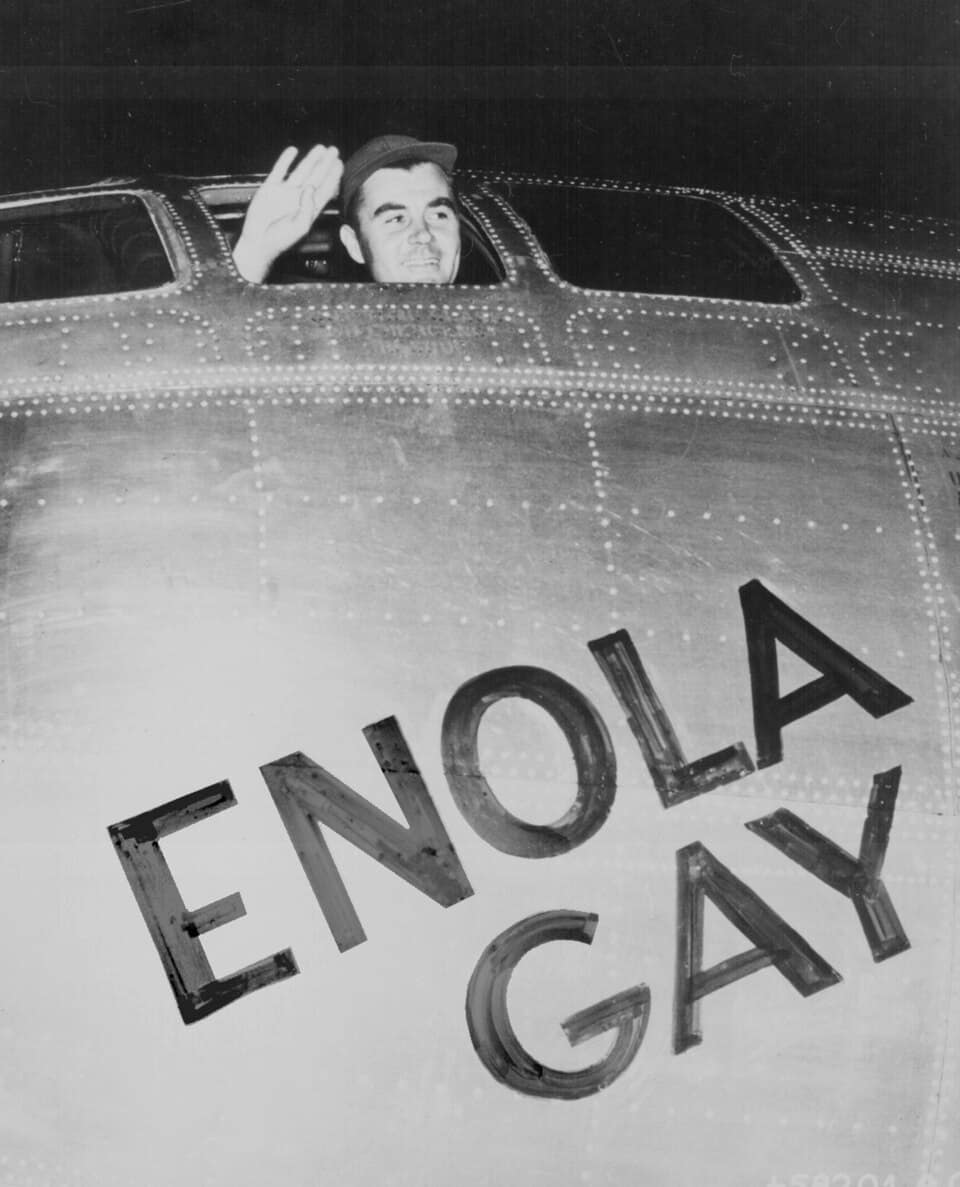
Co-pilot Robert Lewis kept a log for a newspaperman who had been bumped from the flight. What he wrote in it — my God, what have we done? — became the mission’s conscience in print; his crewmates always insisted that what he actually said aloud in the moment was considerably earthier. Both versions are true to the morning.
Below the Cloud
On the ground there was no mission narrative, only a white flash the survivors named pikadon — flash-boom. Around 70,000 to 80,000 people died at once or nearly so; by the end of 1945, deaths from burns and radiation brought the toll to somewhere between 90,000 and 166,000 — the ranges are wide because the records burned with the record offices. Ninety percent of the dead were civilians. At the Sumitomo Bank, 260 metres from the burst, the flash bleached the stone steps around a person sitting waiting for the doors to open, leaving the shadow that now sits behind glass in the Peace Memorial Museum. The gutted dome of the riverside industrial hall, almost directly beneath the burst, still stands where it stood.
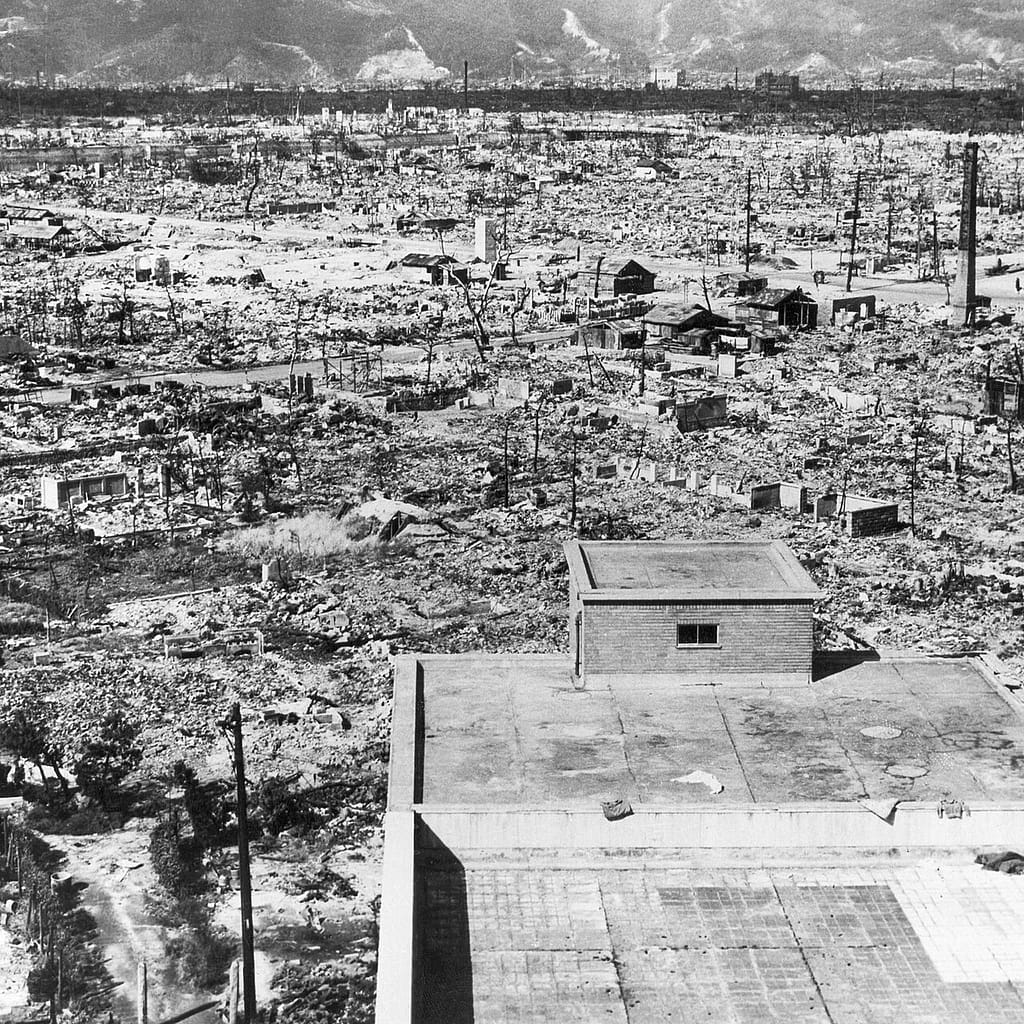
Dr. Michihiko Hachiya, director of a hospital 1,500 metres from the hypocentre, was wounded in the blast and began a diary that day that remains the indispensable ground-level account. A year later, John Hersey’s report Hiroshima, following six survivors, filled an entire issue of The New Yorker and has never been out of print. Sixteen hours after the strike, half a world away, came the first official word anyone in Japan or America heard of what the flash had been.
Period USAAF footage: the loading pits on Tinian, the Enola Gay, and the strike — the mission as the cameras recorded it.
Kokura’s Luck, Nagasaki’s Fate
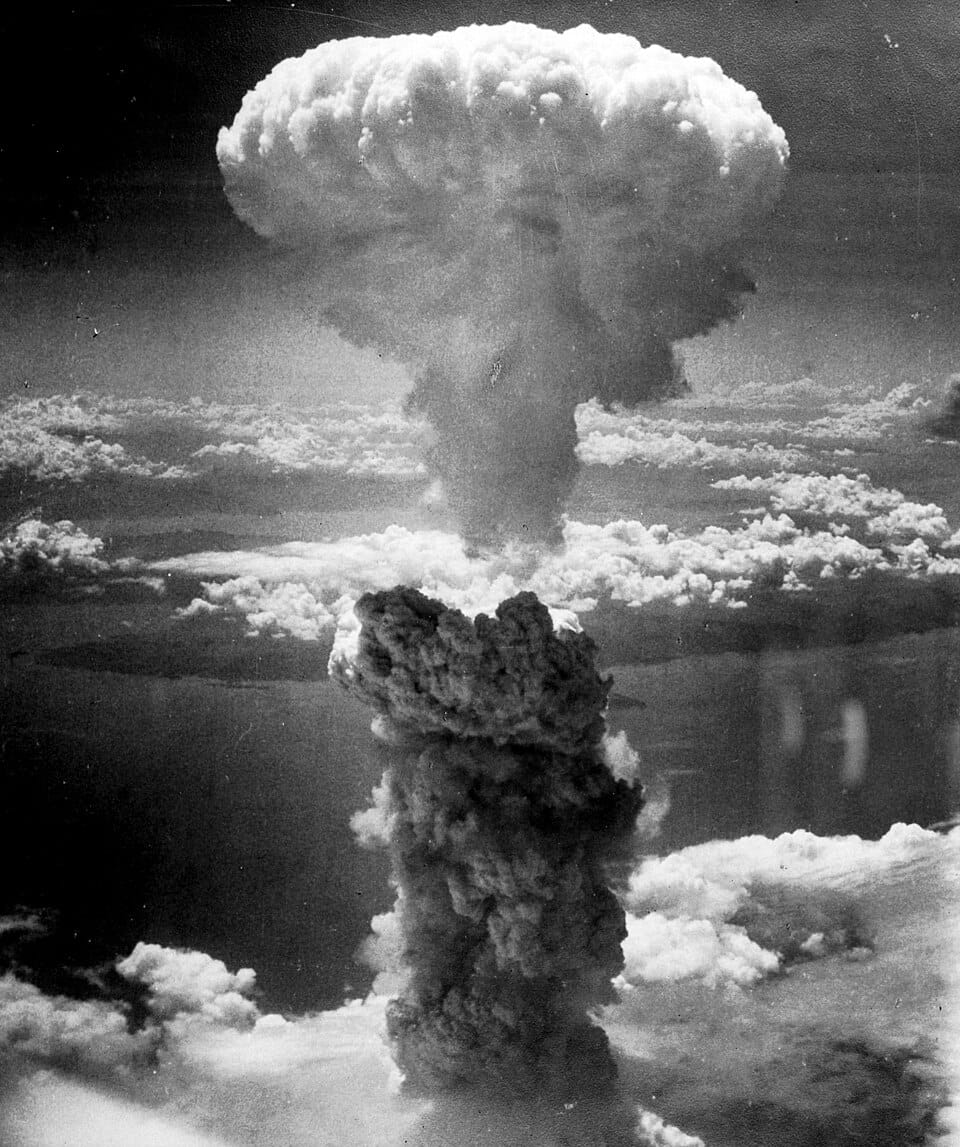
The second mission, three days later, was everything the first was not: a cascade of malfunctions flown on nerve. The aircraft, Bockscar, commanded by 25-year-old Major Charles Sweeney, carried Fat Man — the plutonium implosion design proven at Trinity. Before takeoff a fuel transfer pump failed, trapping 640 gallons in a reserve tank: usable weight, unusable fuel. Tibbets ruled: go anyway. A missed rendezvous burned 45 more minutes. And over the primary target — Kokura, home to a great arsenal — the crew found haze and smoke where the forecast had promised clarity. Three bomb runs over fifty minutes, flak blooming closer, fighters climbing; the weaponeer, Commander Frederick Ashworth, made the call, and Bockscar turned for the secondary. Japan still uses the phrase Kokura’s luck for escaping a doom you never saw.
Nagasaki lay under cloud too. With fuel now critical, bombardier Kermit Beahan found a twenty-second window through the overcast at 11:02 a.m. and released. Fat Man burst 500 metres over the Urakami valley, three kilometres off the intended aiming point; the ridgelines confined the 21-kiloton blast, and the valley — home to Mitsubishi works, and to the largest Christian community in Japan — was destroyed in Hiroshima’s image: roughly 40,000 dead at once, 60,000 to 80,000 by year’s end. Among those under the second cloud was a Mitsubishi engineer named Tsutomu Yamaguchi, who had been burned at Hiroshima on business three days earlier, had come home to Nagasaki, and was describing the first bomb to a sceptical boss when the room filled with the same white light. He lived to 93, the only officially recognised survivor of both.
Bockscar staggered toward Okinawa on fumes, radioing a tower that did not answer; Sweeney ordered every emergency flare in the aircraft fired at once and landed fast and heavy at Yontan, one engine dying of starvation on the rollout. The tanks held less than five minutes of fuel. No aircrew ever delivered a stranger cargo on a thinner margin.
The Voice of the Crane
Six days later, at noon on 15 August, Japanese radio played a recording no ordinary citizen had ever heard: the voice of the Emperor. Hirohito’s rescript never used the word surrender; it noted, in courtly understatement that has entered the language, that the war situation has developed not necessarily to Japan’s advantage, and that the enemy has begun to employ a new and most cruel bomb. Japan, he said, must endure the unendurable and suffer what is insufferable. The Second World War was over.
The argument about the bombs began at once and has never ended, and the honest version of it belongs in this article. Stimson made the classic defence in 1947: facing an invasion expected to cost over a million American casualties, the bomb was, in his words, the least abhorrent choice, and no man in his position could have failed to use it and afterwards looked his countrymen in the face. The counter-case is just as established: the US Strategic Bombing Survey concluded in 1946 that Japan would likely have surrendered before the end of 1945 without the bombs, without invasion; Eisenhower recalled — decades later, in a memory historians treat with caution — having voiced grave misgivings at Potsdam. Tibbets, asked all his life, never wavered: second thoughts? No. He asked that no headstone mark his grave, lest it become a site of protest, and his ashes were scattered over the English Channel. The debate is not this series’ to settle; the numbers, the names and the shadow on the bank steps are its record.
A Tale of Two Cities (1946): the War Department’s own film survey of Hiroshima and Nagasaki, weeks after the strikes.
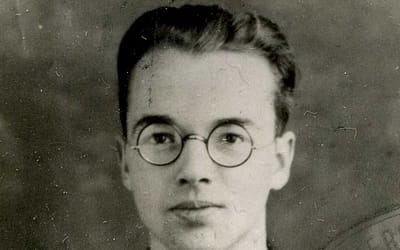
One thread of this story remains untold. At Trinity, at Los Alamos, inside the most guarded secret in human history, there had been a quiet man taking notes for someone else. Four years later a mushroom cloud rose over the Kazakh steppe, years ahead of every CIA estimate — and the explanation ran through a Harvard teenager, a chemist-courier with a street map of Santa Fe, and a British physicist who babysat for his colleagues’ children. The finale of this series: the spies, and the end of the monopoly.
The USSBS physical damage survey footage from Hiroshima, March-April 1946 — the ground truth, unnarrated.
Sources: Atomic Heritage Foundation bombing timeline, Truman Library, Manhattan Engineer District report (1946) via Yale Avalon Project, Radiation Effects Research Foundation estimates, Alex Wellerstein (Restricted Data), The New Yorker, Bulletin of the Atomic Scientists, Wikipedia, Richard Rhodes: The Making of the Atomic Bomb.
The Race for the Bomb — an Afterburner Focus Series
Series overview: all ten parts
Previous — Part 8: History’s Deadliest Air Raid Wasn’t Nuclear
Next — Part 10: The Spy Who Gave Stalin the Bomb
0 commentaire