
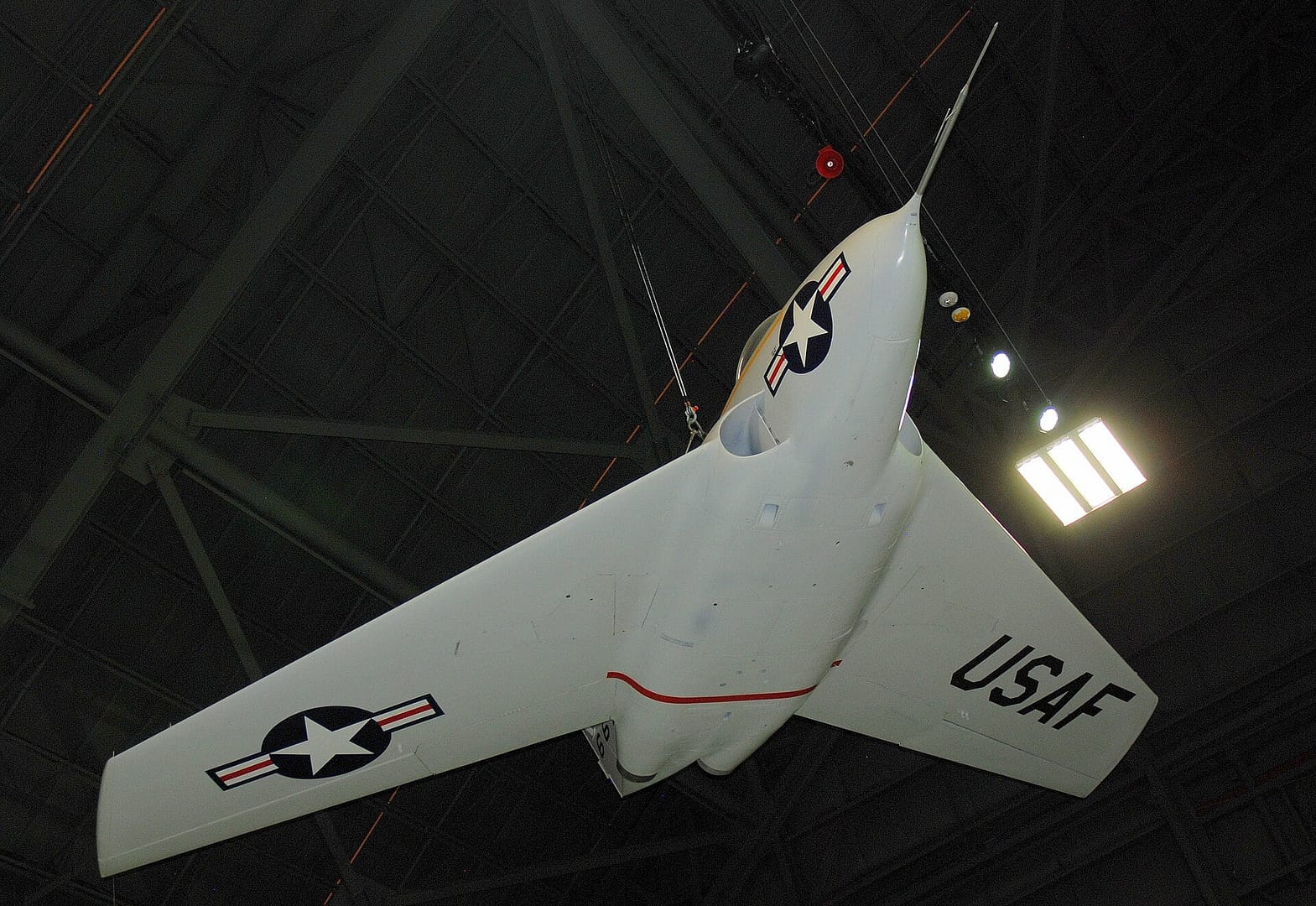
Sometimes the most valuable aircraft is the one that proves an idea wrong. The tiny Northrop X-4 Bantam is exactly that: a jet built to test a tempting theory about the sound barrier, which flew well enough to demonstrate, conclusively, that the theory was a dead end.
And that failure was worth every dollar — because knowing what doesn't work is how you eventually figure out what does.
Informations clés
- Taper: Semi-tailless transonic research aircraft
- Constructeur: Northrop (contract June 1946; two built)
- Premier vol : 15 December 1948, Rogers Dry Lake, California
- Pouvoir: Two small Westinghouse turbojets
- But: Test tailless stability up to about Mach 0.9
- À la retraite: Final NACA flight 29 September 1953
A tempting theory
In the late 1940s, engineers wrestling with the sound barrier had a hunch. The stability problems that appeared as aircraft neared Mach 1 seemed to come from shock waves interacting between the wing and the horizontal tail. So what if you simply removed the tail? A clean, tailless design might sail through the transonic zone where conventional aircraft shook themselves apart.
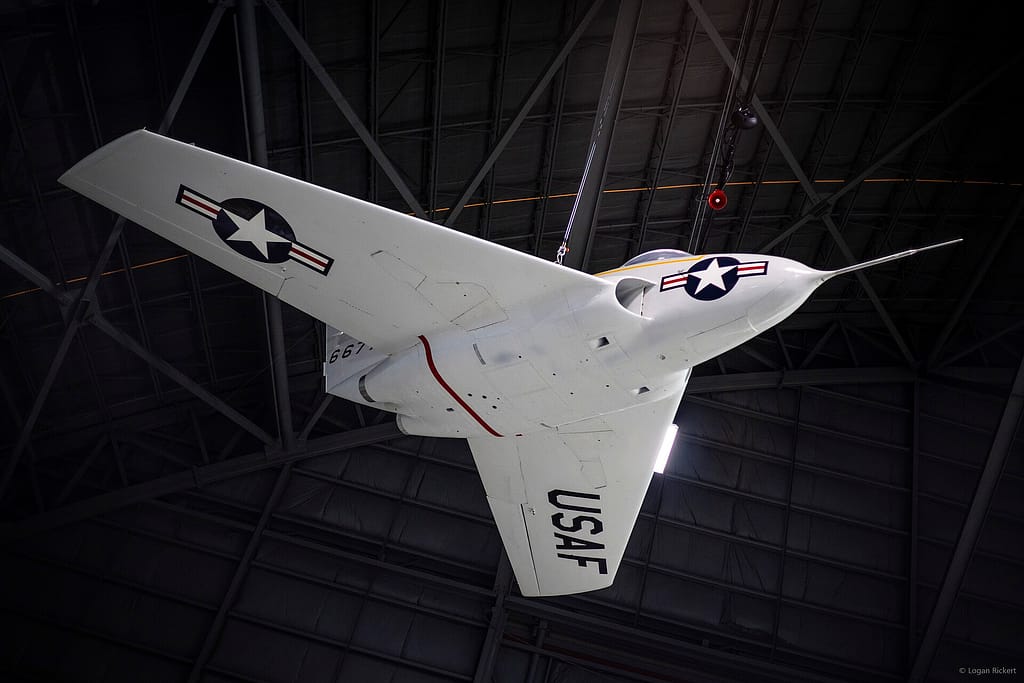
Northrop, already the world's great believer in tailless flight, built two little swept-wing jets to find out. The X-4 had no horizontal stabilizer at all — pitch and roll came from “elevons” on the wing, and the flaps doubled as speed brakes. It was compact, clean, and packed with instrumentation.
Period NACA footage of the X-4 Bantam in flight testing at Edwards.

The porpoise problem
The flying told the story. As the X-4 accelerated toward the speed of sound, it developed a persistent, uncontrollable pitching oscillation — a “porpoising” that made precise flight near Mach 1 impossible. Tested by NACA at what is now Edwards Air Force Base from 1950 to 1953, the little jet kept confirming the same unwelcome result. The tailless shortcut did not tame the transonic zone; it made things worse.
The final report was blunt, and the X-4 earned a reputation as one of the least successful X-planes ever flown. But “unsuccessful” is the wrong word for a research aircraft that answered its question completely.
The X-4 Bantam and the idea it was built to test.
The failure that paid off
The X-4 didn't kill the tailless idea forever — it just proved the technology of 1950 couldn't make it work. Decades later, with computer-driven fly-by-wire flight controls making thousands of tiny corrections a second, tailless flight became not just possible but ideal for stealth. The B-2 Spirit is the ultimate vindication of the concept the X-4 struggled with — achieved with electronics the Bantam's designers could only dream of.
That is the quiet genius of the X-plane program. The X-4 Bantam looked like a flop. It was actually a signpost, pointing engineers away from a dead end and, eventually, toward the future.
Sources: Wikipedia (Northrop X-4 Bantam); NASA; Vintage Aviation News; Flying Magazine.
Articles similaires

0 commentaire