
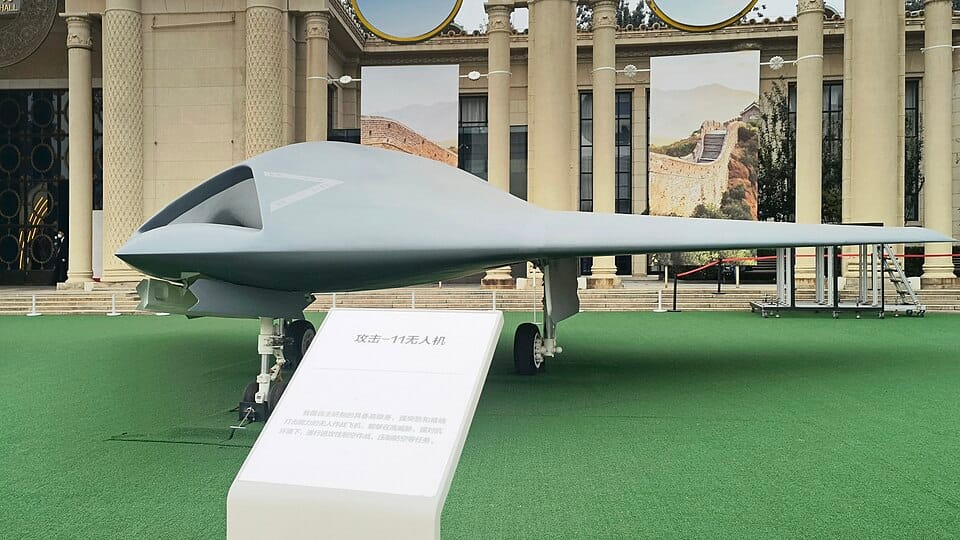
The People’s Liberation Army Navy is on the verge of doing something the U.S. Navy has been trying — and quietly failing — to do for fifteen years: operate a stealth, jet-powered, flying-wing combat drone from the deck of an amphibious assault ship.
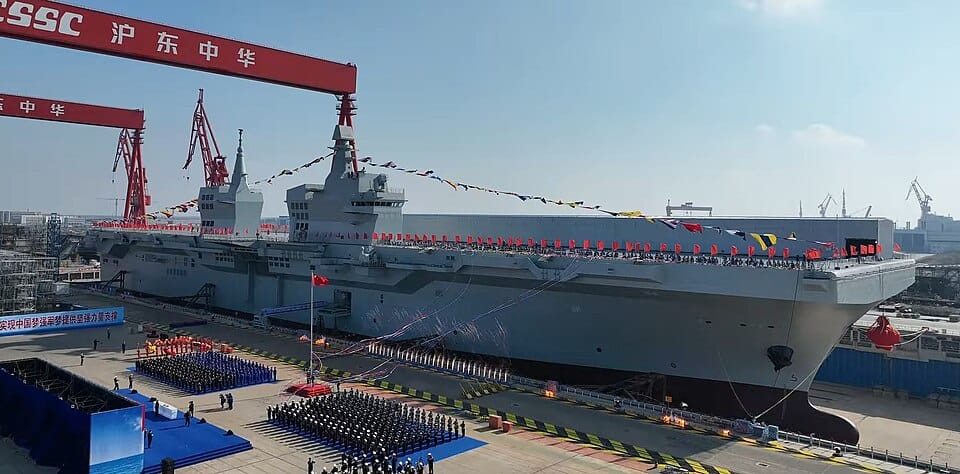
Fresh imagery has appeared online showing a previously-unseen variant of China’s stealth UCAV with its landing gear extended, an arrestor hook bolted on, and a launch bar at the nose. The aircraft is now widely identified as the GJ-21, a navalised derivative of the GJ-11 Sharp Sword, and the platform it is being readied for is the Type 076 Sichuan — China’s brand-new amphibious assault ship, which differs from every other LHD on the planet in one critical respect. It has a catapult.
An LHD with a catapult is, in practical terms, a small carrier. And a small carrier with a stealth UCAV embarked is a serious problem for anyone who thought China was a generation behind on naval aviation.
Quick Facts
Aircraft: Hongdu GJ-21 (carrier-capable stealth UCAV)
Lineage: Naval derivative of land-based GJ-11 Sharp Sword
Configuration: Tail-less flying wing, single jet engine
Carrier: Type 076 Sichuan amphibious assault ship
Launch system: Electromagnetic catapult (CATOBAR)
Mission: Strike, ISR, electronic attack, networked operations
From Sharp Sword to GJ-21
The story begins with the Hongdu GJ-11 Sharp Sword, which first flew in 2013 — making China only the second nation, after the United States, to put a tail-less stealth flying-wing combat drone in the air. Sharp Sword has been quietly maturing ever since. It made its first public appearance at China’s National Day parade in 2019, and it has since been seen in production numbers at the Hongdu Aviation Industry Group’s Nanchang plant.
The GJ-21 is what happens when you take Sharp Sword and ask the engineers a single question: can it fly off a ship? The answer, judging by the new photos, is yes. The wings have been beefed up to handle the impact of an arrested landing. A retractable arrestor hook now sits at the rear. A launch bar — the steel arm that locks into the catapult shuttle — has been added to the nose gear. The undercarriage itself is heavier and stiffer.
None of this is glamorous engineering. It is the unglamorous, expensive, slightly tedious work of turning a land-based aircraft into a carrier-capable one. The U.S. Navy spent the better part of two decades trying to do it with the X-47B, and gave up. China appears to be on the verge of finishing.
Why a catapult on an LHD changes everything
Every other amphibious assault ship in the world today — American, Japanese, Korean, Australian, Italian, Spanish — uses either a ski jump or a flat deck for vertical-takeoff jets. The implication is that the air group is small, light, and limited in payload and range.
The Type 076 throws that template out. By bolting an electromagnetic catapult onto an LHD, China gets a ship that can carry helicopters, landing craft, and tanks like a normal amphib — but can also launch a fixed-wing combat drone with a useful payload to a useful range. It is, depending how you look at it, the world’s smallest carrier or the world’s most aggressive LHD.
And the GJ-21 is the aircraft that makes it work. The drone has no pilot to risk, no ejection seat, no oxygen system, no life-support. That makes it well-suited to risky strike missions and to operations from small flight decks where a manned fighter would be a stretch. The Sichuan and the GJ-21 are designed for each other.
What it means for the U.S. Navy
For the U.S. Navy, the GJ-21 represents something uncomfortable. The Americans pioneered the carrier-based stealth UCAV with the X-47B, ran a successful flight test programme that included autonomous catapult launches and arrested recoveries, and then chose, for budgetary and doctrinal reasons, not to put it into production. The current MQ-25 Stingray that came out of that decision is a tanker — not a strike asset.
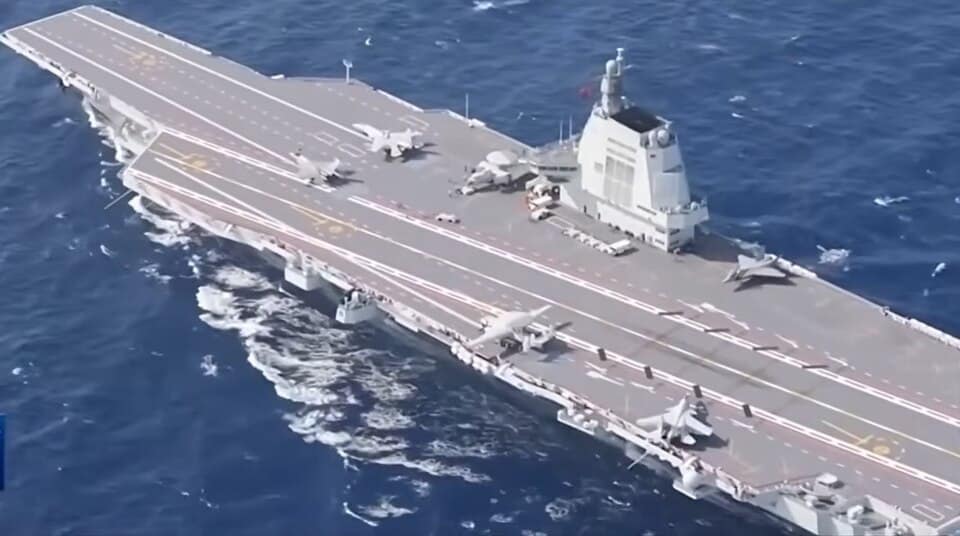
China, meanwhile, has built the strike UCAV that the U.S. Navy stepped back from, and is about to put it on a ship. If the imagery represents what it appears to represent, the Sichuan and the GJ-21 will go to sea before the U.S. Navy has a comparable capability afloat.
That is a long way from the China of fifteen years ago, when the country flew its first carrier-borne fighter on a borrowed Soviet ski-jump deck.
What we do not know
We do not know the exact dimensions of the GJ-21. We do not know its operational range, payload, or sensor fit. We do not know whether the Sichuan’s catapult has been tested with the aircraft. And we do not know how many GJ-21s the PLAN intends to build.
What we know is that the photos are real, the aircraft has the carrier conversion features, and the ship is real. China has rolled out, in plain sight, the most ambitious unmanned naval-aviation programme in the world.
Sources: The Aviationist, Naval News, open-source PLA Navy imagery.

 English
0 Comments