Guy Martin has spent his life chasing speed. The former Isle of Man TT racer, truck mechanic, and Channel 4 presenter has pushed the limits on two wheels at over 180 mph on public roads. But in 2024, he faced a challenge that made even the legendary Mountain Course look tame — learning to fly a classic military jet from scratch, then taking on the Swiss Alps in a 500 mph De Havilland Vampire.
His journey started at Gloucestershire Airport in a British BAC Jet Provost and ended in the thin air above Sion, Switzerland, in one of the most iconic jet fighters of the early Cold War. Both aircraft are operated by MiGFlug — and the whole thing was filmed for Channel 4’s documentary Guy Martin: Top Gun.
Quick Facts
Who: Guy Martin — motorcycle racer, mechanic, and TV presenter
What: Learned to fly military jets from scratch for Channel 4
Documentary:Guy Martin: Top Gun (Channel 4, August 2024)
From Spanners to Stick and Rudder
Guy Martin is not your typical TV presenter. Born in Kirmington, Lincolnshire in 1981, he grew up dismantling lawnmowers in his father’s workshop. His dad, Ian Martin, was a privateer motorcycle racer whose own career ended after a crash in 1988 — an event that paradoxically pushed young Guy toward the sport. He became an apprentice truck fitter, and to this day still works as a heavy vehicle mechanic at a Scania centre in Grimsby. Racing and television have always been side projects for a man whose first love is engines.
After retiring from motorcycle racing in 2017, Martin turned his relentless curiosity toward other machines. He has built a hovervan, raced a hydroplane, and attempted the world land speed record on a bicycle at over 112 mph. But the challenge that drew him in deepest was the one with the highest stakes: flying a classic fighter jet.
The BAC Jet Provost — Britain’s first purpose-built jet trainer. Guy Martin started his flying training in this very type at Gloucestershire Airport. Wikimedia Commons
Step One: The Jet Provost
Martin’s fighter jet education began at Gloucestershire Airport in the side-by-side cockpit of a BAC Jet Provost T.5A. The Jet Provost holds a special place in British aviation — it was the world’s first purpose-built jet trainer, designed specifically to teach new pilots the fundamentals of jet-powered flight. The Royal Air Force used it from the 1950s through to the early 1990s, and thousands of RAF pilots earned their wings in its forgiving cockpit.
The side-by-side seating arrangement is one of the Jet Provost’s defining features. Unlike tandem-seat trainers where the instructor sits behind the student, the Jet Provost places them shoulder to shoulder. For television, this was a gift — cameras captured Martin’s reactions in real time as his instructor walked him through aerobatics, stall recoveries, and the visceral physics of jet flight.
For a man who had spent decades making split-second decisions on a motorcycle at 180 mph, the transition to three-dimensional flight presented a fundamentally different challenge. On a bike, if something goes wrong, you slide along the tarmac. In a jet trainer at 4,000 feet, the margins are measured in altitude and airspeed — and mistakes compound in seconds.
Sir Frank Whittle: The Genius Behind the Jet
The documentary wove Martin’s flying training together with the story of Sir Frank Whittle, the maverick British engineer who invented the jet engine. Whittle patented his turbojet design in 1930, when he was just 23 years old. The Air Ministry dismissed it. The Royal Air Force ignored it. For nearly a decade, Whittle fought a lonely battle against institutional indifference, developing his engine largely on his own time and with private funding.
Sir Frank Whittle — the British engineer who invented the turbojet engine and changed aviation forever. His W.1 engine powered the first British jet aircraft in 1941. Imperial War Museum / Public Domain
True to form, Martin did not just read about Whittle’s invention — he built a working jet engine himself, in his shed, in a single day. It is the kind of hands-on, no-nonsense approach that has made Martin’s television work distinctive. He does not stand in front of CGI animations explaining thermodynamics. He gets his hands dirty, makes mistakes, and figures things out with a spanner and a cup of tea.
The Final Mission: Vampire Over the Swiss Alps
With his Jet Provost training complete, Martin faced the real test. He flew to Sion, Switzerland — home to a military airfield nestled in the Rhône Valley, flanked by Alpine peaks exceeding 4,000 metres — to fly the De Havilland Vampire.
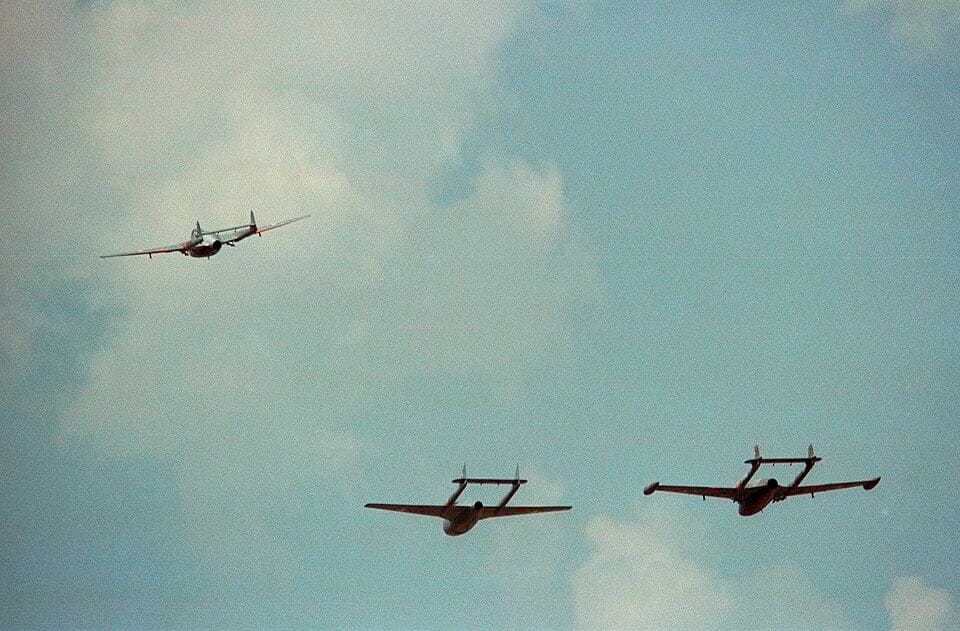
The Vampire is a different animal entirely. First flown in 1943 as only the second British jet aircraft (after the Gloster Meteor), it entered RAF service in 1945 and went on to serve with air forces across the world. The Swiss Air Force operated Vampires from 1946 until 1990 — a remarkable 44-year career that made it one of the longest-serving jet fighters in military history. With its distinctive twin-boom tail and stubby fuselage, the Vampire is instantly recognisable — and still capable of reaching 500 mph.
A De Havilland Vampire in Swiss Air Force markings, 1982. Switzerland operated Vampires for an astonishing 44 years — the same type Guy Martin flew through the Alps. Wikimedia Commons
Martin’s mission in the Vampire was no gentle sightseeing tour. He was tasked with low-level tactical flying through the Alpine valleys — the same kind of terrain-masking that Swiss military pilots practised during the Cold War. Flying at high speed between mountain walls, with peaks towering thousands of feet above and valley floors rushing past below, demanded exceptional concentration and precise flying. Every turn had to be anticipated, every altitude change calculated against the unforgiving granite walls on either side.
For a man who had threaded a motorcycle between stone walls on the Isle of Man at 180 mph, the Alpine valleys offered a strangely familiar kind of danger — but at three times the speed and in three dimensions.
Why MiGFlug?
Both the Jet Provost and the Vampire in the documentary are operated by MiGFlug, the Swiss-based company that has been offering civilian fighter jet flights since 2008. MiGFlug’s fleet spans everything from Cold War classics like the L-39 Albatros and MiG-29 Fulcrum to rare warbirds like the Vampire — giving aviation enthusiasts and thrill-seekers the chance to experience what military pilots train for years to master.
The fact that a Channel 4 documentary chose MiGFlug as its operator speaks to the company’s reputation for safety, professionalism, and access to extraordinary aircraft. Not many operators in the world can put a television presenter in the cockpit of a Vampire for low-level flying in the Alps and make it happen safely.
You do not need to be Guy Martin — or a Channel 4 film crew — to fly these jets. MiGFlug offers Jet Provost flights for anyone who wants to experience the same aircraft that started Guy’s journey, and the Vampire remains one of the most exclusive flying experiences in the MiGFlug fleet.
Watch the Videos
Two clips from the documentary are available on Guy Martin’s official YouTube channel. The first shows his Jet Provost flight training, and the second captures his aerobatic skills as he gets to grips with jet-powered flight:
Guy’s jet fighter flight training in the Jet Provost
Guy’s aerobatic jet fighter skillsSources: Guy Martin Official Website, Channel 4, Gloucestershire Airport
Before AWACS, air warfare was a knife fight in a dark room. Pilots relied on their own radar, ground controllers with limited visibility, and radio calls that were often confused, late, or wrong. After AWACS, one side had the lights on and the other did not. The...
On May 1, 1960, CIA pilot Francis Gary Powers took off from Peshawar, Pakistan in a Lockheed U-2 spy plane. His mission: fly across the entire Soviet Union at 70,000 feet, photographing military installations, and land in Bodø, Norway. He never made it. A Soviet S-75...
When the Sukhoi Su-47 Berkut rolled out in 1997, it looked like nothing else in the sky. Its wings swept forward instead of back — an aerodynamic concept that promised extraordinary agility, superior low-speed handling, and enhanced controllability at high angles of...



 English
0 Comments