

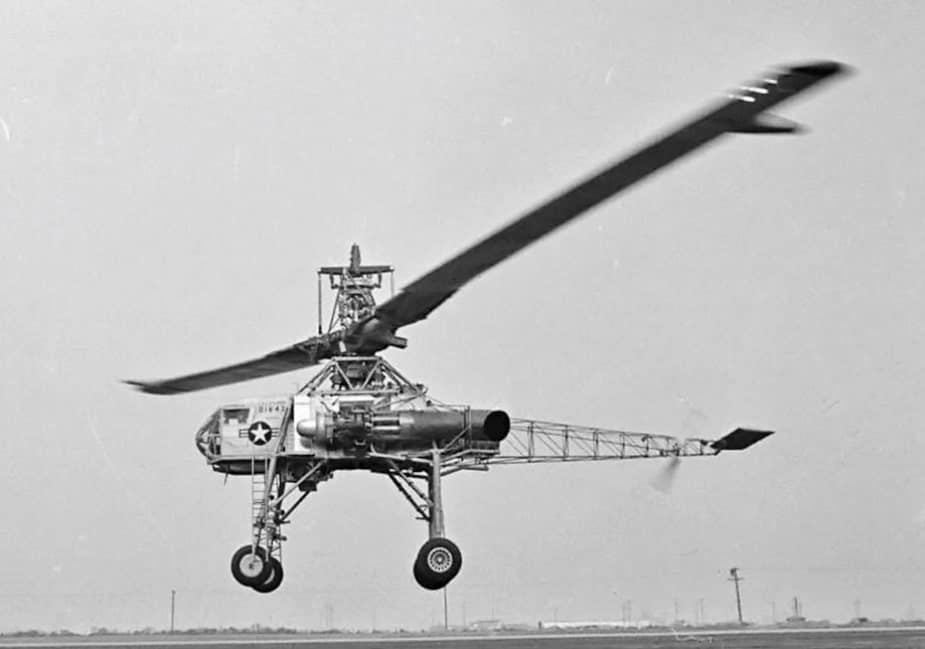
Look closely at the photograph: those are two full-size 1950s automobiles, parked comfortably underneath the helicopter. Above them sits a single rotor so vast that each of its two blades weighs as much as a small car and is wide enough to walk along. And it was spun not by gears, but by jets of fire burning at the very tips of the blades.
This was the Hughes XH-17 — one of the strangest flying machines ever built, and the holder of a record that still stands more than seventy years later.
Quick Facts
- Aircraft: Hughes XH-17 “Flying Crane” — an experimental heavy-lift research helicopter
- Rotor: two blades, 134 ft (41 m) across — still the largest rotor ever flown
- Drive: no main gearbox — two GE J35 turbojets fed compressed air up the hollow blades to burning tip-jets that spun the rotor
- First flight: October 23, 1952, at Culver City, California
- The catch: hugely inefficient — range about 40 miles. Only one was ever built
A Rotor You Could Almost Stand On
The XH-17’s two-blade rotor measured 134 feet from tip to tip — wider than the wingspan of many airliners — and no helicopter before or since has flown with a larger one. Each blade weighed around 5,000 pounds, was roughly six feet wide and a foot thick. The whole contraption grossed more than 50,000 pounds, and was famously cobbled together from the parts bin of post-war aviation, borrowing wheels, tanks and pieces from bombers and transports.
Driven by Fire at the Tips
The cleverest, maddest part was how it turned that enormous rotor. A conventional helicopter uses a heavy gearbox to drive the rotor from the hub, which creates torque that has to be cancelled by a tail rotor. The XH-17 did away with all that. Two General Electric J35 turbojets sat in the fuselage and pumped compressed air up through the hollow blades to the tips, where fuel was injected and ignited. The rotor was, in effect, dragged around by small jet engines at its own wingtips.
Because the drive force was applied at the tips rather than the hub, there was almost no torque to fight — so the giant needed only a tiny tail rotor. On paper, it was elegant.
Why It Never Caught On
In practice, tip-jets are spectacularly thirsty and almost unbelievably loud — the XH-17 could reportedly be heard from miles away. That inefficiency was fatal: the prototype could fly barely 40 miles before running dry. Combined with its cumbersome size, that doomed any hope of a production heavy-lifter. Just one XH-17 was ever built, and a planned larger follow-on, the XH-28, was cancelled.
And yet the idea behind it never died. The notion of a dedicated “sky crane” built purely to haul heavy, awkward loads lived on in later, more practical machines. The XH-17 was a glorious dead end — but it pointed the way.
Sources: Smithsonian Magazine; Simple Flying; Old Machine Press; Wikipedia.
Related Questions
What aircraft had the largest helicopter rotor ever built?
The Hughes XH-17 Flying Crane, an experimental American heavy-lift helicopter of the 1950s, had the largest rotor ever flown — a two-blade rotor 134 feet (41 m) across. No helicopter before or since has flown with a bigger rotor.
How big was the XH-17's rotor?
Its two-blade rotor spanned 134 feet (41 metres) — wider than the wingspan of many airliners. It remains the largest helicopter rotor ever to fly.
How did the Hughes XH-17 work?
Instead of a conventional gearbox, the XH-17 used tip-jets: two General Electric J35 turbojets fed compressed air up through the hollow rotor blades to burners at the blade tips, and the burning jets spun the giant rotor. This avoided the huge gearbox such a rotor would need.
Why was the XH-17 never produced?
It was hugely inefficient. The tip-jet drive guzzled fuel, giving a range of only about 40 miles, which made it useless for real heavy-lift work. Only one XH-17 was ever built, and it remained a research aircraft.
When did the XH-17 first fly?
The Hughes XH-17 made its first flight on 23 October 1952 at Culver City, California. It proved that a rotor of unprecedented size could fly, even if the design was too thirsty to be practical.

0 Comments