
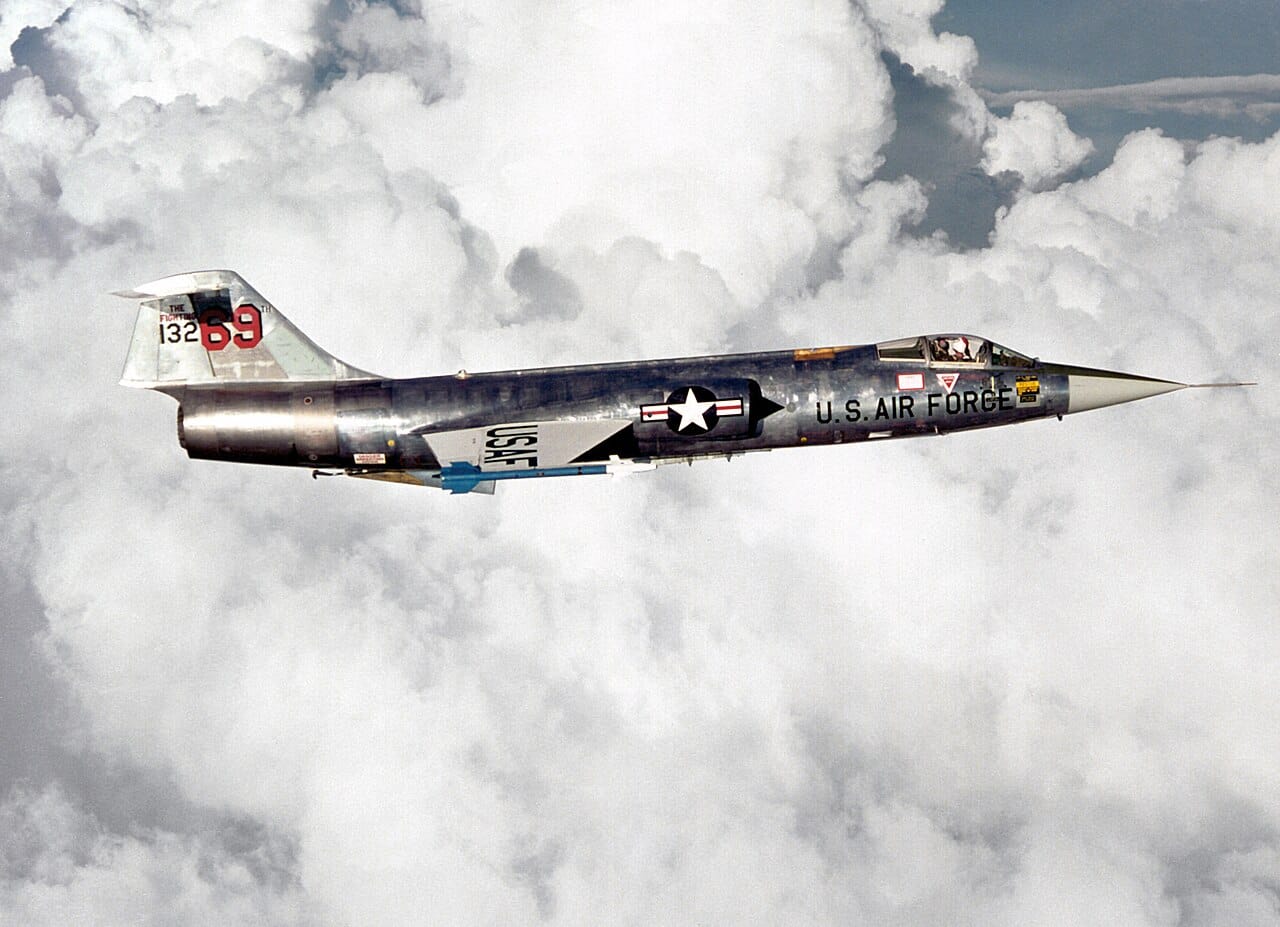
Kelly Johnson built the F-104 Starfighter to do one thing: climb fast, fly high, and kill Soviet bombers before they reached American cities. The Lockheed engineer surveyed Korean War fighter pilots in 1951 and concluded that what they wanted was not another heavy, complex machine but a small, fast, high-altitude interceptor — a "missile with a man in it." What emerged from his Skunk Works was exactly that: a needle-nosed, razor-winged aircraft with a General Electric J79 engine that could push it past Mach 2 and above 100,000 feet. In 1958, the F-104 held the world records for speed, altitude, and time-to-climb simultaneously — the first aircraft ever to do so.
Then Germany got hold of it, and the legend turned into a nightmare.
916 Bought, 292 Crashed, 116 Pilots Killed
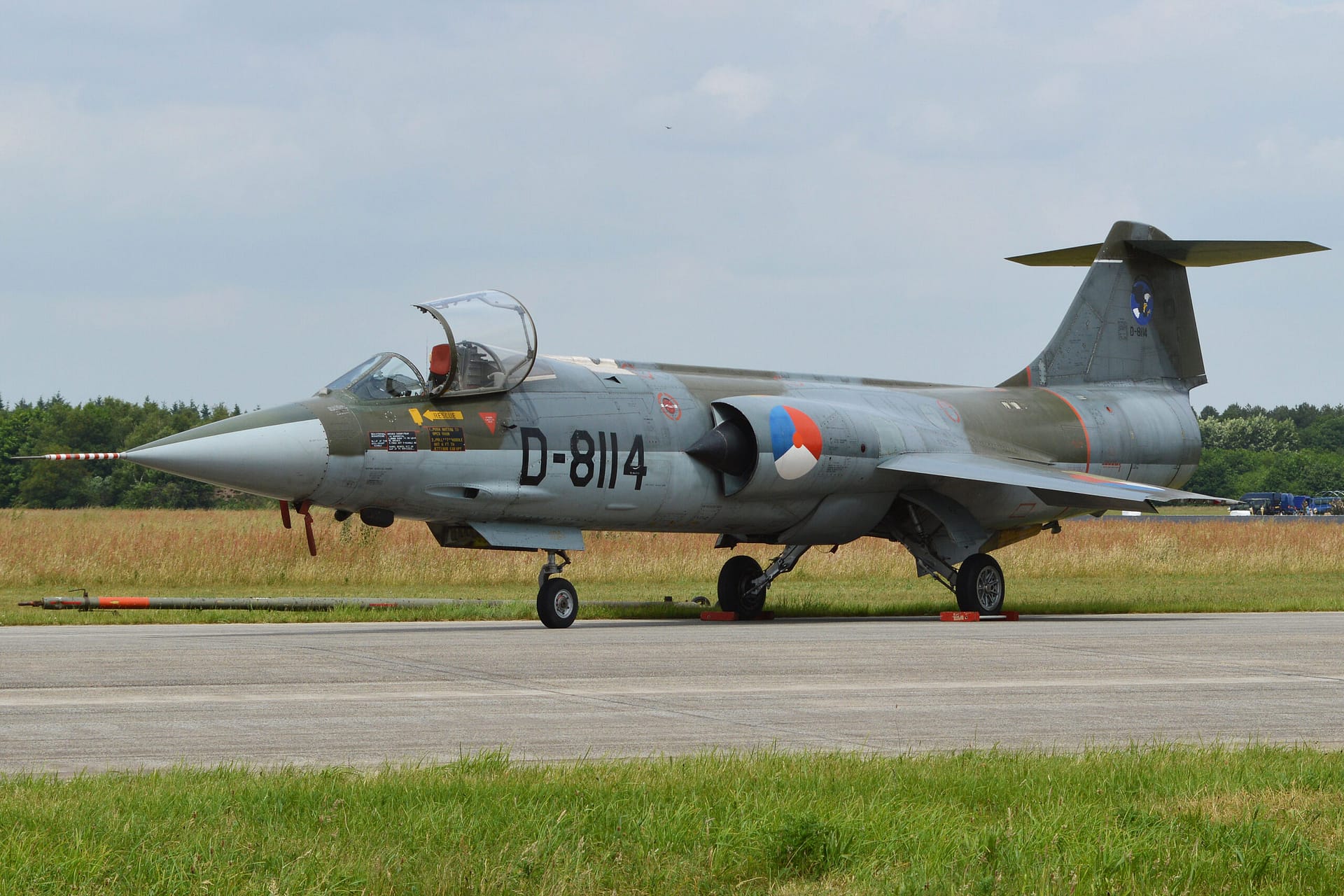
The Luftwaffe acquired 916 Starfighters from 1960 onwards — the largest F-104 fleet in the world. Within years, the aircraft had earned a nickname that stuck: Witwenmacher, the Widowmaker. By the time the last German Starfighter was retired in 1991, 292 had been destroyed in accidents and 116 pilots had been killed. That is a loss rate of nearly one in three — a figure unmatched by any comparable Western fighter programme.
The German public was horrified. Newspapers ran running tallies of crashes. The Starfighter crisis — the Starfighter-Krise — became a political scandal that brought down defence officials and fed a national debate about whether the Bundeswehr was fit for purpose. But the question that still divides aviation historians is a simple one: was the F-104 a bad aircraft, or did Germany simply use it wrong?
The Wrong Jet for the Wrong Job
The answer, overwhelmingly, is the latter. Kelly Johnson designed the F-104A as a clear-weather, high-altitude interceptor. Its tiny wings — just 21 feet 11 inches from tip to tip, with leading edges so sharp that ground crews fitted protective covers to prevent cuts — were optimised for supersonic flight at altitude. They generated minimal lift at low speeds and in thick air, making the aircraft unforgiving in the low-level regime and during landing approaches.
Germany did not use the Starfighter as a high-altitude interceptor. The Luftwaffe assigned the F-104G to every role imaginable: low-level nuclear strike, conventional ground attack, tactical reconnaissance, all-weather interception, and close air support. The "G" model was loaded with additional avionics, a heavier airframe, and extra hardpoints for bombs and external stores that Johnson's original design had never anticipated. The aircraft was heavier, draggier, and asked to fly in exactly the conditions — low altitude, bad weather, heavy turbulence — where its razor-thin wings and marginal low-speed handling made it most dangerous.
On top of the role change, Germany introduced extensive modifications to the airframe, avionics, and weapons systems. The Luftwaffe's F-104G carried a NASARR radar, an inertial navigation system, and additional equipment that increased weight and complexity. Many of these modifications were developed specifically for the German fleet and introduced failure modes that other operators never encountered. German maintenance and training procedures were also adapted for the multi-role mission, further stretching an airframe that had been designed with narrow margins.
Other Nations, Fewer Crashes
The contrast with other F-104 operators is striking. The United States Air Force, which used the F-104 in its originally intended role as a short-range, high-altitude interceptor, experienced a far lower loss rate. The USAF retired the type early — not because it crashed too often, but because the mission evolved — and its accident record, while not spotless, was broadly in line with other Century Series fighters.
Italy operated the F-104 longer than any other nation, flying the Aeritalia F-104S — a dedicated interceptor variant — until 2004. While Italy's overall loss numbers were not negligible, the country used the aircraft primarily in its designed role: high-altitude air defence over relatively benign Mediterranean weather. Italian Starfighter pilots did not routinely fly at 200 feet in Central European fog and rain, and the accident rate per flying hour reflected that difference.
Spain is perhaps the most telling case. The Spanish Air Force operated the F-104G exclusively as a good-weather interceptor for seven years and recorded zero losses. Not a single aircraft crashed. The same machine that killed 116 German pilots went through an entire national service life without a scratch — because Spain used it the way Kelly Johnson intended.
The Starfighter That Never Crashes
Today, more than six decades after the Starfighter first flew, the F-104 is still airborne — and it has not lost its edge. MiGFlug operates F-104 Starfighter flights at Cape Canaveral, Florida, offering licensed pilots the chance to fly the legendary interceptor from the 15,000-foot runway originally built for the Space Shuttle. The programme is a three-day course: ground school, safety and ejection-seat training, and then a supersonic flight in dedicated restricted airspace over the Atlantic.
The MiGFlug Starfighter programme has a perfect safety record. Across more than twenty years of operations and over 10,000 flights of all types, MiGFlug has never had an incident of any kind. The F-104 at Cape Canaveral flies the way Johnson designed it to fly — at altitude, in clear Florida skies, with experienced pilots at the controls. No low-level strike missions in freezing fog. No heavy bomb loads on an airframe that was never meant to carry them. No modifications that pushed the engineering envelope beyond its limits. Just a supersonic interceptor doing what a supersonic interceptor was built to do.
The Starfighter programme is available exclusively to licensed pilots (private pilot licence minimum). It is not a passenger ride — it is genuine flight training on a Mach 2 military jet, and it remains one of the most extraordinary aviation experiences available anywhere in the world. The Widowmaker, it turns out, was never the problem. The problem was asking it to be something it was not.
0 Commenti