
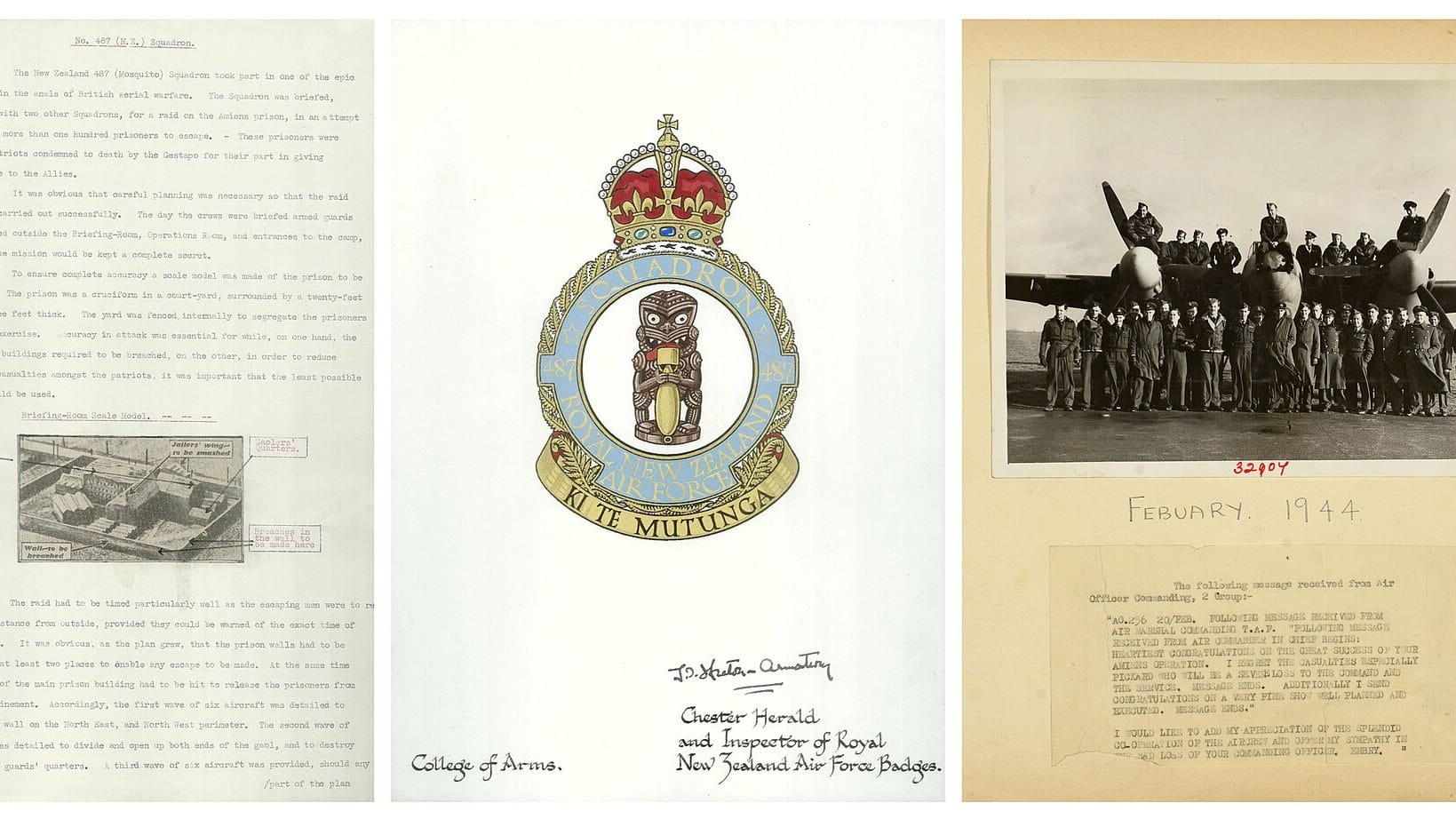
At noon on 18 February 1944, the guards of Amiens prison sat down to lunch, as they did every day. Outside, snow lay deep across Picardy and the sky was a low grey ceiling. Inside the cruciform building, behind a three-and-a-half-metre perimeter wall, were hundreds of prisoners of the German occupation — among them men and women of the French Resistance, some reportedly facing the firing squad the very next morning.
Alle dodici e un minuto, il muro esplose.
The bombs had come in at fifty feet, slung beneath de Havilland Mosquitoes that had crossed the Channel below the radar and followed a poplar-lined road straight to the gates. Operation Jericho remains one of the most audacious precision strikes ever flown — a raid mounted not to destroy, but to set people free. It cost the RAF one of its most beloved airmen, and to this day, nobody can say for certain who asked for it.
Informazioni rapide: Operazione Gerico
| Data | 18 febbraio 1944, inizio dell'attacco alle ore 12:01. |
| Forza | 18 Mosquito FB.VIs of 140 Wing — 487 Sqn RNZAF, 464 Sqn RAAF, 21 Sqn RAF — with Typhoon escort |
| Bersaglio | Amiens prison, occupied France — walls breached with 500 lb bombs on 11-second delay fuses |
| Guidato da | Group Captain Percy “Pick” Pickard, DSO and two bars, DFC |
| Prigionieri | ~832 held; roughly 250–260 escaped, around 100 killed (figures vary by source) |
| perdite della RAF | Due Mosquito e due Typhoon; Pickard e il navigatore Bill Broadley tra le vittime |
| Mistero | Le ricerche del dopoguerra non sono mai riuscite a stabilire chi avesse effettivamente richiesto il raid. |
A Prison Full of the Résistance
By early 1944, the Gestapo was winning its quiet war in Picardy. Arrests had gutted the resistance networks of the Somme, and Amiens prison held the result: an internal count on 18 February listed 832 prisoners, with the German-controlled section holding well over a hundred “politicals” — captured résistants, couriers and suspected Allied agents.
According to accounts assembled after the war, more than two dozen prisoners were due to be shot on 19 February by order of the Amiens tribunal. Among recent arrivals was Raymond Vivant, the sous-préfet of Abbeville and a resistance figure who, some historians argue, knew dangerously much about Allied invasion preparations.
A ground assault had been considered and abandoned — the Germans had reinforced the prison with extra troops and a permanently manned machine-gun post. If the doors were to be opened, it would have to be done from the air, with a precision that in 1944 bordered on fantasy: knock down a wall without flattening the people behind it.
Diciotto zanzare in una bufera di neve
The job went to 140 Wing of the RAF’s 2nd Tactical Air Force: six Mosquitoes each from No. 487 Squadron RNZAF, No. 464 Squadron RAAF and No. 21 Squadron RAF — New Zealanders, Australians and British flying the fastest wooden aeroplane in the world. Leading them was Group Captain Percy Charles Pickard, 28 years old, six foot three, three times decorated with the DSO, famous to the British public as the pilot of “F for Freddie” in the film Obiettivo per stasera.
The crews learned their target only at the 8 a.m. briefing on the day, in a camp sealed off for security, with a plaster model of the prison on the table. The plan was surgical: 487 Squadron would open the outer walls, 464 Squadron would strike the ends of the main building where the guards ate their lunch, and 21 Squadron would wait in reserve — with the grim task of bombing the prison flat if the raid failed, on the logic that the prisoners preferred death to what the Gestapo offered.
The weather that morning was atrocious — snow squalls, low cloud, a rendezvous with the Typhoon escort that largely failed. Four Mosquitoes lost the formation in the murk and turned back. Pilot Officer Maxwell Sparks of 487 Squadron remembered climbing out through “that grey soupy mist and snow and rain beating against the Perspex window” — and then, two miles off the French coast, the sky suddenly turning beautifully clear.
Quattordici bombardieri proseguirono la loro corsa attraverso la Piccardia a bassa quota, così tanto che i piloti viravano per evitare che le punte delle ali si impigliassero nei pioppi.
Mezzogiorno oltre le mura
The run-in followed the long, straight Albert–Amiens road, white with snow. One 487 Squadron pilot recalled it vividly: “The poplars suddenly petered out, and there, a mile ahead, was the gaol. It looked just like the model, and within a few seconds we were almost on top of it.”
At 12:01 the first bombs — 500-pounders fuzed with an eleven-second delay so the low-flying attackers could escape their own blast — went into the eastern and northern walls. Minutes later, 464 Squadron’s Mosquitoes came through the smoke at fifty feet and put their bombs into the wall again and into the main building, where a direct hit on the guards’ quarters killed or stunned many of the men who would have manned the machine guns.
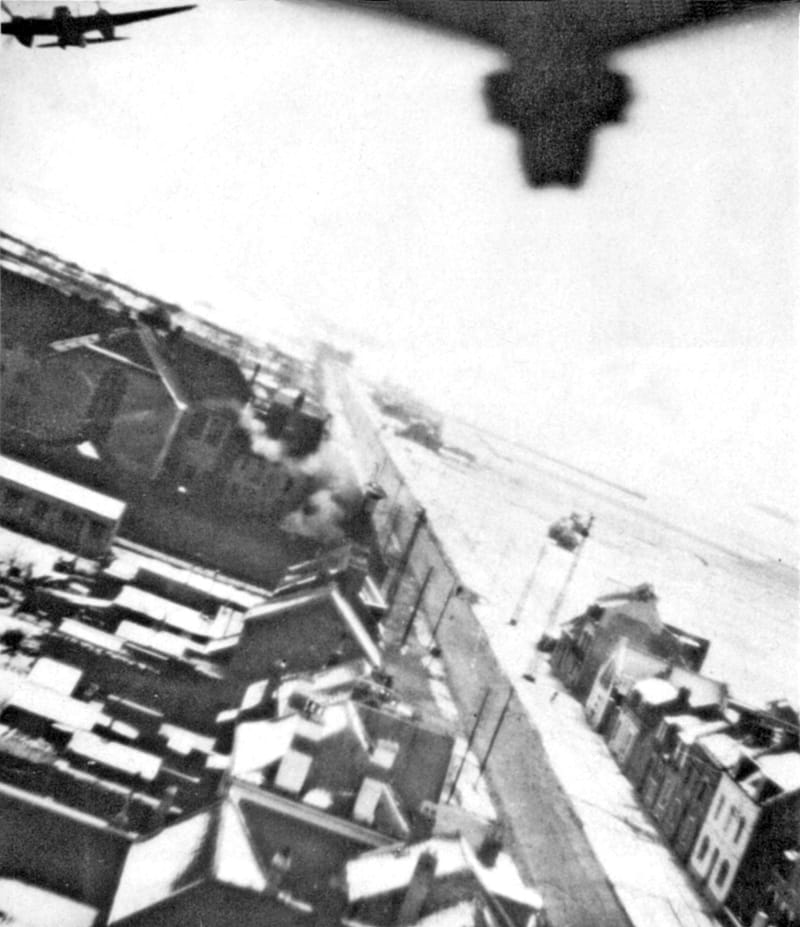
Above the smoke, Pickard circled at 500 feet in “F-Freddie”, watching for the one thing that mattered: figures streaming through the breaches. When he saw prisoners running, he called off 21 Squadron’s reserve force — the signal, in the dry humour of the wing, was “Red, Daddy, Red”.
A photo-reconnaissance Mosquito of the RAF Film Production Unit made three runs over the burning prison, its camera turning. The footage — snow, smoke, tiny running figures — would appear in newsreels within months, and remains some of the most extraordinary film of the air war.
Il prezzo
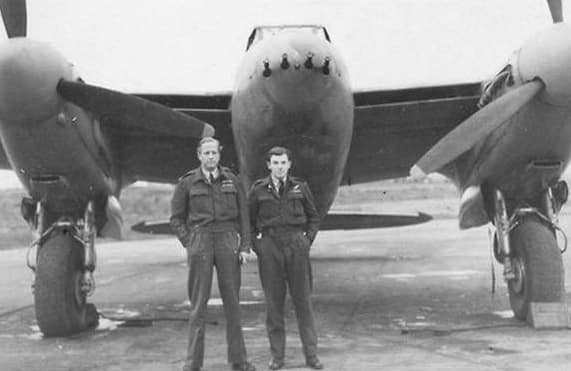
Pickard lingered too long. As he circled to confirm the escape, a Focke-Wulf Fw 190 of JG 26 flown by Feldwebel Wilhelm Mayer caught the lone Mosquito and shot its tail off. The aircraft went in near Saint-Gratien, a few kilometres north of Amiens. Pickard and his navigator, Flight Lieutenant John Alan “Bill” Broadley — his inseparable crewmate through more than a hundred operations together — were killed instantly. They are buried side by side in Amiens.
Flak claimed a second Mosquito, whose pilot, Squadron Leader Ian McRitchie, survived badly wounded as a prisoner while his navigator, Flight Lieutenant Richard Sampson, died. Two escorting Typhoons were also lost. The RAF had bought the breach in the walls with four airmen’s lives and two more taken prisoner.
Attraverso le macerie
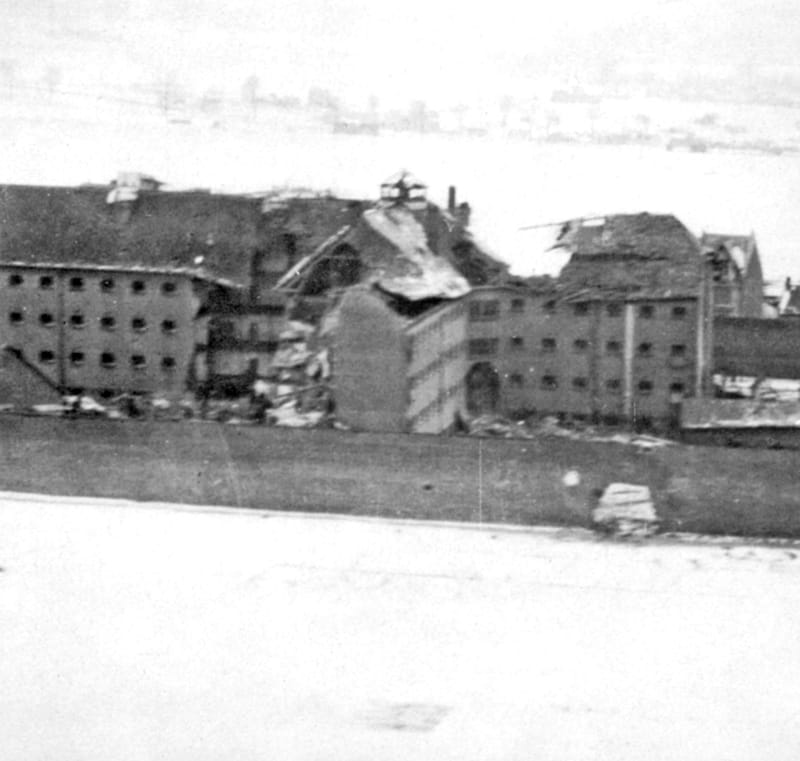
Inside the prison, the blast had done exactly what the planners had promised the model could not guarantee: the first bombs blew in the walls and sprang the cell doors. Prisoners poured out through the breaches into the snow, and the people of Amiens — farmers, housewives, passers-by with bicycles — hid them, dressed them, moved them along.
The numbers have never fully agreed with each other. Later research settled on roughly 255 to 258 escapees of the 832 inside; about two-thirds were recaptured in the days that followed. Around 100 prisoners died in the bombing and the machine-gun fire that followed — the resistance’s own contemporary signal spoke of 37 killed, later studies of as many as 102, alongside some 50 German dead.
For the réseaux of the Somme, the raid was oxygen. Escaped résistants went on to expose more than sixty Gestapo agents and informers in the region. Ordinary prisoners who evaded recapture were, in a very French arrangement, quietly left alone by the local police.
Eppure, i conti restano difficili da accettare: un raid aereo organizzato per salvare i condannati a morte uccise circa un centinaio delle persone che intendeva salvare. Nessuno sentì quel peso più degli equipaggi stessi, ai quali era stato detto che i prigionieri avrebbero preferito morire sotto le bombe della RAF piuttosto che contro un muro della Gestapo.
Chi l'ha chiesto?
For decades the raid was told as a simple story: the Resistance begged London to break open the prison, and the RAF answered. The reality is stranger. A post-war RAF investigation found that resistance leaders in the region apparently knew nothing of the raid until the RAF itself asked for a description of the prison. Maurice Buckmaster, head of SOE’s French section, denied ever requesting it — and said he did not know who had.
Files around the operation remained closed for decades, and historians have offered competing readings: a genuine rescue sought through intelligence channels — possibly connected to the captured sous-préfet Vivant and what he knew — or, as a 2011 BBC documentary speculated, a deception designed to draw German attention toward the Pas-de-Calais in the run-up to D-Day. None of these theories has been proven. What is certain is what the crews were told, and what they did.
At Amiens today a plaque on the prison honours the dead of 18 February 1944 — the prisoners and the airmen together. Pickard and Broadley lie a short drive away. The walls they broke were rebuilt long ago; the argument about why they fell has never quite ended, and perhaps that is fitting for an operation named after a miracle.
Sources: Wikipedia; Imperial War Museums; The People’s Mosquito; Warfare History Network
Domande correlate
Cos'era l'Operazione Gerico?
L'Operazione Jericho fu un raid di bombardamento di precisione a bassa quota condotto dalla RAF il 18 febbraio 1944 contro la prigione di Amiens, nella Francia occupata. I bombardieri Mosquito aprirono delle brecce nelle mura della prigione per consentire ai prigionieri della Resistenza di fuggire. Circa 250-260 prigionieri riuscirono a scappare, mentre un centinaio rimasero uccisi. Rimane uno degli attacchi di precisione più audaci mai effettuati.
Perché la RAF bombardò la prigione di Amiens?
La RAF bombardò la prigione di Amiens per liberare i membri della Resistenza francese detenuti lì dall'occupazione tedesca, alcuni dei quali, a quanto pare, erano in attesa di esecuzione. Sfondando le mura perimetrali con bombe a tempo preciso, gli attentatori miravano a far fuggire i prigionieri nelle campagne circostanti. Curiosamente, le ricerche del dopoguerra non hanno mai stabilito chi avesse effettivamente richiesto il raid.
Quali aerei furono impiegati nell'Operazione Jericho?
L'operazione Jericho fu condotta da 18 cacciabombardieri de Havilland Mosquito FB.VI del 140° Stormo, provenienti dal 487° Squadrone RNZAF, dal 464° Squadrone RAAF e dal 21° Squadrone RAF, con un combattente scorta dei Typhoon. La velocità e la precisione a bassa quota del Mosquito in legno lo rendevano ideale per infiltrarsi tra le mura della prigione e i detenuti.
Quanti prigionieri sono evasi dal carcere di Amiens?
Il 18 febbraio 1944, il carcere di Amiens ospitava circa 832 prigionieri. Dopo l'irruzione, tra 250 e 260 riuscirono a evadere, mentre un centinaio furono uccisi durante l'attacco, sebbene le cifre varino a seconda delle fonti. Molti evasi furono rapidamente ricatturati, ma l'operazione rappresentò comunque un duro colpo per il morale della Resistenza nella Francia occupata.
Chi ha guidato il raid nella prigione di Amiens?
Il raid fu guidato dal Group Captain Percy "Pick" Pickard, uno degli aviatori più rispettati della RAF, insignito della DSO con due barrette e della DFC. Lui e il suo navigatore, Bill Broadley, persero entrambi la vita durante l'operazione. La RAF perse due Mosquito e due Typhoon di scorta, proprio come in precedenza aerei d'attacco della RAF perdite.
L'irruzione nella prigione di Amiens è stata un successo?
L'incursione fu un successo parziale. Permise di sfondare le mura e di consentire a diverse centinaia di prigionieri di tentare la fuga, con 250-260 che riuscirono a scappare, ma causò anche la morte di circa 100 persone e del suo celebre comandante. Gli storici dibattono ancora oggi sul suo valore, in parte perché nessuno sa chi la ordinò.

0 Commenti