
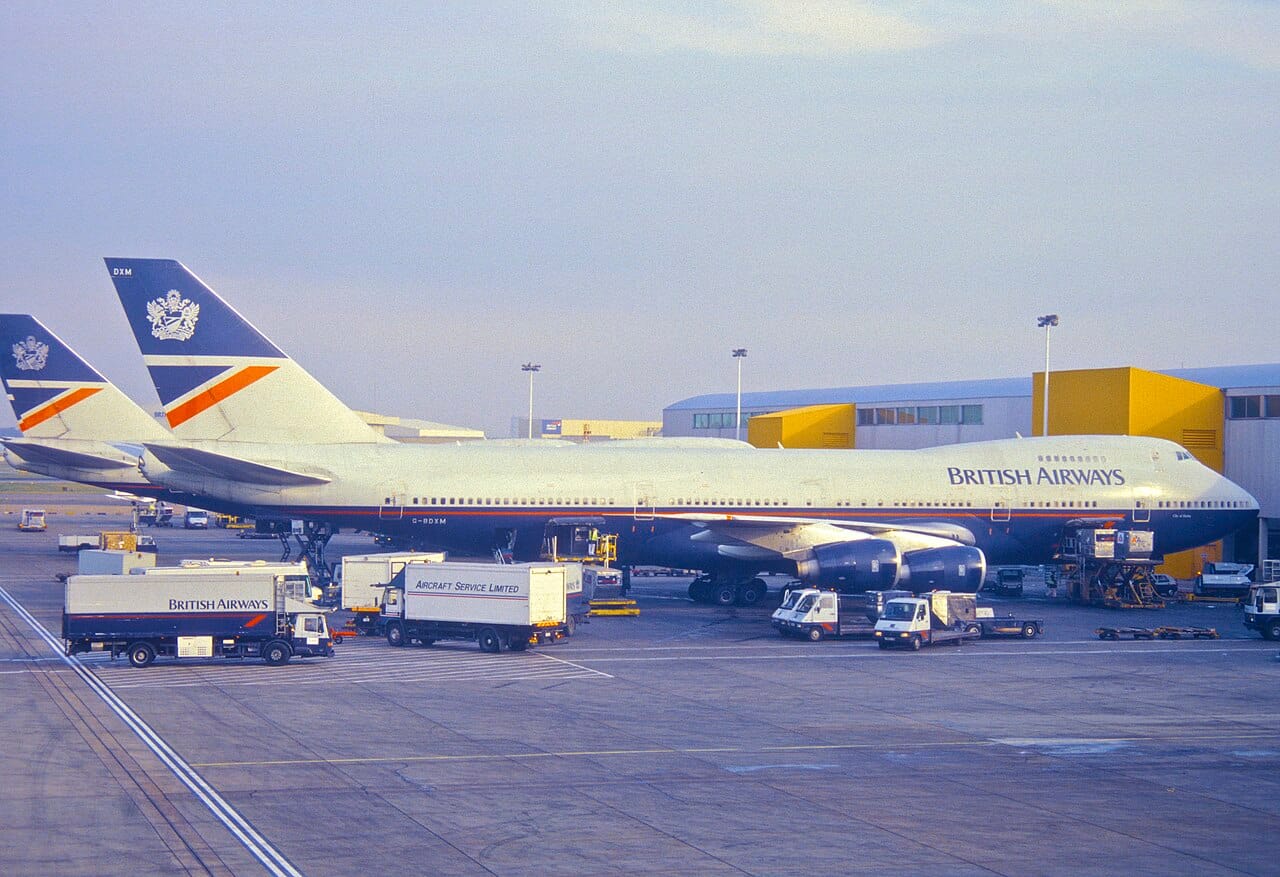
It was a calm, clear night over the Indian Ocean on 24 June 1982 when the passengers of British Airways Flight 9 noticed something strange: a glow along the wings, and puffs of smoke curling into the cabin that smelled of sulphur. Up front, the crew watched St Elmo’s fire dance across the windscreen. Then, one by one, all four engines of their Boeing 747 stopped.
What followed became one of the greatest feats of airmanship in aviation history — a fully-laden jumbo jet, 263 souls aboard, gliding silently through the dark with no power at all, and a captain whose calm announcement has never been bettered.
INFORMAZIONI RAPIDE
| Volo | British Airways Flight 9 (“Speedbird 9”) |
| Data | 24 June 1982 |
| Aeromobili | Boeing 747-236B, G-BDXH “City of Edinburgh” |
| Aboard | 263 passengers and crew |
| Causa | Volcanic ash from Mount Galunggung, Indonesia |
| The glide | From 37,000 ft down to 12,000 ft with no engines |
| Risultato | All aboard survived; landed at Jakarta |
The invisible cloud
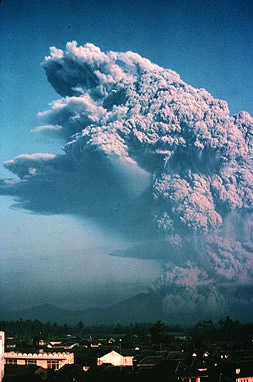
The 747 was cruising at 37,000 feet on the leg from Kuala Lumpur to Perth. What the crew could not see — because dry volcanic ash does not show up on weather radar — was that Mount Galunggung had erupted below and to the south, filling the night sky with a vast, abrasive cloud of pulverised rock. The 747 flew straight into it.
The ash sandblasted the aircraft, glowed in the engines, and choked them of the airflow they needed. Engine four surged and failed first. Then two and three. Then one. At 37,000 feet, the largest airliner in the world had become the largest glider in the world.
In the cabin, Captain Eric Moody reached for the public-address system and delivered a message that has become legendary for its very British understatement.
The story of the Galunggung glider.
Sixteen minutes of silence
With no engines, the 747 could glide roughly 15 kilometres for every kilometre of height it lost. That gave the crew a cruelly simple problem: restart the engines before they ran out of altitude, or ditch in the ocean at night. They ran the relight drills again and again as the jet sank through the dark.
The reason it worked was the same reason it had failed. In the engines, the ash had melted into glass and coated the interior. As the powerless engines cooled during the long glide, that glass cracked and flaked away — and once the aircraft descended below the ash cloud, the engines could breathe again. One by one, they roared back to life.

Landing blind
The ordeal was not over. The ash had frosted the windscreen almost opaque, and one engine began vibrating so badly it had to be shut down again. Moody brought the 747 into Jakarta on three engines, peering at the runway through a narrow strip of clearer glass at the edge of the windscreen. Every one of the 263 people aboard walked away.
The incident changed aviation. Volcanic ash, once a barely-understood hazard, became a monitored global threat, with a network of Volcanic Ash Advisory Centres now tracking eruptions in real time so no airliner ever flies blindly into a cloud like Galunggung again. And Eric Moody’s announcement remains the gold standard for grace under pressure — proof that in a crisis, the calmest voice in the aeroplane is often the most reassuring sound in the world.
Documentary: the night Flight 9 lost all four engines.
Inside the crew’s fight to restart the engines.
Sources: official accident reporting; Flight Safety Australia; Simple Flying; interviews with Captain Eric Moody.
0 Commenti