

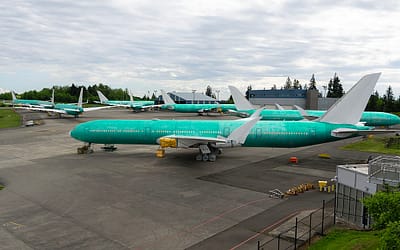
Last week the Royal Air Force's second E-7 Wedgetail flew out of Birmingham looking like somebody had forgotten to finish it. No roundels, no squadron markings, no grey. Just an unlovely metallic green from nose to tail.
Almost every aircraft you have ever seen went through that stage. Very few people ever photograph it, because by the time an aeroplane is interesting enough to point a camera at, somebody has painted it.
The green is not a placeholder. It is doing a job, and the reason it gets flown rather than covered up first turns out to be a decent lesson in how aircraft manufacturing actually works.
Informazioni rapide
What the green is: chromate-based anti-corrosion primer
Why green: zinc chromate primer is yellow. Adding lampblack turns it green and improves UV resistance
What it protects against: moisture, oils and oxidation attacking bare aluminium
Typical paint weight: around 200 to 400 lb on a normal airliner
Boeing 777: roughly 555 lb of paint dry, and over 1,000 lb while still wet
Airbus A380: about 950 gallons of paint, adding roughly 2,425 lb
Time to paint an airliner: up to two weeks depending on size and livery complexity
Layers: primer, base coat, top coat, applied by high-volume low-pressure spray
Aluminium wants to corrode
Bare aluminium alloy is not stable. Exposed to moisture, oil and air it oxidises, and in an aircraft structure that is not a cosmetic problem. Corrosion in a lap joint or around a fastener is how fatigue cracks start.
So the moment metalwork is finished, the structure gets sealed. The traditional answer was zinc chromate primer, which is bright yellow on its own and turns green when lampblack is added. The lampblack was not decoration either: it improved resistance to ultraviolet light, which matters for a component that may sit in a yard for months.
There is an unpleasant footnote. Chromates are carcinogenic, and factory workers exposed to them developed lung disease. The industry moved to trivalent chromium and phosphate-based formulations that are considerably less dangerous and, inconveniently, somewhat less durable. That trade, worker safety against coating life, is one the whole industry made and does not much advertise.

Why fly before painting
Here is the part that surprises people: on new-build airliners, the aircraft usually flies before it is painted at all.
The logic is sequencing. A paint job takes up to two weeks in a specialised, environmentally controlled booth, and paint booths are among the most capacity-constrained facilities in the entire production system. Boeing has run discrete-event simulations specifically to model paint facility throughput, because when a new variant requires parts to loop through painting and curing twice, the paint shop becomes the constraint on the whole delivery schedule.
If you paint first and then discover a problem on the first flight that requires opening the structure, you have destroyed two weeks of the scarcest resource you own. So you fly the aircraft in primer, confirm it works, and only then commit it to the booth.
On a conversion programme like the Wedgetail the logic is even stronger. That airframe was taken apart, had a radar spine grafted onto it and was put back together. You would not paint that before finding out whether it flies properly.
Paint is a fuel cost
The second reason the industry thinks hard about paint is that paint is weight, and weight is fuel, forever.
A typical airliner carries somewhere between 200 and 400 pounds of it. A Boeing 777 carries around 555 pounds once dry, and over half a ton while still wet, which is a genuine handling consideration in the booth. An A380 takes roughly 950 gallons of paint, adding about 2,425 pounds.
That weight flies on every sector for the life of the aircraft. Which is why an airline will spend real engineering effort to shave a few kilograms off a coating.
The numbers behind that are worth seeing, because they explain why anyone bothers. The reformulated livery saves 27 kilograms per aircraft. That is not much. But applied across the fleet by 2030, easyJet expects it to cut fuel burn by 1,296 tonnes a year, equivalent to around 4,095 tonnes of carbon dioxide.
Twenty-seven kilograms, multiplied by a fleet and by every flight those aircraft will ever make.

The military calculation is different
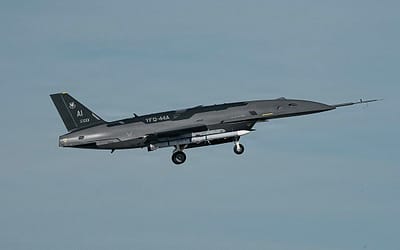
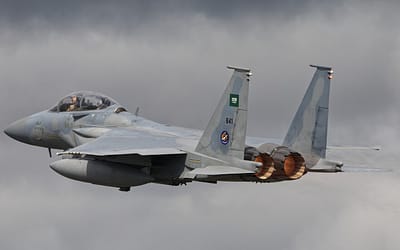
Military aircraft add a requirement civil operators do not have: the paint has to do something tactically.
Grey air-superiority schemes are chosen to reduce visual detection against sky. Low-visibility markings, the washed-out roundels and near-invisible serials on modern fighters, exist because a high-contrast marking is something for an enemy pilot's eye to lock onto. And on stealth aircraft the coating is not paint in any ordinary sense but part of the radar-absorbent structure, which is why it is expensive, fragile and maintained under conditions closer to a laboratory than a hangar.
So what you are actually looking at
When you see an aeroplane in green primer, you are looking at a machine that has been judged airworthy but not yet finished. It is the aviation equivalent of a building with the scaffolding still up: complete enough to work, not yet complete enough to photograph for the brochure.
Enthusiasts rather like it, which is why the RAF released the pictures. There is something appealing about seeing an aircraft as its engineers see it, before the marketing department and the paint shop get involved.
Then it goes into a booth for two weeks, comes out grey, and gains a couple of hundred kilograms it will carry for the next thirty years.
Sources: easyJet media centre, Mankiewicz Aviation Coatings, Boeing, Aviation Week, Simio case studies, Sherwin-Williams aerospace coatings, ADS Advance.
0 Commenti