
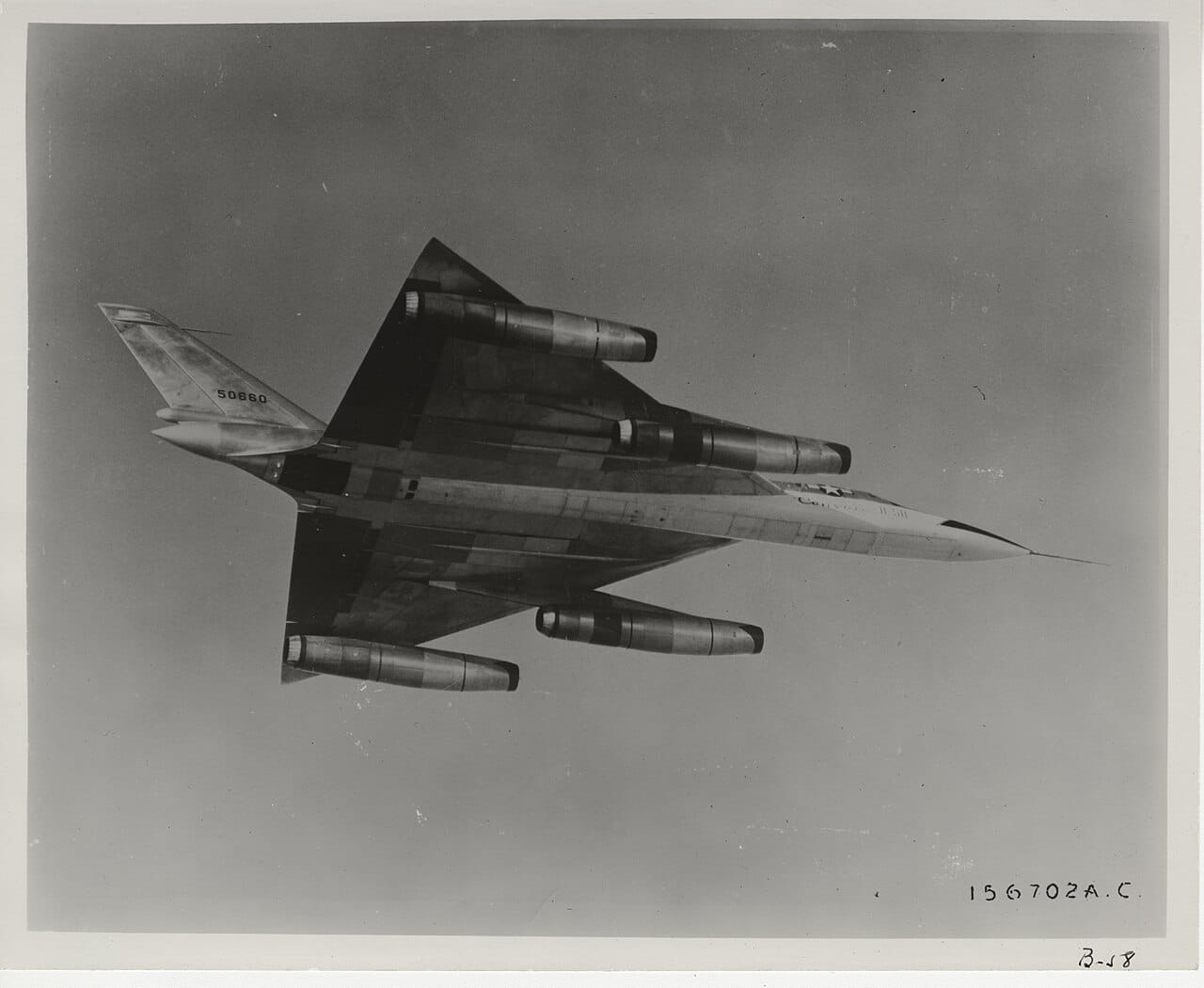
In 1960 the Convair B-58 Hustler was, by every measurable standard, the most advanced combat aircraft on Earth. It could sustain Mach 2 — a speed contemporary fighters could reach only in short dashes. It carried a thermonuclear weapon in a detachable streamlined pod slung beneath its delta wing. It was the first supersonic bomber ever produced. It set 19 world speed and altitude records during its service life.
The B-58 was also the most expensive aircraft per unit weight that the United States had ever built. It killed more of its own crews than any enemy. And it lasted just ten years before Strategic Air Command quietly retired it.
It is one of the most extraordinary failures in American aviation — beautiful, brilliant, and ultimately wrong.
Informazioni rapide
Aeromobili: Convair B-58A Hustler
Primo volo: 11 novembre 1956
Operational service: 1960–1970
Velocità massima: Mach 2.0 (1,325 mph at altitude)
Equipaggio: 3 — pilot, navigator/bombardier, defensive systems operator (in separate cockpits)
Weapon: MB-1C nuclear weapon in detachable pod under fuselage
Totale costruito: 116 aircraft
Hull losses: 26 aircraft (22% of fleet) to accidents — 36 crew killed
The Delta and the Pod
Convair's design started from a single, ruthless requirement: cruise at twice the speed of sound at 60,000 feet. Everything else flowed from that. The shape was a slender delta wing with no horizontal tail — supersonic-clean, low-drag, structurally elegant. The four General Electric J79 turbojets, each putting out 15,600 pounds of thrust on afterburner, were carried in individual underwing pods.
The weapon was the strangest piece. The B-58 had no internal bomb bay. Instead, a long fairing hung beneath its belly — half streamlined pod, half external fuel tank, with a nuclear warhead inside. Releasing the weapon meant releasing the whole pod. The aircraft instantly lost drag and became even faster after dropping its bomb.
The Crashes
The B-58 was terrifying to fly. Its delta wing had no comfort margin at low speed — landing approach speeds were exceptionally high, and the aircraft had no leading-edge slats or flaps to soften the approach. Visibility from the pilot's high-nosed cockpit was poor on touchdown. Engine failure on takeoff at maximum gross weight was, by every test pilot's account, fatal more often than not.
By the end of the programme, 22 percent of the entire B-58 fleet had been lost to non-combat accidents. Thirty-six crew were dead. The Air Force, looking at the numbers, started shifting Strategic Air Command's strategic-nuclear deterrent to the B-52 — slower, older, but vastly safer.
“The Hustler was a brilliantly engineered and utterly potent aircraft retired in its prime.”
Col. George Holt Jr., USAF — B-58 navigator/bombardier, 305th Bombardment Wing, Bunker Hill AFB
A Cost the Air Force Couldn't Stomach
The B-58 had been built for a single mission: deliver a hydrogen bomb to a Soviet target at Mach 2 from 60,000 feet. By the early 1960s, that mission was already obsolete. Soviet SA-2 surface-to-air missiles had demonstrated they could engage targets above 60,000 feet — Francis Gary Powers' U-2 was shot down in 1960 by an SA-2 at 70,000 feet. The B-58 was no longer faster than the threat.
And it was eye-wateringly expensive. A single B-58 cost more than its weight in gold — literally. SAC could buy three B-52s for the price of one Hustler.
The aircraft was retired in 1970. Most surviving airframes sat in storage at Davis-Monthan until they were finally scrapped in 1977. Eight examples survive in museums.
A Beautiful, Brilliant Wrong Answer
The B-58 was an aircraft that asked one question — "How fast can a bomber go?" — and answered it perfectly. It then turned out that the question itself had become the wrong one. The future of strategic deterrence was not speed, it was stealth, then standoff, then submarines. The Hustler arrived at exactly the moment the world stopped needing what it was for.
Its shape is still beautiful. Its records still stand. And the people who flew it still describe the experience of cruising past Mach 2 with awe.
“A Strategic Marvel That Became an Operational Nightmare” — the B-58 Hustler.
Sources: SAC historical archives, Convair B-58 Hustler in Action (Squadron/Signal), Air & Space Smithsonian.
Domande correlate
Cos'era il Convair B-58 Hustler?
The Convair B-58 Hustler was the world's first supersonic bomber, in US service from 1960 to 1970. Capable of sustained Mach 2 flight, it carried a thermonuclear weapon in a detachable pod beneath its delta wing. Only 116 were built. Brilliant but dangerous and hugely expensive, it set 19 world records yet lasted just a decade.
Quanto era veloce il B-58 Hustler?
The B-58 could sustain Mach 2.0 — about 1,325 mph at altitude — a speed contemporary fighters could only reach in brief dashes. Its four General Electric J79 turbojets each produced 15,600 pounds of thrust on afterburner. During its service the Hustler set 19 world speed and altitude records, making it the fastest bomber of its era.
Why was the B-58 Hustler retired so quickly?
The B-58 served only about ten years because it was extraordinarily expensive — the costliest US aircraft per unit weight to that point — and dangerously hard to fly. Some 22 percent of the fleet was lost to accidents, killing 36 crew. The Air Force shifted its nuclear deterrent to the slower but far safer B-52 Stratofortress.
Why was the B-58 so dangerous to fly?
Its delta wing had no horizontal tail and no leading-edge slats or flaps, so landing approach speeds were very high and unforgiving. Cockpit visibility on touchdown was poor, and an engine failure on takeoff at maximum weight was often fatal. Of 116 built, 26 were lost in accidents — a 22 percent hull-loss rate from non-combat causes alone.
How did the B-58 carry its nuclear weapon?
Unusually, the B-58 had no internal bomb bay. Instead it carried a large pod slung beneath the fuselage — part streamlined weapon container, part external fuel tank — holding the nuclear warhead. Releasing the weapon meant dropping the entire pod. This single-mission design, optimized for one high-speed nuclear strike, limited the aircraft's flexibility.
What replaced the B-58 Hustler?
The B-52 Stratofortress absorbed the strategic nuclear role the B-58 was meant to share. Older and slower but vastly safer and cheaper, the B-52 far outlived the Hustler and still flies today. The supersonic-bomber idea itself continued in projects like the Mach 3 XB-70 Valkyrie, though that too was ultimately abandoned.
0 Commenti