
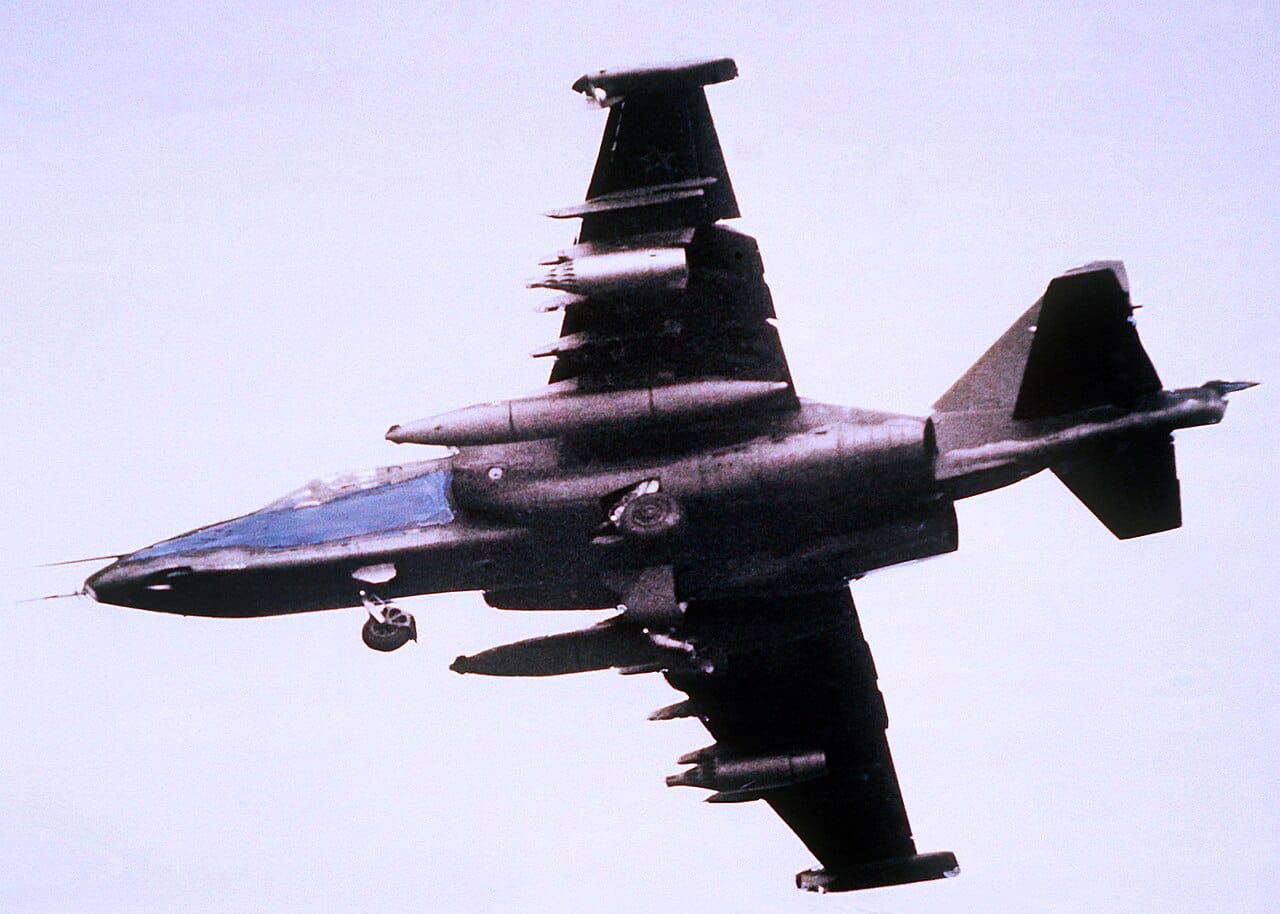
Most modern combat aircraft are built to avoid getting hit. The Su-25 Frogfoot was built to get hit and keep flying. Squat, blunt-nosed and wrapped in armour, the Sukhoi Su-25 — called Grach ("Rook") by its crews and "Frogfoot" by NATO — is the Soviet Union's answer to a very old idea: put a tough, cannon-and-rocket-armed aircraft low over the battlefield and let it slug it out with whatever is shooting back.
Its pilots sit inside a welded titanium bathtub. Its engines are boxed off from each other behind armour. It has flown home from Afghanistan, the Caucasus and Ukraine trailing smoke, missing pieces of wing and tail, sometimes on a single engine. For four decades it has been one of the hardest aircraft in the sky to kill — even as the modern battlefield has, at last, started to catch up with it.
Informazioni rapide
- Tipo: Sukhoi Su-25 "Grach" (NATO: Frogfoot), single-seat jet attack aircraft
- Primo volo: T-8 prototype, 22 February 1975; in service from the early 1980s
- Armour: all-welded titanium cockpit "bathtub," 10-24 mm thick
- Motori: two non-afterburning turbojets (R-95Sh / R-195), in separate armoured bays
- Gun: 30 mm GSh-30-2 twin-barrel cannon; up to ~4,400 kg of ordnance on 10 hardpoints
- Combattere: Afghanistan (60,000+ sorties), Chechnya, Georgia 2008, Syria, and Ukraine
A modern Shturmovik
The Su-25's DNA runs straight back to World War II. On the Eastern Front the Soviets built their doctrine around the Ilyushin Il-2 Shturmovik — "flying artillery" that worked in intimate support of the ground troops, and which Stalin is said to have called as essential to the Red Army as air and bread. When jets arrived, fast fighter-bombers like the Su-7 turned out to be hopeless at close air support: too quick to see the target, too fragile to survive the ground fire. In 1968 the Soviet military asked for a specialised, heavily armoured, subsonic assault jet — the Shturmovik reborn.
Sukhoi's T-8 prototype won out over Ilyushin's more old-fashioned Il-102, and first flew on 22 February 1975. Where the loser still carried a rear-facing defensive gun like a WWII bomber, the Sukhoi bet everything on toughness: a compact airframe, redundant controls, and a pilot cocooned in titanium.
Built to endure
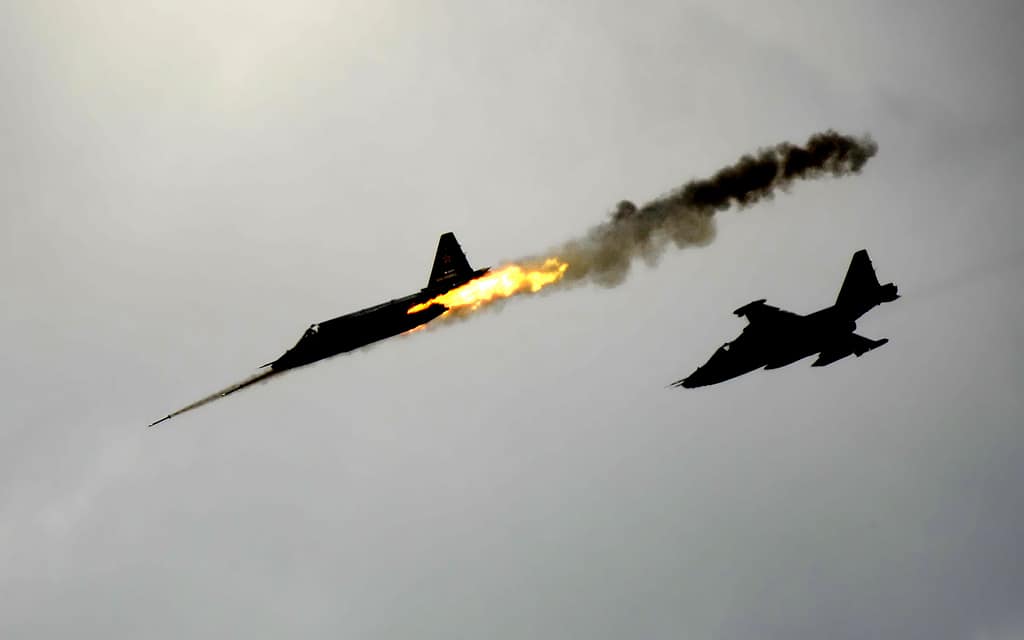
The heart of the Su-25 is that titanium bathtub — an all-welded armoured shell 10 to 24 mm thick, wrapped around the cockpit to shrug off anti-aircraft fire and cannon rounds. The two turbojets sit in separate stainless-steel bays divided by an armoured firewall, so a hit that kills one need not kill the other. The fuel tanks are foam-filled to suppress explosions, and the controls use heavy push-rods so the pilot keeps flying even if the hydraulics are shot away.
The designers even chose non-afterburning engines on purpose: less top speed, but a much smaller heat signature for enemy heat-seeking missiles to lock onto. Every choice serves the same master — get low, hit hard, come home.
Trial by fire
Afghanistan made the Frogfoot's reputation. Soviet Su-25s flew more than 60,000 sorties in the mountains, and crews came home from hits that would have downed a lesser aircraft. But the war also exposed its limit: when the US supplied shoulder-fired Stinger missiles, the heat-seekers found the Frogfoot, and around two dozen were lost. Pilots adapted, climbing higher and reaching for the first Soviet precision-guided missiles.
That pattern — brutal effectiveness, then hard lessons — repeated across Chechnya, the 2008 war with Georgia, Syria, and now Ukraine, where both sides fly the type and both have lost them in numbers. It invites the obvious comparison with America's A-10 Warthog, and the two aircraft answer the same question in very different accents.
The twilight of the flying tank
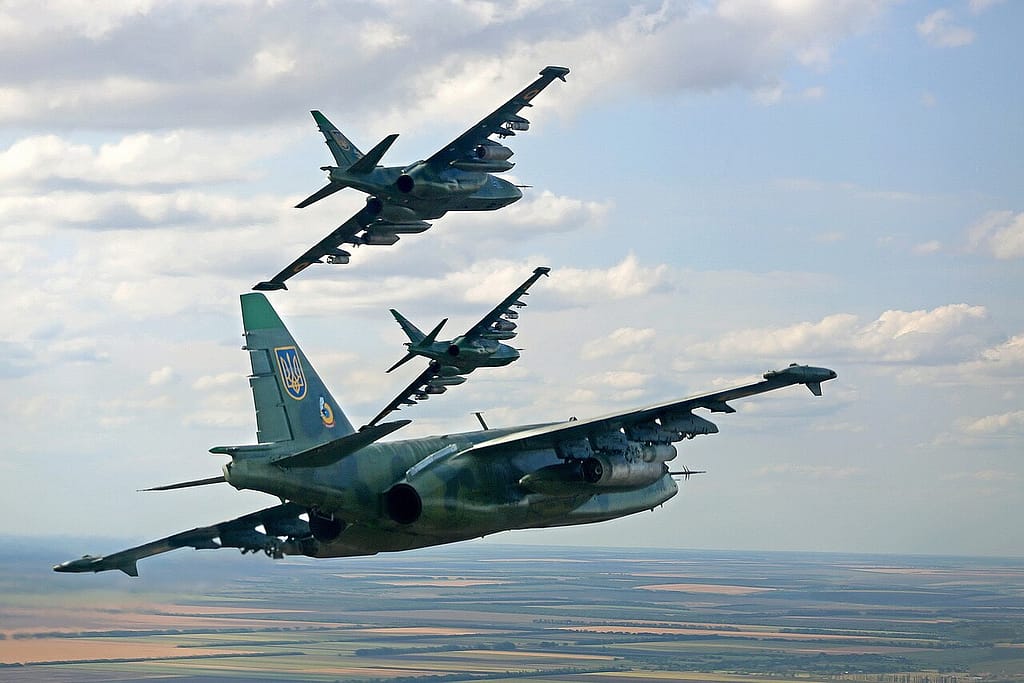
The Frogfoot's very toughness cannot save it from the arithmetic of the modern battlefield. In Ukraine, flying low and slow near the front has become close to suicidal, and pilots now "loft" unguided rockets from a distance, trading away all their accuracy for a chance of survival. The heavy-ordnance job has shifted to standoff glide bombs dropped by fighters like the Su-34, and the close-in eyes-on-target work has gone to cheap drones.
None of that erases what the Su-25 was. For forty years it did exactly what it was built to do: absorb punishment and keep delivering fire for the soldiers below. The game has changed around it, but the Rook remains one of the great expressions of a simple, stubborn idea — that sometimes the best way to survive a battlefield is to be too tough to kill.
Sources: 19FortyFive (Harry J. Kazianis), The National Interest, The Aviationist, Airforce Technology. Quotes by Harry J. Kazianis as published in 19FortyFive.

0 Commenti