
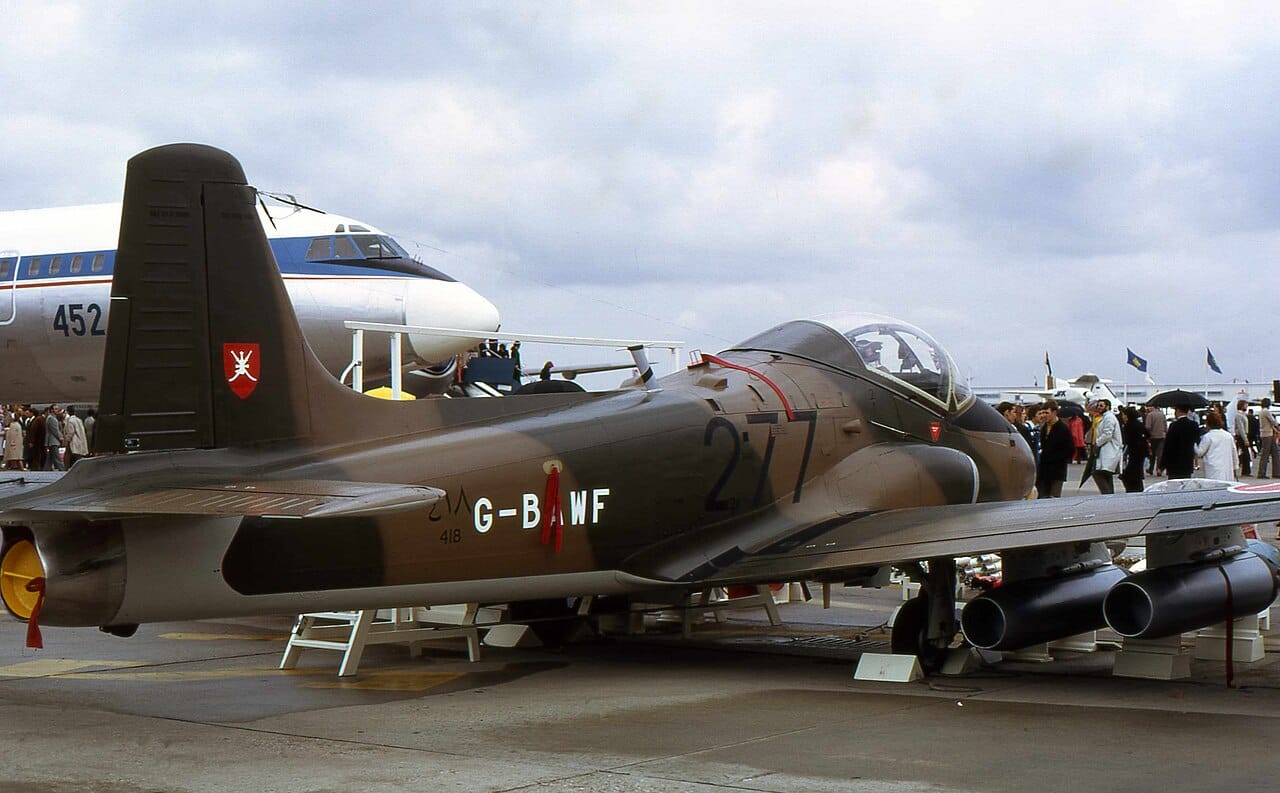
Most fast jets seat their crew one behind the other, the passenger staring at the back of the pilot's helmet. The BAC Jet Provost and its armed cousin, the BAC Strikemaster, do it differently. In these aircraft you sit shoulder to shoulder with the pilot, close enough to follow every hand on the throttle and every glance at the instruments.
That layout began as a teaching tool. It turned the Jet Provost into the friendly schoolhouse jet that taught a generation of RAF pilots to fly, and it is exactly why, decades later, these aircraft make some of the most enjoyable warbird rides in the world.
But the family also had a harder side. Bolt weapons under the wings of a Jet Provost and you get a Strikemaster — a gentle trainer turned genuine light-attack jet that fought real wars in real deserts.
Informazioni rapide
Jet Provost: RAF basic jet trainer, side-by-side seating inherited from the piston Percival Provost
Strikemaster: armed export development of the Jet Provost T.5 — first flew 1967
Motore: Rolls-Royce Viper turbojet; up to around 480 mph
Strikemaster weapons: eight underwing hardpoints, up to ~3,000 lb of bombs and rockets, plus guns
Costruito: around 150 Strikemasters for export; hundreds of Jet Provosts for the RAF
Combattere: Oman's Dhofar War (including the Battle of Mirbat, 1972) and the 1995 Cenepa War
Shoulder to Shoulder
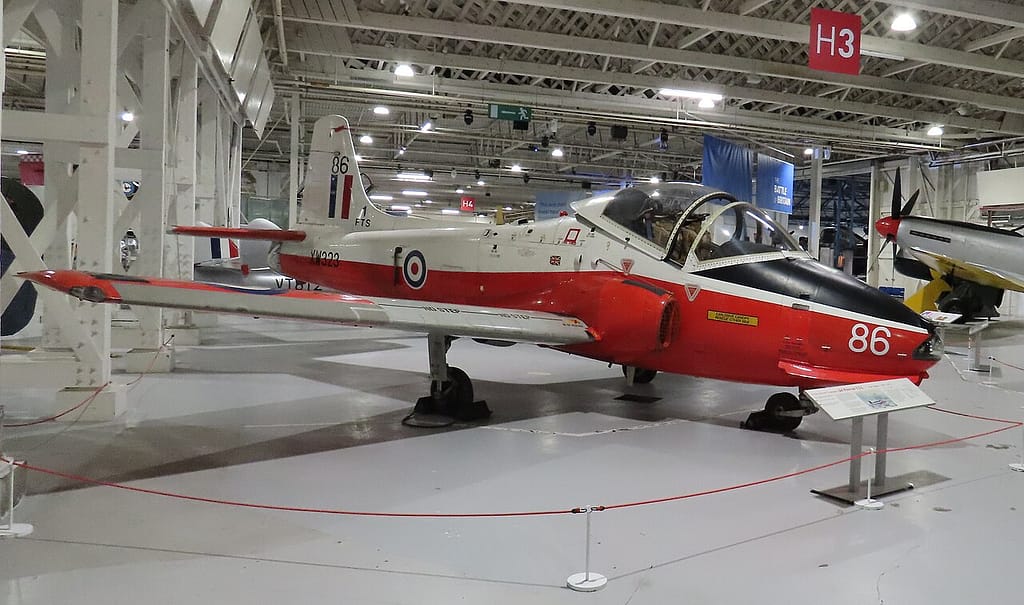
The Jet Provost inherited its side-by-side cockpit from the piston Percival Provost it replaced, and the RAF loved it for training. With instructor and student sitting abreast, the instructor could see exactly what the student's hands were doing, follow their eyes onto the dials, and simply point at things. It made the leap into jets far less intimidating, and from the mid-1950s the Jet Provost became the aircraft on which countless RAF pilots first flew a jet.
That same intimacy is what makes the aircraft special from a passenger seat. You are not cargo in a tube behind the pilot; you are sitting next to them, watching the whole flight unfold at arm's length.
A closer look at the BAC Jet Provost, the RAF's long-serving jet schoolhouse.
From Schoolhouse to Strike
BAC saw a fighter hiding in the trainer. Engineers took the proven Jet Provost T.5, strengthened its airframe, uprated the Rolls-Royce Viper engine, armoured the cockpit and hung eight hardpoints under the wings. The result, first flown in 1967, was the Strikemaster: a light-attack aircraft that could carry some 3,000 pounds of bombs and rockets and strafe with built-in guns, yet was cheap to buy and easy to maintain.
Around 150 were sold to air forces that wanted punch without the price of a supersonic fighter — Oman, Saudi Arabia, Kenya, New Zealand, Ecuador and more. For many small nations, the Strikemaster was the whole air force's combat capability.
The Seventh Cavalry Over Mirbat
The Strikemaster's most famous hour came in Oman. Through the Dhofar War of the 1970s, the Sultan of Oman's Air Force flew the type hard, rocketing and strafing insurgents across the jebel. On 19 July 1972, at the Battle of Mirbat, a tiny group of SAS soldiers and Omani gunners held off an assault by roughly 300 rebels — and Strikemasters flying through low cloud and monsoon rain provided the close air support that helped turn the fight.
Ecuadorian Strikemasters were still flying combat as late as the 1995 Cenepa War against Peru — respectable service for an aircraft that started life teaching teenagers to fly.
A Strikemaster through the Mach Loop — the view from the cockpit.
Still Flying — and You Can Ride
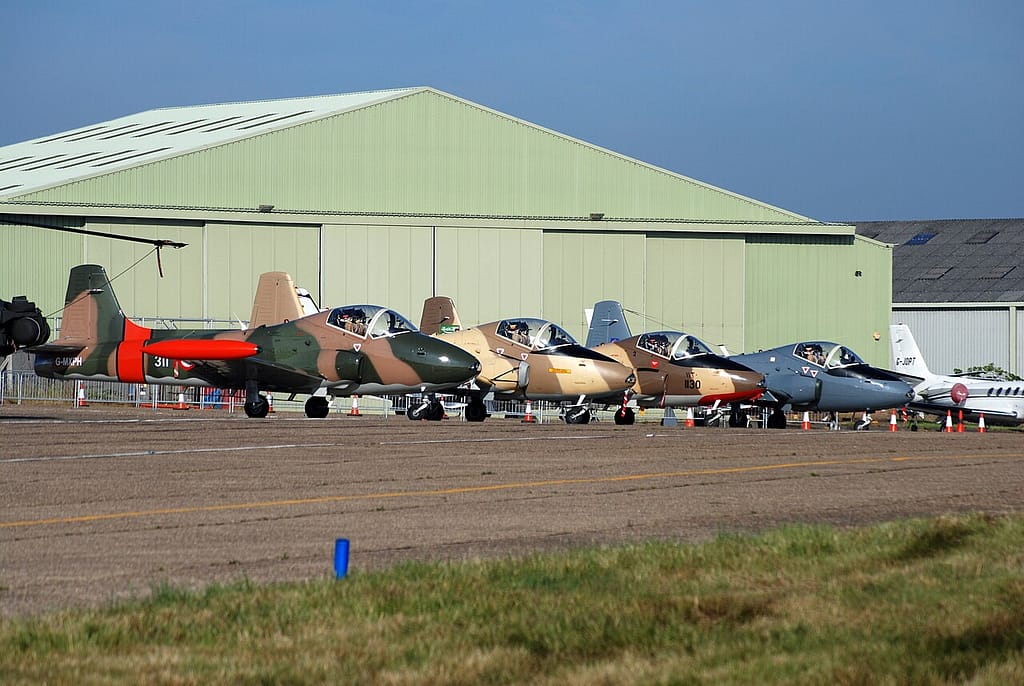
Because they are docile, tough and cheap to run by jet standards, both types have thrived in private hands. Display teams still fly them, and a lucky few passengers get to strap in beside a pilot for the ride of their lives.
This is where MiGFlug comes in. We have flown guests in both the Jet Provost and the Strikemaster, and we are preparing to bring the Jet Provost back soon. The side-by-side cockpit is the whole point: instead of sitting behind the pilot, you sit right next to them, hand near the controls, eyes on the same horizon — the friendliest introduction to fast-jet flying there is. If a low-level blast through the valleys in a real ex-military jet is on your list, keep an eye on MiGFlug.
A pair of Strikemasters in a formation display.
Few aircraft bridge the gap between gentle trainer and combat jet the way this family did. Fewer still let you share the cockpit to find out what that feels like. The Jet Provost taught a nation to fly, the Strikemaster took it to war — and both still know how to show a passenger a very good time.
Sources: Wikipedia (BAC Jet Provost; BAC Strikemaster; Battle of Mirbat); Vintage Aviation News; MiGFlug; Military Factory.
0 Commenti