
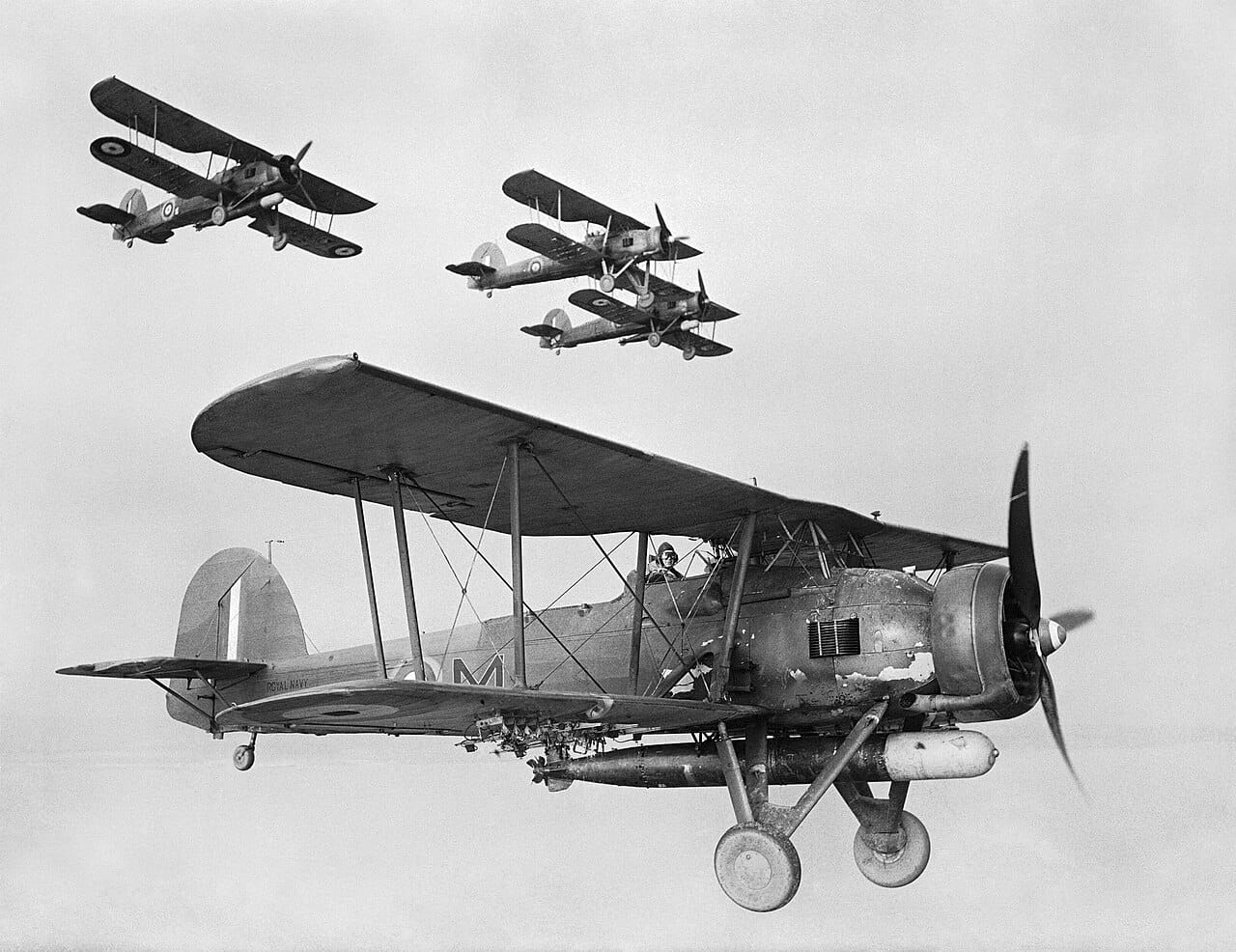
It is approaching eleven o’clock on the night of 11 November 1940, and Lieutenant Commander Kenneth “Hooch” Williamson is pushing his Fairey Swordfish down through the flak over Taranto harbour. Magnesium flares hang in the sky, throwing the anchored Italian battle fleet into silhouette. His biplane — fabric, wire and an open cockpit — clatters in low over the water, and he releases his torpedo at the great hull of the battleship Conte di Cavour.
Moments later his own aircraft is hit and goes into the harbour; Williamson and his observer survive, to be taken prisoner. But the torpedo runs true. Behind and around him, twenty other antique biplanes are doing the same thing to the most powerful fleet in the Mediterranean.
By dawn, three Italian battleships are sitting on the bottom of their own harbour. The age of the battleship has just ended — and almost nobody has realised it yet.
Informazioni rapide
| Data | Night of 11–12 November 1940 |
| Attacker | 21 Fairey Swordfish biplanes from HMS Illustrious |
| Bersaglio | The Italian battle fleet at anchor in Taranto harbour |
| Risultato | Three battleships put out of action (Littorio, Caio Duilio, Conte di Cavour); cruisers and shore facilities damaged |
| British losses | Two Swordfish |
| Eredità | The first all-aircraft carrier strike on a fleet — and a template for Pearl Harbor |
An impossible target
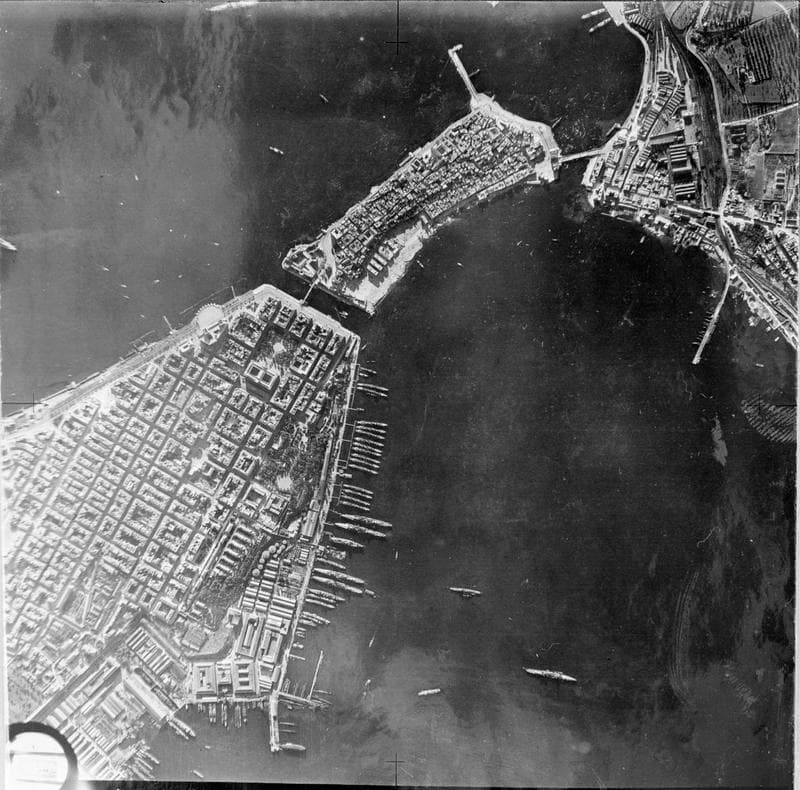
Taranto was the Regia Marina’s great naval base, and its battle fleet lay at anchor behind barrage balloons, torpedo nets, and a wall of anti-aircraft guns. Worse, the harbour was shallow — a conventional air-dropped torpedo would simply dive into the mud. The British answer was to modify their torpedoes with trim wires and breakaway fins so they would run shallow, and to attack at night, when the defences were hardest to coordinate.
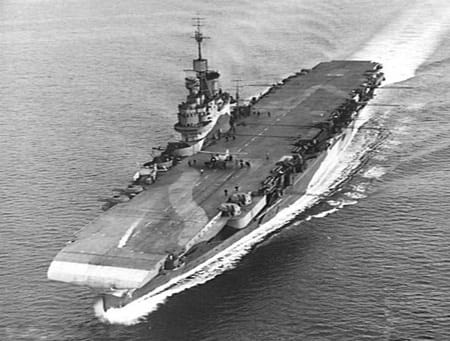
The strike had been in the Royal Navy’s drawer for years — contingency plans for a carrier attack on Taranto dated back to the 1930s. Operation Judgement, as it was finally christened, was originally set for 21 October 1940, Trafalgar Day, with two carriers taking part. Then a hangar fire aboard Illustrious destroyed two Swordfish and damaged more, and HMS Eagle dropped out for emergency repairs. The raid slipped to the night of 11–12 November, with a single carrier — Illustrious — flying aircraft and crews borrowed from Eagle to make up the numbers. In the days before, RAF Martin Maryland reconnaissance aircraft from Malta photographed the anchorage and confirmed that virtually the entire Italian battle fleet was home.
The technical puzzle that made Taranto “impossible” was water depth. The Mar Grande anchorage is roughly 12 metres (40 feet) deep, and a standard air-dropped torpedo plunges far deeper than that before settling onto its run — against Taranto, it would simply have buried itself in the mud.
The Fleet Air Arm’s answer was a pair of modifications. The torpedoes were fitted with Duplex pistols — magnetic exploders designed to detonate under a ship’s unarmoured belly rather than against its side — and a drum of wire rigged between aircraft and torpedo pulled the weapon’s nose up as it fell, so that it belly-flopped onto the surface instead of diving. It was a trick other navies would study with great interest barely a year later.
Two waves, one antique biplane
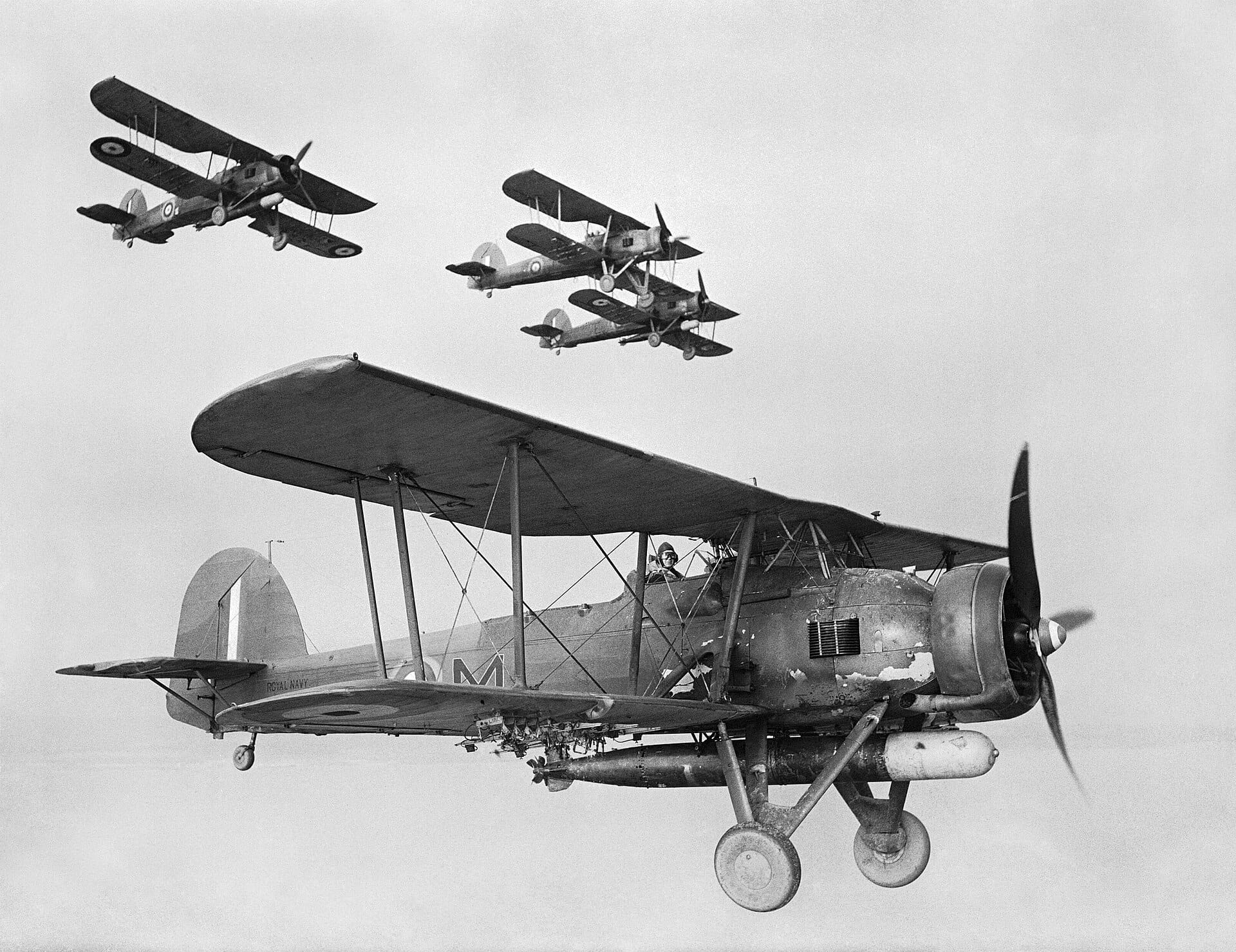
The aircraft that did it looked like a relic even in 1940. The Fairey Swordfish — affectionately the “Stringbag” — was a fabric-skinned biplane with a top speed of barely 140 mph and crew sitting in the open air. Twenty-one launched in two waves, the first of twelve led by Williamson just before 21:00, the second of nine about ninety minutes later.
Coming in under their own flares, the Swordfish put torpedoes into the new battleship Littorio and the older Caio Duilio and Conte di Cavour. The Littorio was crippled for months; the Cavour was so badly damaged it never returned to service. For all of it, the Royal Navy lost just two aircraft.
The first wave — twelve aircraft led by Lieutenant Commander Kenneth “Hooch” Williamson of 815 Naval Air Squadron — began lifting off Illustrious’s deck shortly before 21:00, from a launch point roughly 170 miles from Taranto. Flare-droppers lit the harbour from the east while the torpedo aircraft let down to mast height, threading between the balloon cables and into the flak.
The second wave, nine aircraft under Lieutenant Commander John “Ginger” Hale of 819 Squadron, followed roughly ninety minutes behind. Between them, the two waves put three torpedoes into the brand-new battleship Littorio, one into the Caio Duilio and one into the Conte di Cavour, while the bombers among the force went after cruisers, destroyers and the seaplane base. Cavour never sailed again; Littorio and Duilio were out of the war for months.
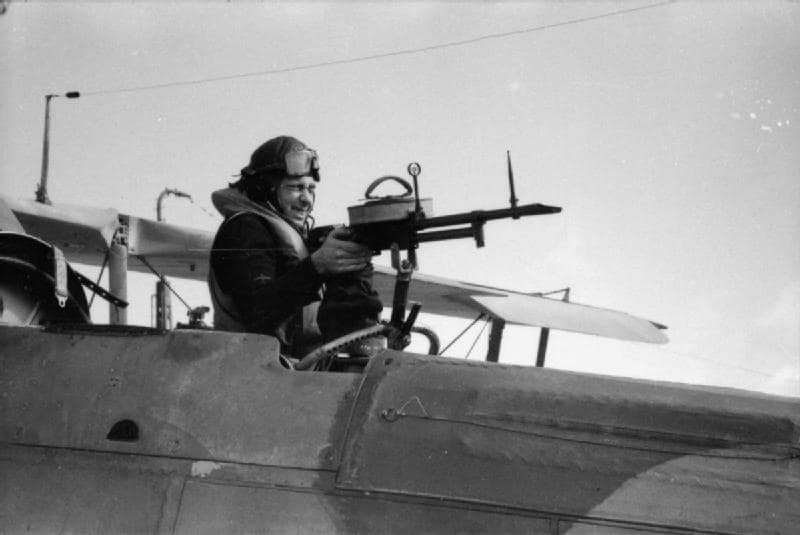
The price was two aircraft. Williamson and his observer, Lieutenant Norman Scarlett, were fished out of the harbour and taken prisoner; Lieutenant Gerald Bayly and Lieutenant Herbert Slaughter, shot down in the second wave, were killed. Eleven torpedoes dropped, two crews lost, half a battle fleet neutralised — the Mediterranean’s balance of power had been rewritten in about an hour.
The shot heard in Tokyo
In a single night, a handful of canvas biplanes had knocked out half of Italy’s battle fleet and tilted the balance of the Mediterranean. But the most consequential audience was not in Rome or London. In Japan, naval planners studied Taranto closely: here was proof that carrier aircraft could cripple a battle fleet at anchor, in shallow water, by surprise. A little over a year later, that lesson arrived over Pearl Harbor.
The battleship admirals had spent decades insisting the big gun ruled the sea. On one November night, twenty-one biplanes wrote the first line of the carrier age — and the rest of the war would spell out the rest.
Nowhere was the lesson read more carefully than in Tokyo. Within weeks, Lieutenant Commander Takeshi Naito, Japan’s assistant naval attaché in Berlin, flew to Taranto to inspect the results first-hand. The Imperial Japanese Navy, already contemplating a strike against the US Pacific Fleet, seized on the parallel: Pearl Harbor’s anchorage is about as shallow as the Mar Grande, and the shallow-running torpedo modifications Japan began testing in early 1941 solved exactly the problem the Fleet Air Arm had cracked over Taranto.
None of that diminishes what the twenty-one crews did; it multiplies it. One November night in 1940 did not merely cripple a fleet — it handed every navy on Earth the blueprint for the next war at sea, thirteen months before Pearl Harbor proved the point at scale.
Sources: Imperial War Museums; The National WWII Museum; Royal Navy (Navy Wings).
Domande correlate
What was the Battle of Taranto?
The Battle of Taranto was a British air raid on the night of 11\u201312 November 1940, in which 21 Fairey Swordfish biplanes from the carrier HMS Illustrious attacked the Italian battle fleet anchored at Taranto. It was the first all-aircraft ship-to-ship naval attack in history.
When did the Battle of Taranto happen?
The attack took place on the night of 11 to 12 November 1940, during the Second World War, in the Mediterranean Sea.
What aircraft attacked Taranto?
The raid was carried out by Fairey Swordfish biplane torpedo-bombers \u2014 fabric-and-wire aircraft with open cockpits, nicknamed the \u201cStringbag\u201d \u2014 flown from the Royal Navy carrier HMS Illustrious.
How many ships were damaged at Taranto?
Three Italian battleships were put out of action \u2014 the Littorio, the Caio Duilio and the Conte di Cavour \u2014 along with damage to cruisers and shore facilities. The Conte di Cavour never returned to active service.
Did Taranto inspire the attack on Pearl Harbor?
Yes. Japanese naval planners studied Taranto as proof that carrier aircraft could cripple a battle fleet at anchor in shallow water. The lessons informed the planning of the December 1941 attack on Pearl Harbor.
What is a Fairey Swordfish?
The Fairey Swordfish was a British biplane torpedo-bomber of the Fleet Air Arm. Despite being obsolete-looking by 1940, it served throughout the war and is famous for the Taranto raid and for helping to sink the German battleship Bismarck.
0 Commenti