
| Informazioni rapide | |
|---|---|
| Squadra | U.S. Navy Blue Angels |
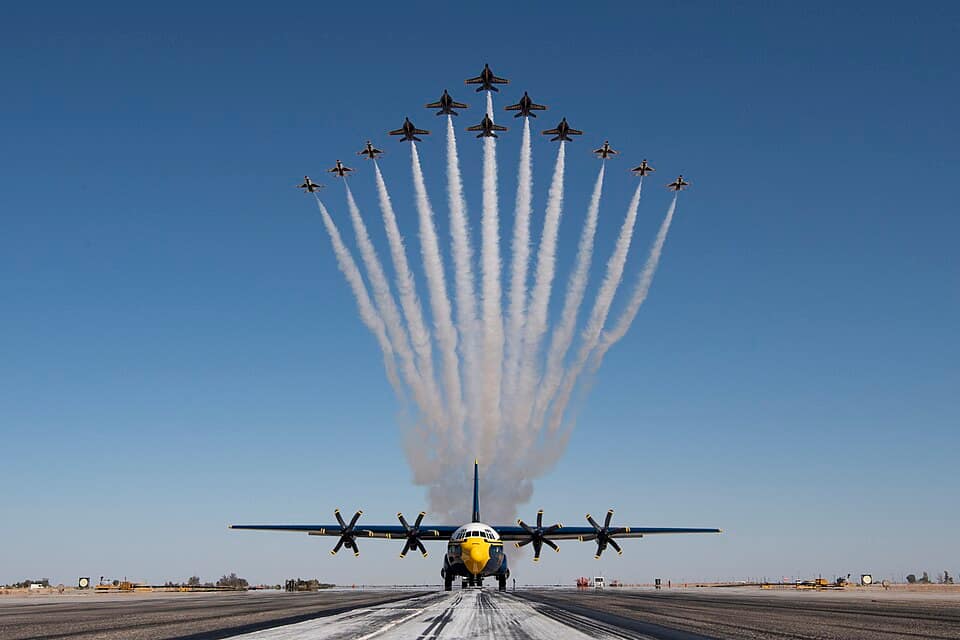
| Aeromobili | F/A-18E/F Super Hornet (6), C-130J Super Hercules "Fat Albert" (1) |
| 2026 Season Status | Multiple shows cancelled; more cancellations expected |
| Motivo | Heightened base security (Iran war) + Fat Albert maintenance |
| Fat Albert Issue | Center wing box replacement in UK — expected to add decades of airframe life |
| Next Scheduled Shows | Apr 11–12 Cocoa Beach, Apr 18–19 Kingsville, Apr 25–26 Vidalia (subject to change) |

The Blue Angels aren't flying. Not because of weather. Not because of a mechanical failure. Because the war in Iran has turned every U.S. military installation into a fortress — and airshow demonstration teams are the first casualty of heightened force protection.
At least two shows have already been scrapped from the 2026 season. More cancellations are expected. The Navy's elite demonstration squadron — six F/A-18E/F Super Hornets that normally spend spring and summer dazzling crowds from Florida to California — is grounded by security protocols that didn't exist two months ago.
And their iconic support aircraft isn't even in the country.
Fat Albert Is in the UK
The C-130J Super Hercules known as "Fat Albert" — the Blue Angels' cargo and support aircraft that traditionally opens each show with a dramatic short-field takeoff — is undergoing a major structural overhaul in the United Kingdom. The work involves replacing the integral center wing box, the massive structural component that connects the wings to the fuselage and carries the entire flight load of the aircraft.
It's not a minor repair. The center wing box replacement is one of the most intensive maintenance procedures a C-130 can undergo, essentially rebuilding the structural spine of the airframe. The upside: it should add decades to Fat Albert's service life. The downside: the aircraft has been out of action since November 2025, and there's no confirmed return date for the 2026 season.
Without Fat Albert, Blue Angels shows lose the opening act that fans travel hours to see — the lumbering four-engine transport pulling manoeuvres that look physically impossible for an aircraft its size.
When War Grounds the Show
The bigger problem is security. Since Operation Epic Fury launched against Iran on February 28, every U.S. military base has been operating under elevated force protection conditions. That means restricted access, tighter perimeters, heightened screening, and a general posture that doesn't lend itself to inviting 100,000 civilians onto a flight line for a weekend airshow.
Airshows at military installations require enormous logistical support: open gates, temporary fencing, civilian parking on base property, medical stations, portable infrastructure. All of that draws security resources away from the base's primary mission. In peacetime, it's manageable. During an active air campaign that has already seen Iranian strikes on U.S. assets in Saudi Arabia, commanders are making a different calculation.
The result: shows are being cancelled not because the aircraft can't fly, but because the bases can't safely host the crowds.
The Ripple Effect
The Blue Angels aren't the only team affected. The Air Force Thunderbirds — flying their own F-16 demonstration schedule — face the same security constraints. Across the country, airshow organisers are scrambling to fill slots or adjust schedules as military participation becomes uncertain week to week.
For the communities that host these events, the economic impact is real. A Blue Angels airshow can draw 200,000 to 400,000 spectators over a weekend. Hotels, restaurants, local businesses — entire regional economies plan their spring around these dates. A last-minute cancellation doesn't just disappoint aviation fans. It vaporizes revenue.
The Navy has kept upcoming dates on the schedule — Cocoa Beach on April 11–12, Kingsville on April 18–19, Vidalia on April 25–26 — but added the caveat that all dates are subject to change. In military language, that means: don't book your hotel yet.
A Strange Kind of Casualty
Wars have consequences that extend far beyond the battlefield. The Blue Angels exist to connect the Navy with the American public — to show what naval aviation looks like at its absolute best. Grounding them is a small thing measured against the scale of an air campaign over Iran. But it's a visible one. It's the moment when a distant conflict becomes tangible at home.
Somewhere in Pensacola, six Super Hornets sit in a hangar painted blue and gold, waiting for a world that lets them fly for a crowd instead of a war. That wait may last a while.

Sources: Flying Magazine, Yahoo News, AvWeb
Domande correlate
Chi sono i Blue Angels?
The Blue Angels are the U.S. Navy's flight demonstration squadron, flying six F/A-18E/F Super Hornets at airshows across the country. They are supported by a C-130J Super Hercules transport nicknamed Fat Albert. The team performs precision aerobatics to showcase naval aviation and support recruiting.
Che tipo di aereo usano i Blue Angels?
The Blue Angels fly six F/A-18E/F Super Hornets, the Navy's frontline carrier-based multirole fighter, plus a C-130J Super Hercules support aircraft called Fat Albert. The modern Super Hornet is a capable combat jet - the Navy is even developing a hypersonic missile for it.
Why were the Blue Angels grounded in 2026?
Several 2026 Blue Angels shows were cancelled because of heightened base-security measures tied to the war in Iran, which locked down U.S. military installations. A second factor was that Fat Albert, the team's C-130J support aircraft, was undergoing a major overhaul in the United Kingdom. Other teams were affected too - the F-22 was pulled from airshows per ragioni simili.
Chi è Fat Albert?
Fat Albert is the Blue Angels' C-130J Super Hercules support aircraft, which carries the team's equipment and personnel and traditionally opens shows with a dramatic short-field takeoff. In 2026 it was in the UK for a center wing box replacement - a major structural overhaul expected to add decades of airframe life.
What is the difference between the Blue Angels and the Thunderbirds?
The Blue Angels are the U.S. Navy's demonstration squadron, flying F/A-18 Super Hornets, while the Thunderbirds are the U.S. Air Force equivalent, flying F-16 Fighting Falcons. Both perform precision aerobatics at airshows and occasionally fly together in a combined Super Delta formation.
Can civilians fly in a fighter jet like the Blue Angels?
The Blue Angels are a military unit, so the public cannot fly with them. However, civilians can experience similar military jets through specialist operators - for example, many people ask whether it is possible to fly in an F-14 Tomcat or other fast jets.
0 Commenti