
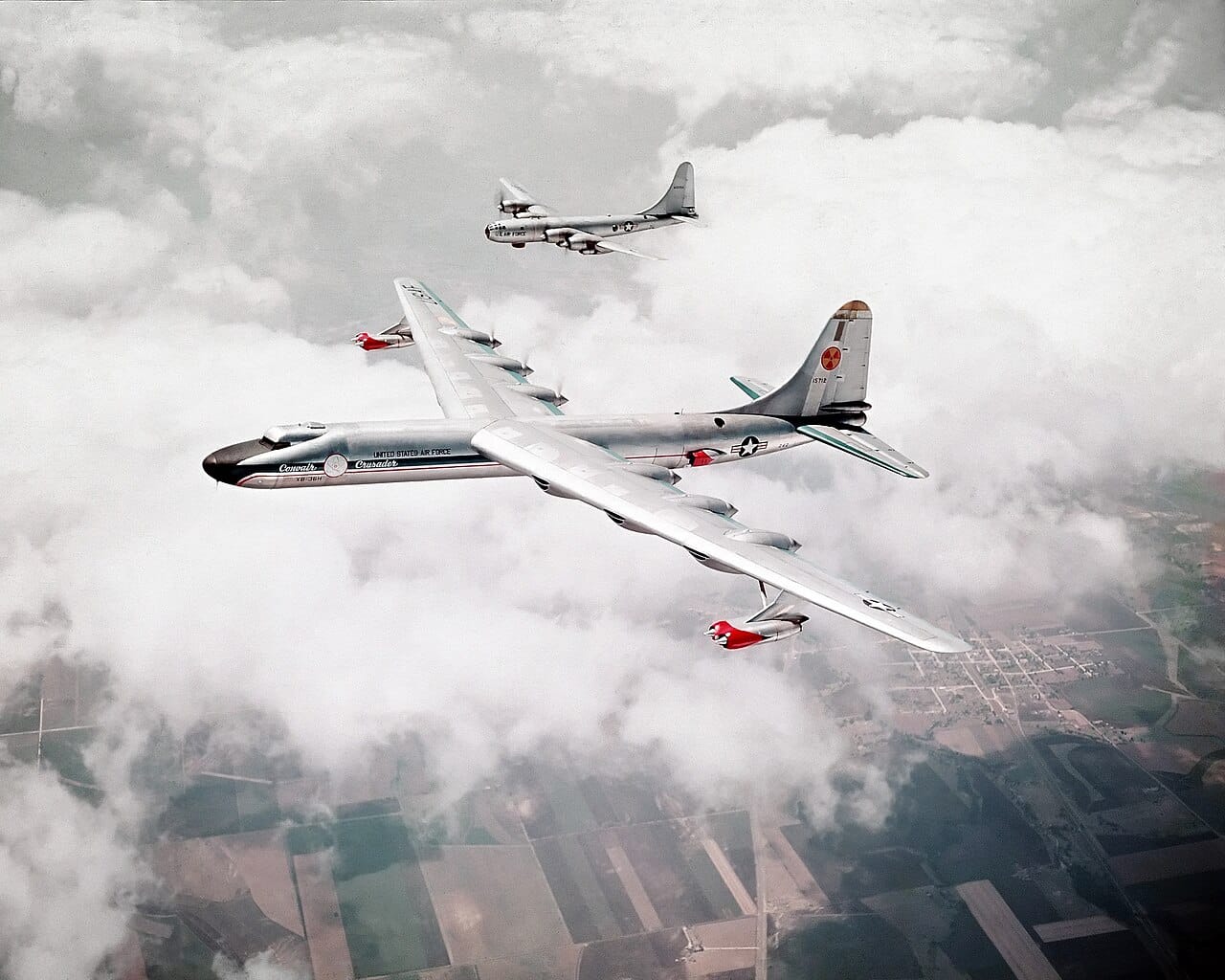
Between 1955 and 1957, a B-36 bomber the size of a building flew over Texas and New Mexico with a live nuclear reactor humming in its belly. It was escorted everywhere by a planeload of armed Marines, ready to parachute down and seal off the area if it ever crashed.
The Convair NB-36H "Crusader" was America's boldest, strangest Cold War experiment: an attempt to find out whether an aircraft could one day be powered by atomic energy and stay aloft for weeks. The reactor it carried never actually drove the propellers — but it proved the U.S. was deadly serious about nuclear flight.
Informazioni rapide
- Aeromobili: Convair NB-36H "Crusader" (modified B-36 Peacemaker)
- Reactor: a small air-cooled reactor (~1 megawatt) that ran in flight
- Powered the engines? No — it was a shielding and feasibility test
- Voli: 47 test flights, 1955–1957
- Crew protection: a lead-and-rubber shielded cockpit capsule
- Successor: the Convair X-6, cancelled in 1961
A Reactor With Wings
The dream was intoxicating: an engine that never runs out of fuel. A nuclear-powered bomber could, in theory, loiter near an enemy for days. To test the idea, Convair gutted a B-36 damaged by a tornado and rebuilt the nose as a 12-tonne shielded crew capsule of lead and leaded glass. Behind the crew sat the reactor, lowered into the bomb bay for each flight and removed afterward.
Why It Never Powered the Plane
The NB-36H's reactor generated heat and radiation, but it was never connected to the engines. The point was to learn whether a crew could be shielded from an airborne reactor and whether the aircraft could be operated safely. The answers were sobering: the shielding needed was enormously heavy, and a crash could scatter radioactive material across the landscape — which is why those Marines flew along on every mission.
The Soviets ran their own parallel experiment, the Tu-95LAL, with the same conclusion. Both superpowers eventually accepted that the weight and danger made nuclear-powered flight impractical, and the dream — along with the Convair X-6 that was meant to follow — was abandoned.
The documentary above explains just how far both superpowers went chasing the atomic airplane.
Sources: National Museum of the U.S. Air Force; Convair/General Dynamics records; Real Engineering.
Domande correlate
Did a plane ever fly with a nuclear reactor on board?
Yes. The Convair NB-36H, a modified B-36 Peacemaker bomber, carried a small operating nuclear reactor on 47 test flights between 1955 and 1957. The reactor ran in flight, though it did not actually power the aircraft's engines.
What was the Convair NB-36H?
The NB-36H Crusader was a modified B-36 bomber built to test whether nuclear-powered flight was feasible. It carried a small air-cooled reactor of about 1 megawatt and a heavily shielded crew capsule, flying 47 times to study reactor operation and radiation in the air.
Did the nuclear reactor power the NB-36H?
No. The roughly 1-megawatt reactor ran during flight but never drove the engines — it was purely a shielding and feasibility test. The aircraft still flew on its conventional piston and jet engines while engineers studied how to protect a crew from an airborne reactor.
How was the NB-36H crew protected from radiation?
The crew sat in a special cockpit capsule shielded with lead and rubber, designed to protect them from the reactor's radiation during flight. Studying this shielding was one of the main purposes of the entire test programme.
Why was the nuclear aircraft program cancelled?
The follow-on Convair X-6, meant to actually fly on nuclear power, was cancelled in 1961. The dangers of a reactor crash, the immense shielding weight, and the rise of intercontinental ballistic missiles made the nuclear-powered bomber unnecessary and impractical.
Post correlati
The Tu-95LAL: The Soviet Bomber Powered by a Nuclear Reactor
The Pilots of Chernobyl: Flying Helicopters Over an Open Nuclear Reactor
0 Commenti