
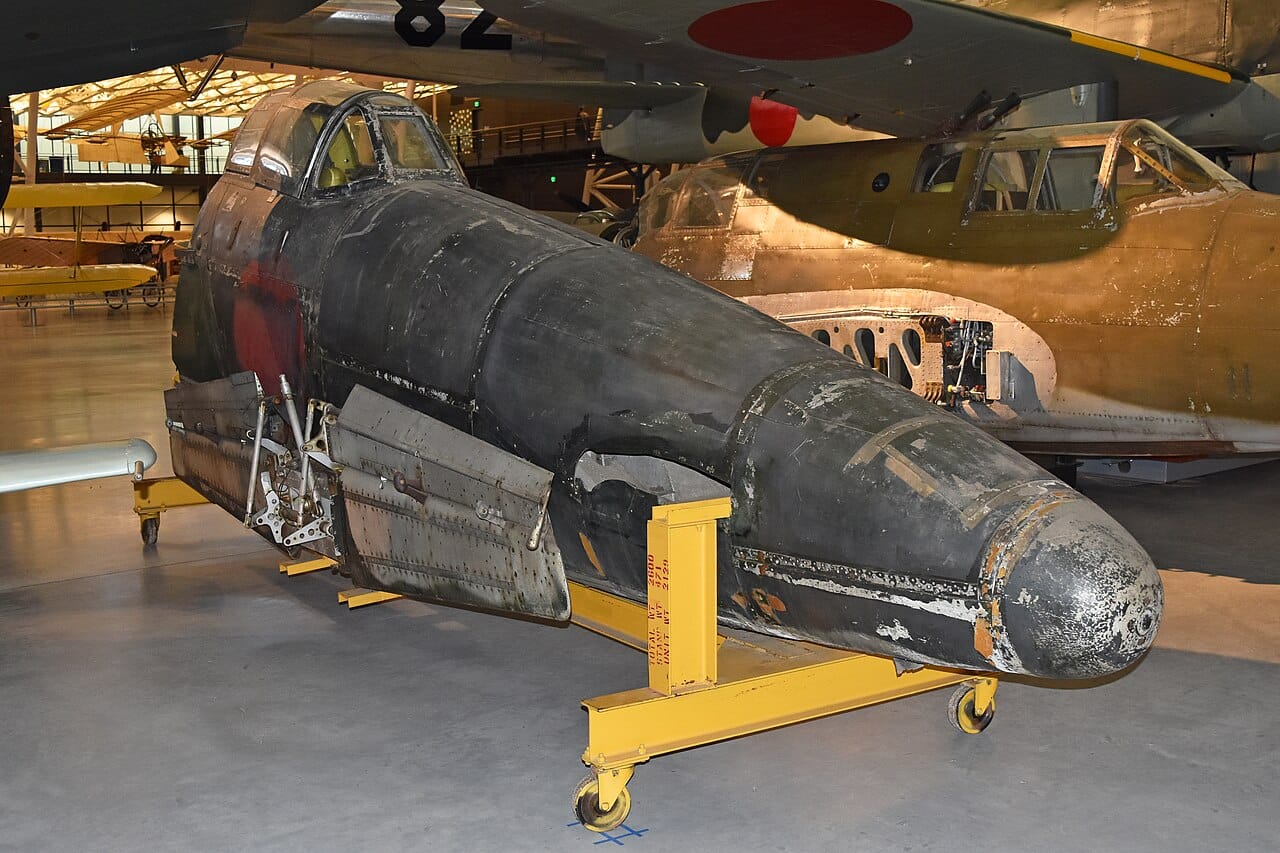
On August 3, 1945, a Japanese test pilot named Masayoshi Tsuruno climbed into the strangest fighter prototype Japan had ever built and pushed the throttle forward. The aircraft trundled along the runway at Kyūshū Aircraft Company's Mushiroda Airfield, lifted its nose canard, and bounced into the air.
Tsuruno landed a few minutes later. He made two more brief flights over the following days. And then, on August 15, the Emperor announced Japan's surrender. The Shinden — "Magnificent Lightning" — had flown five days too late to fight.
Had it arrived a year earlier, the Pacific War's air history might read very differently.
Informazioni rapide
Designazione: Kyūshū J7W1 Shinden ("Magnificent Lightning")
Configurazione: Canard wings forward, main wings aft, pusher propeller
Motore: 2,130 hp Mitsubishi MK9D radial, behind cockpit, driving 6-blade prop
Armamento: 4× nose-mounted 30 mm Type 5 cannons
Maximum design speed: 750 km/h (466 mph)
Designed against: B-29 Superfortress bombing raids on Japan
Primo volo: 3 August 1945
Numero totale di voli: 3 (roughly 45 minutes of total airtime)
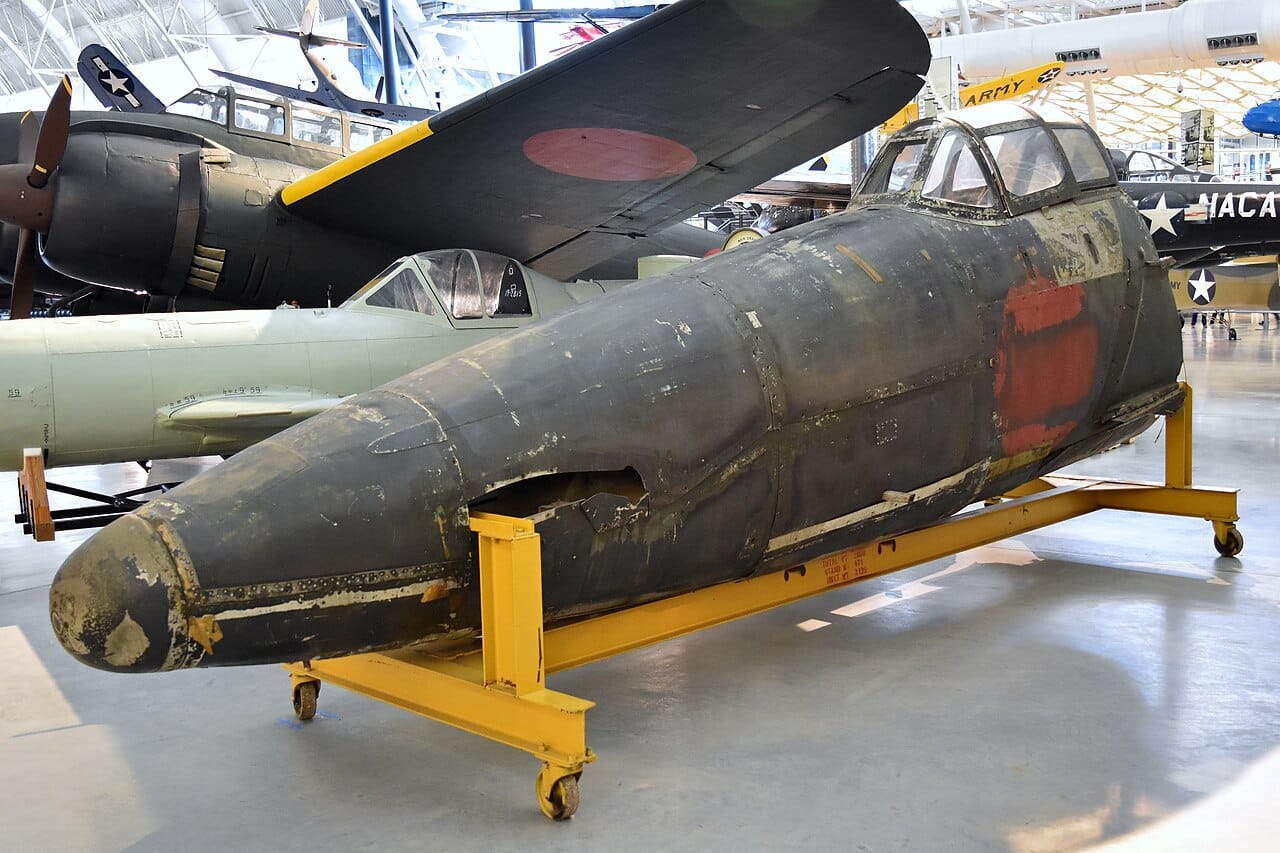
Surviving airframes: 1 (forward fuselage at Smithsonian Udvar-Hazy)
A Fighter Built Backwards
The Shinden was the strangest-looking fighter the Imperial Japanese Navy ever ordered, and the strange look was the entire engineering point. By 1943, Japanese designers had concluded that a conventional fighter — engine in the nose, wings in the middle, tail at the back — was no longer good enough to catch the B-29 Superfortress at altitude.
The B-29 was the existential threat. It cruised at 30,000 feet at speeds the Japanese Mitsubishi A6M Zero and Kawanishi N1K1 Shiden could not match. Every conventional Japanese interceptor approaching a B-29 formation was a slow, low-thrust nuisance. The IJN needed something with a higher service ceiling, much higher speed, and concentrated nose armament heavy enough to shoot down a four-engine bomber in a single firing pass.
Lieutenant Commander Masayoshi Tsuruno, on the IJN's technical staff, proposed an unconventional solution in early 1943: put the engine behind the pilot, driving a pusher propeller. Put the main wing at the back. Use a small canard wing at the front for pitch control. Mount the entire armament — four 30 mm Type 5 cannons — in the now-empty nose, with no propeller arc to fire through.
It looked like a paper-aeroplane sketch a child would draw. It was, on careful analysis, exactly what Japan needed.
Why the Canard Layout Was So Clever
Modern fighter designers have rediscovered the canard configuration repeatedly — the Eurofighter Typhoon, the Dassault Rafale, the JAS 39 Gripen, and the Chinese J-10 E J-20 all use canard control surfaces. The advantages are real: lower drag than a conventional tail in supersonic flight, better high-AOA manoeuvrability, and the structural elegance of carrying control loads at the wing's natural reference point.
In 1943, the Japanese were essentially fifty years ahead of the world on this. The Shinden's small canard at the nose did three jobs: pitch control, lift augmentation at low speeds, and protection of the cannons' line of fire by removing the propeller from the nose entirely. The pusher configuration meant the propeller could be huge — six blades, driven by an extension shaft from the rear-mounted engine — and could spin at the optimal speed for high-altitude performance.
The first prototype completed three brief flights between 3 and 9 August 1945, totalling roughly 45 minutes of airtime. The flights were successful but revealed a strong torque pull to starboard, some flutter of the propeller blades, and vibration in the extended drive shaft. Production quotas totalling 150 aircraft per month across two factories had been set even before the first flight; none were built.
The Cannons That Would Have Eaten Bombers
The Shinden's most fearsome feature was its armament. Four 30 mm Type 5 cannons mounted in the nose, each capable of firing 1.5-kilogram explosive shells at a muzzle velocity of 750 metres per second. A single one-second burst from a Shinden would have put roughly twelve kilograms of high-explosive ammunition into a target.
For comparison: the most heavily armed American fighter of the war, the P-47 Thunderbolt, mounted eight .50 calibre machine guns. The Shinden's single firing pass would have delivered roughly five times the projectile mass of a P-47 burst, with the explosive payload of dedicated anti-bomber rockets.
Against B-29s, this would have been devastating. American bomber crews could survive a P-51 Mustang or an Fw 190 firing pass. The Shinden was specifically designed to ensure they could not survive a single Japanese pass.
Why It Never Fought
The Shinden had been ordered into production even before the prototype ever flew. Two prototypes were built. The first flight occurred on August 3, 1945. By August 6 the United States dropped an atomic bomb on Hiroshima. By August 9 a second bomb fell on Nagasaki. By August 15 the Emperor surrendered. The Shinden had made three flights, totalling about 45 minutes of airtime.
Series production had been planned, with monthly quotas of 30 aircraft from Kyushu’s Zasshonokuma factory and 120 from Nakajima’s Handa plant — some 1,086 Shinden expected by March 1947. None were built. One of the two prototypes was claimed by a U.S. Navy Technical Air Intelligence Unit in late 1945, dismantled, and shipped to the United States. The aircraft was later reassembled but never flown, and placed in long-term storage. The forward fuselage survives today at the Smithsonian's Udvar-Hazy Center near Dulles Airport — the only physical evidence that the Shinden ever existed.
What Would Have Happened
Counter-factual history is a fool's errand, but the Shinden's specifications are interesting enough to invite the thought experiment. If the Imperial Japanese Navy had received its first 200 Shindens by mid-1946 — the production schedule's actual aim — would the B-29 campaign have survived?
Almost certainly yes, eventually. The American P-51D Mustang escort fighters and the Lockheed P-80 Stella cadente jet, deploying in spring 1946, would have matched or exceeded the Shinden's performance. American industrial mass would have overwhelmed Japanese production within months. The atomic bombs would still have been dropped if necessary.
But the Shinden would have made the air war over Japan significantly more dangerous for Allied bomber crews in late 1945. The aircraft was that good. The configuration was that clever. And it arrived, as so much of Japanese aircraft design in 1945 did, five days too late to matter.
The Magnificent Lightning lit up briefly. And then went dark.
Sources: Wikipedia (Kyushu J7W); Smithsonian Air & Space Museum collection notes; Old Machine Press; Vintage Aviation News.
Domande correlate
What was the Kyushu J7W Shinden?
The Kyūshū J7W Shinden ("Magnificent Lightning") was a radical Japanese fighter of 1945 built with a canard layout — small foreplanes at the nose, main wings at the rear, and a pusher propeller behind the cockpit. It was designed to intercept American B-29 raids in the final months of World War II.
What is a canard configuration?
A canard aircraft places small horizontal foreplane wings ahead of the main wings, rather than a tail at the back. The layout can improve control and efficiency. The J7W Shinden used a canard with a rear-mounted pusher propeller, giving it a distinctive backwards appearance.
Did the J7W Shinden ever fight?
No. It first flew on 3 August 1945, only days before Japan surrendered, and made just three short flights totalling around 45 minutes. The war ended before it could be developed or used in combat against the B-29s it was meant to stop.
Why was the J7W Shinden designed?
To shoot down high-flying B-29 Superfortress bombers attacking Japan. Its four nose-mounted 30 mm cannon and projected 750 km/h top speed were meant to give it the firepower and performance needed to reach and destroy the bombers — but it arrived far too late.
How fast was the J7W Shinden?
It had a maximum design speed of about 750 km/h (466 mph), driven by a 2,130 hp Mitsubishi radial engine mounted behind the cockpit turning a six-blade pusher propeller. Whether it could reach that speed in service was never established, as only three brief test flights were made.
Post correlati
Japan's Secret Masterpiece: The Mitsubishi Ki-83
0 Commenti