
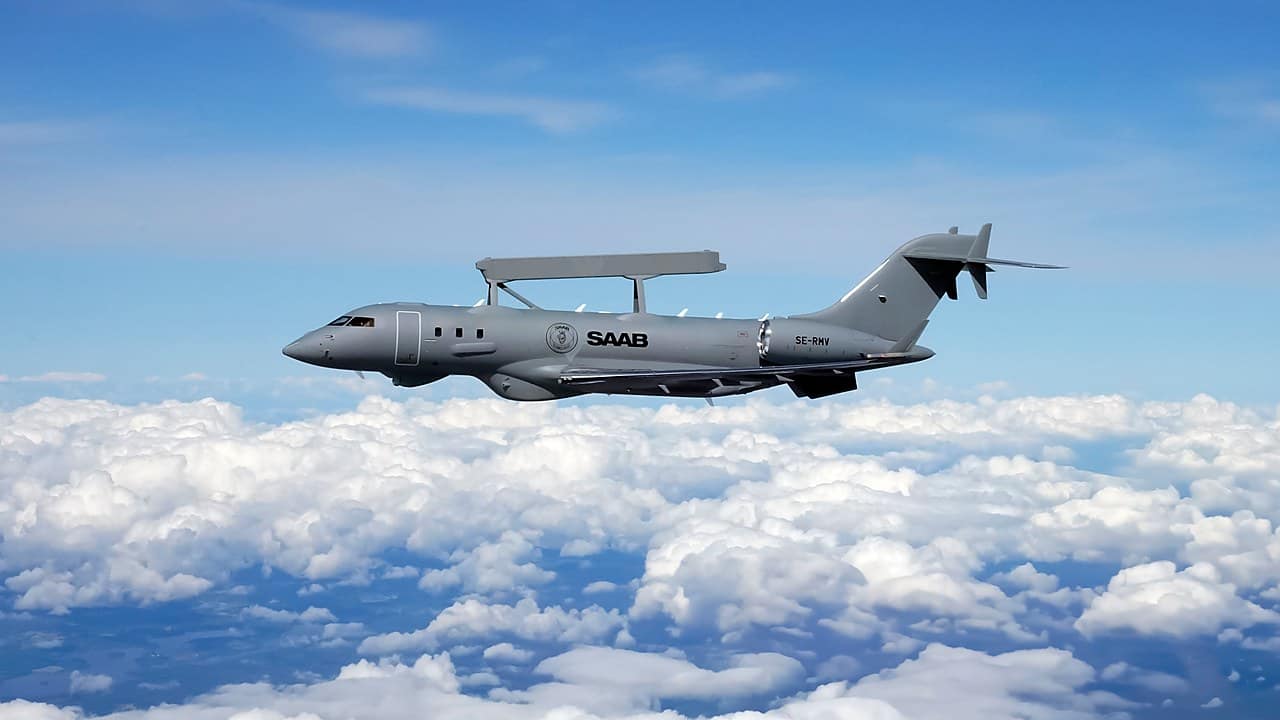
When we wrote last week that NATO's next radar jet would be Swedish, the news still wore the modest clothing of a Reuters exclusive. On Tuesday in Ankara, it acquired numbers, signatures and a price tag. Secretary General Mark Rutte confirmed that the Alliance will open formal negotiations with Saab for up to ten GlobalEye airborne early warning and control aircraft, a programme Reuters values at roughly 4.5 billion dollars.
"This will ensure we keep NATO's... surveillance and early warning capability strong and credible for decades to come," Rutte said at the summit's defence industry forum. The substance was real. Saab, with admirable Nordic sobriety, noted in its own statement that it "has not signed a contract or received an order related to the announcement." The negotiations with the NATO Support and Procurement Agency begin now.
Saab chief executive Micael Johansson put the unit price between 400 and 450 million dollars and said deliveries could begin in 2030 if a deal is signed soon. The market approved: Saab shares rose nearly four percent on a day the broader European defence index drifted lower. In Stockholm, the prime minister did not attempt to conceal his delight.
Informazioni rapide
- NATO confirmed 7 July it will negotiate with Saab for up to ten GlobalEye AEW&C aircraft, a plan Reuters values at roughly $4.5 billion
- Saab CEO Micael Johansson: $400–450 million per aircraft; deliveries could begin in 2030 if a contract is signed soon
- Eleven allies back the buy, per NATO: Belgium, Canada, Denmark, Germany, Latvia, Lithuania, Luxembourg, the Netherlands, Norway, Romania and Sweden
- The GlobalEyes will replace NATO's 14 remaining E-3A AWACS, though not one-for-one
- Denmark, Finland, Germany and Norway signed a letter of intent for up to five MQ-4C Triton drones
- Seven nations launched a pooled A400M airlift fleet; Finland joined the A330 MRTT pool, which gains one more tanker
- No contracts are signed yet — every element announced Tuesday now moves to negotiation
A Swedish Victory, Carefully Dressed as a Transatlantic One
The diplomatic choreography deserves a moment of appreciation. NATO had selected Boeing's E-7 Wedgetail back in 2023, only to shelve that plan in late 2025 as the American programme wobbled. Choosing a Swedish radar house over Boeing, at a summit where Donald Trump was pressing allies to buy American, required a certain finesse.
Rutte supplied it. "Like its predecessor, GlobalEye is a transatlantic programme, delivered by European and Canadian industries with essential contributions from US industries. It is a real success story, again, made in NATO," he told delegates. And it is true: the Erieye Extended Range radar is Swedish, but it rides on a Bombardier Global 6500 built in Canada, with American systems throughout. Eleven allies stand behind the decision, per NATO's statement: Belgium, Canada, Denmark, Germany, Latvia, Lithuania, Luxembourg, the Netherlands, Norway, Romania and Sweden.
For Saab, whose Gripen order book has also swelled this year, the moment is a consecration. Johansson allowed himself a rare flourish.

The details worth retaining: the fleet of up to ten will not replace the fourteen surviving E-3As one-for-one, a bet that modern sensors and data fusion beat sheer hull count. The first GlobalEyes will reportedly lack air-to-air refuelling, a capability the E-3 used constantly near Ukraine; Reuters reports it is expected in a later update. Prudence suggests watching that item closely.
The aircraft itself remains a remarkable machine: the GaN-based Erieye ER above the fuselage, a Leonardo Seaspray maritime radar below, eleven-hour endurance, and a multi-domain command-and-control suite that watches air, sea and land at once.
Saab's own look at why airborne early warning matters — the system NATO has now chosen.
The Tritons of the North
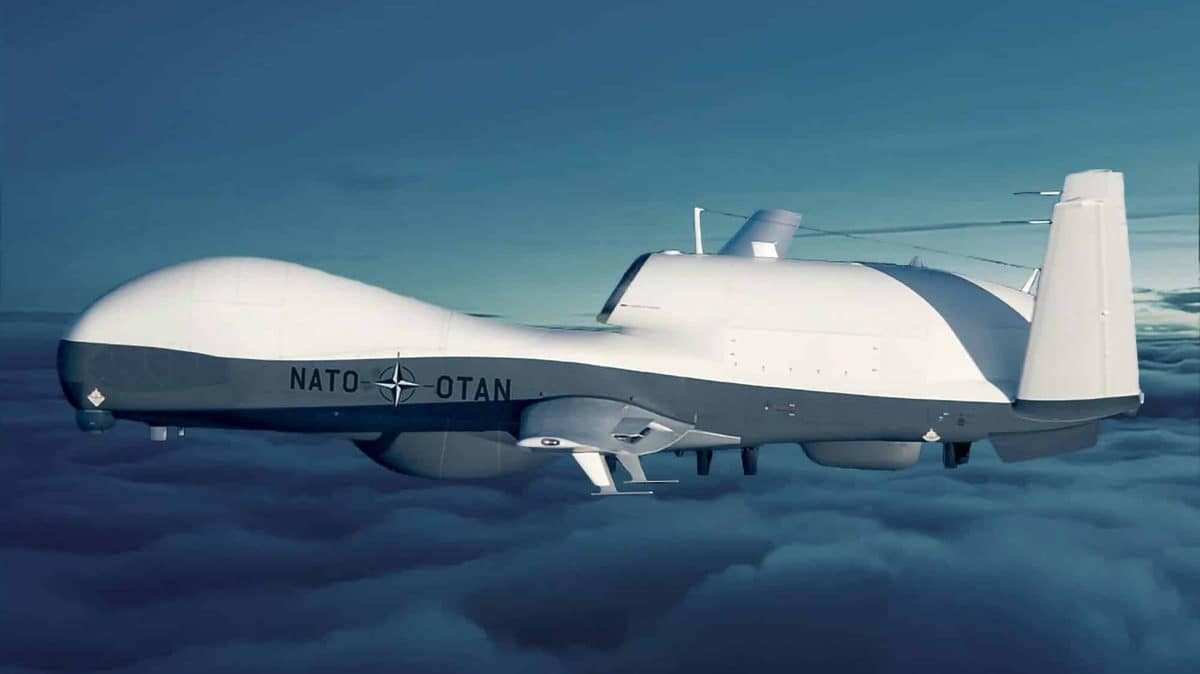
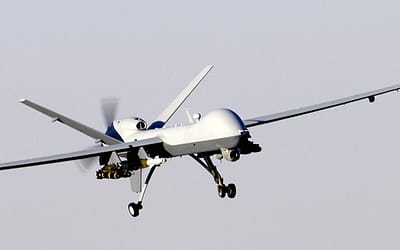
The GlobalEye headline rather overshadowed the day's second act. Denmark, Finland, Germany and Norway signed a letter of intent for up to five Northrop Grumman MQ-4C Triton high-altitude surveillance drones, to reinforce NATO's own intelligence, surveillance and reconnaissance force alongside the RQ-4D Phoenix fleet at Sigonella.
The Triton is a maritime creature: flights beyond 24 hours above 50,000 feet, with sensors built to watch sea lanes across millions of square miles. NATO says the aircraft will support operations "in demanding regions, such as the Arctic and the High North," which tells you precisely whose submarines everyone is thinking about. A letter of intent is not a contract, bien sûr, but four Nordic-adjacent treasuries rarely sign such letters for sport.
Notably, the arrangement is a genuine industrial marriage: Northrop Grumman builds the air vehicles, while Airbus Defence and Space and other European firms provide the ground segment, data management and mission support. "It is genuinely made in NATO, and creating jobs on both sides of the Atlantic," Rutte said.
And the Atlas Shall Carry Europe
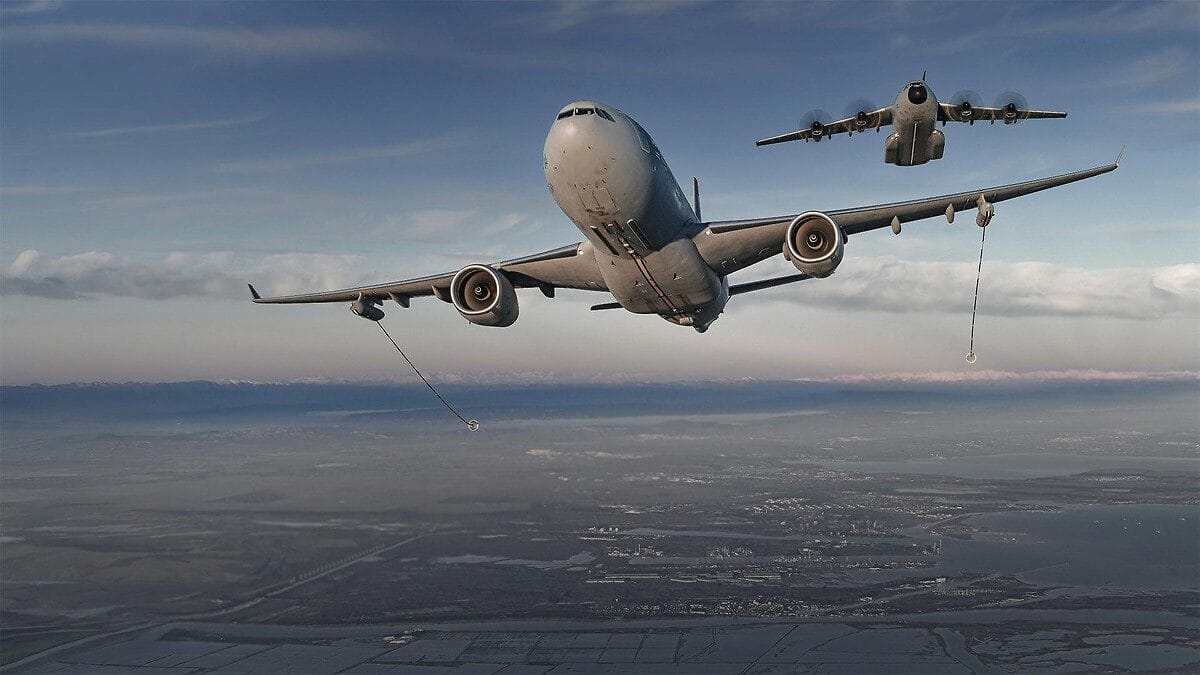
The third announcement is, to this writer, the most quietly consequential. Belgium, Croatia, France, Poland, Spain, Türkiye and the United Kingdom launched a High Visibility Project to create a pooled, multinationally owned fleet of Airbus A400M transports, explicitly modelled on the pooling-and-sharing logic of the Multinational MRTT tanker fleet at Eindhoven.
That tanker pool grows too: Finland became its ninth member, and Rutte announced one more A330 MRTT for the fleet, its tenth aircraft on the path to a planned twelve. "It is about air power, which is essential to strengthen our deterrence and defence," he said. For the A400M, whose export ledger has long been thinner than its capabilities deserve, a NATO-badged fleet is a vote of confidence Airbus will savour, even if the initial pool draws on aircraft already flying, with new orders a question for later.
Add it together and a pattern emerges. The surveillance backbone: Swedish. The tanker and transport backbone: Airbus. The drones: American airframes wrapped in European ground infrastructure. Europe is not merely spending more; it is buying, increasingly, from itself, and doing so without slamming the transatlantic door.
A final note of sobriety, as always. Nothing announced Tuesday is a signed contract. The GlobalEye must survive negotiations with the NSPA; the Tritons rest on a letter of intent; the A400M pool is a framework awaiting flesh. Summits produce announcements the way Provence produces lavender, and some of it fades.
But the direction is unmistakable. As Washington trims its contributions to alliance enablers, Europe is assembling, piece by piece, its own eyes, its own tankers and its own airlift. The E-3's rotating radome served for nearly half a century as the very silhouette of NATO. Its successor will be smaller, Swedish and shared. Voilà the new architecture.
Sources: Reuters, Saab, NATO, Airbus, Associated Press via PBS News, Breaking Defense
Domande correlate
What is the Saab GlobalEye?
The GlobalEye is a Swedish airborne early warning and control (AEW&C) aircraft built by Saab on a Bombardier Global 6000 business-jet airframe, carrying the Erieye ER radar. NATO confirmed on 7 July 2026 that it will negotiate to buy up to ten of them — a program Reuters values at roughly $4.5 billion.
How many GlobalEyes is NATO buying?
NATO will open formal negotiations with Saab for up to ten GlobalEye aircraft. No contract is signed yet — Saab itself stressed it 'has not signed a contract or received an order' — but eleven allies back the buy, and deliveries could begin in 2030 if negotiations conclude soon.
What will replace NATO's AWACS fleet?
The Saab GlobalEye will replace NATO's 14 remaining Boeing E-3A AWACS aircraft, though not one-for-one. The move ends decades of American-built radar aircraft in the role — a shift first reported when NATO's pick of the Swedish jet leaked, and a milestone in how AWACS-style aircraft have shaped air warfare since the 1970s.
How much does a GlobalEye cost?
Saab CEO Micael Johansson put the price at $400–450 million per aircraft. The overall NATO program for up to ten jets is valued by Reuters at roughly $4.5 billion, with deliveries possible from 2030 if a contract is signed soon.
Which NATO countries back the GlobalEye purchase?
Eleven allies, per NATO: Belgium, Canada, Denmark, Germany, Latvia, Lithuania, Luxembourg, the Netherlands, Norway, Romania and Sweden. The buy is part of a wider push for European-owned capabilities as America trims its NATO commitments.
What else did NATO announce alongside the GlobalEye deal?
Denmark, Finland, Germany and Norway signed a letter of intent for up to five MQ-4C Triton surveillance drones; seven nations launched a pooled A400M airlift fleet; and Finland joined the multinational A330 MRTT tanker pool, which gains one more aircraft. Every element now moves to negotiation.

0 Commenti