

Here is a strange way to predict a North Korean missile test. Open a flight-tracking website, and watch for a single, ageing American jet to take off from Nebraska, cross the Pacific, and start flying long racetrack patterns over the Yellow Sea. When that aircraft appears, something is about to be launched.
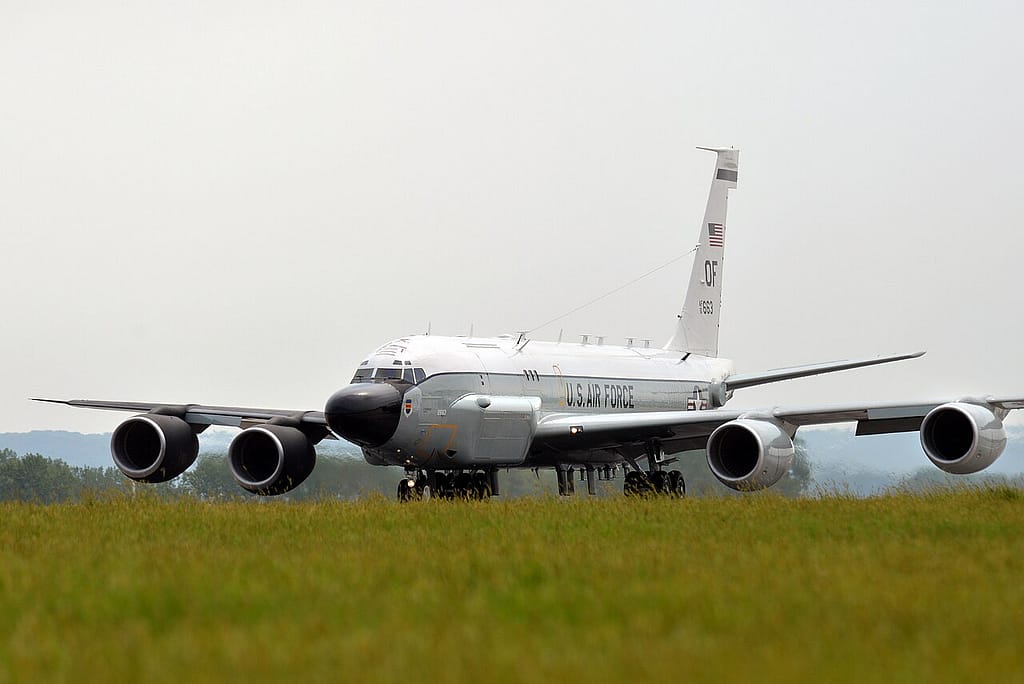
The jet is the RC-135S Cobra Ball, and it is one of the rarest and least-photographed aircraft in the United States Air Force. There are only three of them. Two things make it instantly recognisable to the handful of people who know what they are looking at: it is a 1960s Boeing airliner bristling with telescopes, and one of its wings is painted black.
It is not a stealth aircraft. It is not fast. It carries no weapons. And yet it may be the single most strategically valuable aeroplane the Air Force owns, because its job is to watch other people's missiles fly — and to see them better than anyone else on Earth.
Informazioni rapide
Aeromobili: Boeing RC-135S Cobra Ball (C-135 / 707 airframe)
Ruolo: MASINT — tracking ballistic missiles during boost and re-entry with electro-optical sensors
Costruito: four converted; three remain in service
Operatore: 45th Reconnaissance Squadron / 97th Intelligence Squadron, 55th Wing, Offutt AFB, Nebraska
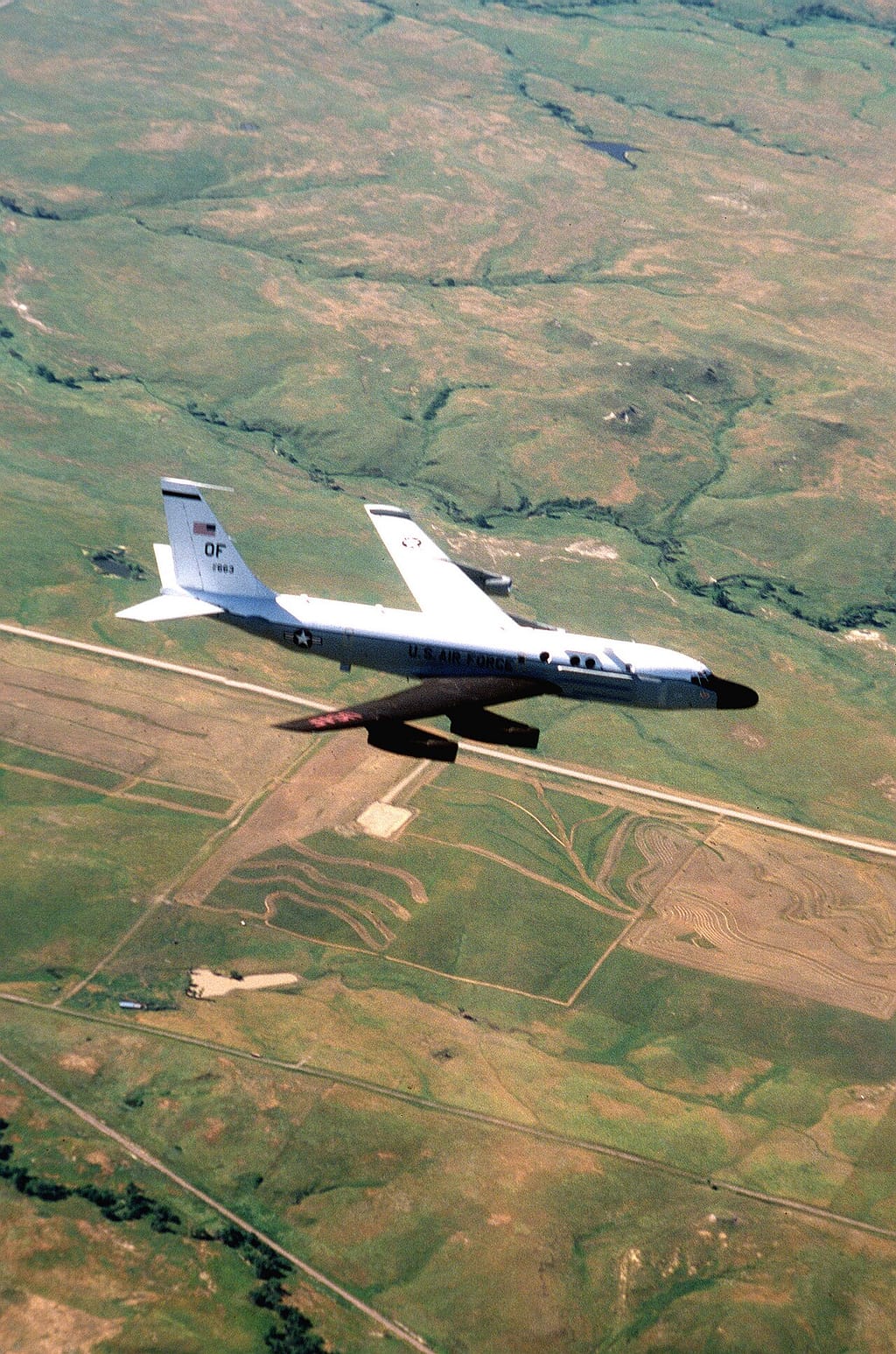
Signature feature: the starboard wing and inner engine nacelles painted black to cut sun glare into the cameras
Designation since: 24 October 1969, replacing Rivet Ball and Rivet Amber
One Wing Painted Black
Start with the wing, because everyone does. When the first Cobra Ball came back from its Big Safari modification, crews found that sunlight bouncing off the polished upper surface of the starboard wing was flooding the optical sensors and washing out their images. The fix was gloriously low-tech: paint that wing, and the inner sides of its engine nacelles, matte black. It worked, and it stuck. Every Cobra Ball since has flown lopsided in colour, bright on one side and black on the other.
Under the skin sits the reason for all that care about glare. The aircraft carries linked electro-optical instruments — systems known as the Real Time Optics System and the Large Aperture Tracker System — that can lock onto a missile hundreds of kilometres away and record its plume, its speed, and the behaviour of its re-entry vehicle in the final seconds of flight. This is MASINT, measurement and signature intelligence: not listening to radio chatter, but measuring the physical fingerprint of a weapon in the act of flying.
The Cobra Ball's mission, explained.
Born to Watch the Soviets
The Cobra Ball was a child of the Cold War arms race. It took its current name on 24 October 1969, replacing two earlier missile-watchers called Rivet Ball and Rivet Amber, and for years it flew from bleak, wind-scoured Shemya at the tip of the Aleutian Islands. From there it shadowed Soviet missile tests arcing toward the Kamchatka peninsula, working in concert with a ground radar called Cobra Dane and a tracking ship called Cobra Judy — a whole family of "Cobra" sensors aimed at the same target.
Only four were ever converted, and today just three remain. That scarcity shapes everything about how the fleet is flown and guarded.
The Jet That Announces a Missile Test
Here is the modern twist. Because civilian flight-trackers like Flightradar24 pick up the aircraft's transponder, open-source watchers have learned to read a deploying Cobra Ball as a warning light. When one leaves Offutt and turns up orbiting off the Korean coast, a launch is usually imminent — the Air Force has moved its irreplaceable eye into position because it knows something is coming.
It has paid off repeatedly. When North Korea launched its Hwasong-15 intercontinental missile in 2017, a Cobra Ball was already airborne to capture the data. When Pyongyang attempted a satellite launch years later, GPS records placed an RC-135S waiting in international airspace over the Yellow Sea, between China and the peninsula, ready to record every second of the flight.
Why a subsonic airliner is one of the most valuable spy planes in the fleet.
Three of a Kind
The glamorous strategic reconnaissance jets get the posters. The SR-71 Blackbird e il U-2 Dragon Lady are household names. The Cobra Ball, a converted airliner with mismatched wings, is not — and that suits everyone concerned just fine. It does its most important work in plain sight and near-total anonymity.
The airframes are old, dating to the era of the first jetliners, and have been re-engined to keep flying. But there is no queue of replacements: the sensors, the crews and the decades of accumulated know-how cannot be conjured overnight, which is exactly why a squadron so small guards its three aircraft so jealously. As long as somebody, somewhere, is testing a ballistic missile, a lopsided grey-and-black Boeing will take off from Nebraska and go watch it fly.
A Cobra Ball fly-by at Offutt AFB.
Sources: U.S. Air Force fact sheets; Air & Space Forces Magazine; GlobalSecurity.org; Newsweek; Key Aero; Offutt AFB news.
0 Commenti