
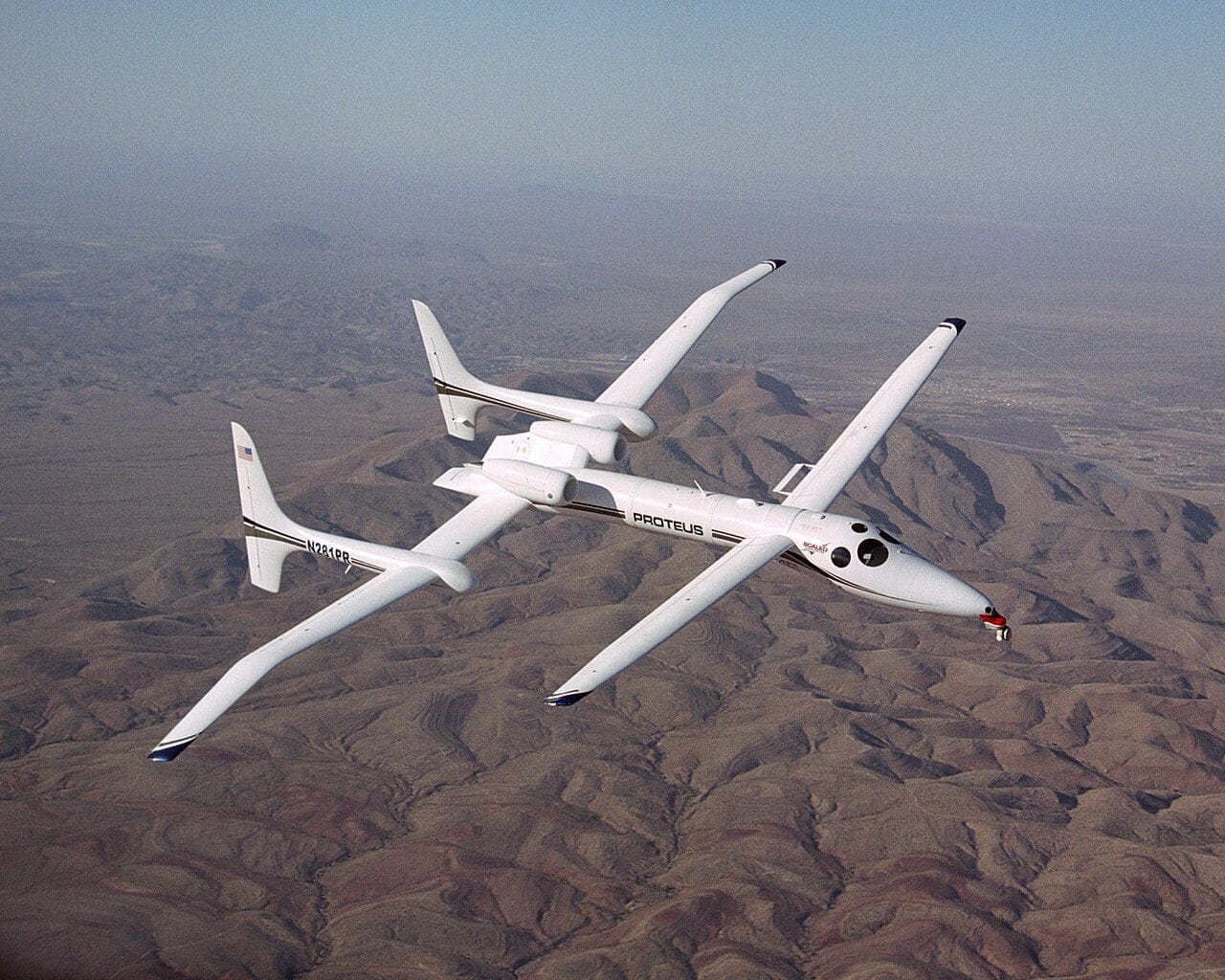
Some aircraft look powerful. A few look beautiful. The Scaled Composites Proteus looks impossible, a spindly, insect-like machine of twin booms, stalky tandem wings and a slender pod, apparently held together by optimism. It seems far too fragile to fly. And yet this strange creation of the legendary Burt Rutan has spent more than a quarter of a century soaring higher and longer than almost anything else in the sky, and setting records while it does.
Named after the shape-shifting sea god of Greek myth, the Proteus was built to be many aircraft in one: a telecommunications relay, a high-altitude research platform, a sensor testbed. It shape-shifts its mission, not its form, and it is one of the most quietly remarkable aircraft flying today.
Informazioni rapide
| Aeromobili | Scaled Composites Model 281 Proteus |
| Designer | Burt Rutan / Scaled Composites |
| Primo volo | 26 July 1998, at Mojave |
| Configurazione | All-composite tandem-wing, twin-boom, two Williams FJ44 turbofans |
| Apertura alare | 77 ft, extendable to 92 ft with removable tips |
| Performance | Above 60,000 ft for up to 18 hours |
| Named after | Proteus, the shape-shifting Greek sea god |
| Records | Multiple altitude-with-payload world records in its class, 1998 |
Designed to Loiter at the Edge of Space
Rutan built the Proteus to answer a very 1990s question: could an aircraft loiter high over a city for hours, acting as a kind of low-flying satellite to relay broadband data? To do that job it needed to fly extraordinarily high, stay up extraordinarily long, and carry a useful payload while sipping fuel. The answer he came up with looks nothing like a conventional aeroplane.
The all-composite structure is astonishingly light. Two small Williams turbofans give just enough thrust. Long, high-aspect-ratio wings, arranged in tandem, provide huge lift for minimal drag. And a ventral pylon under the fuselage can carry a large payload, originally an 18-foot telecommunications antenna. The result can orbit a fixed point above 60,000 feet for the better part of a day.
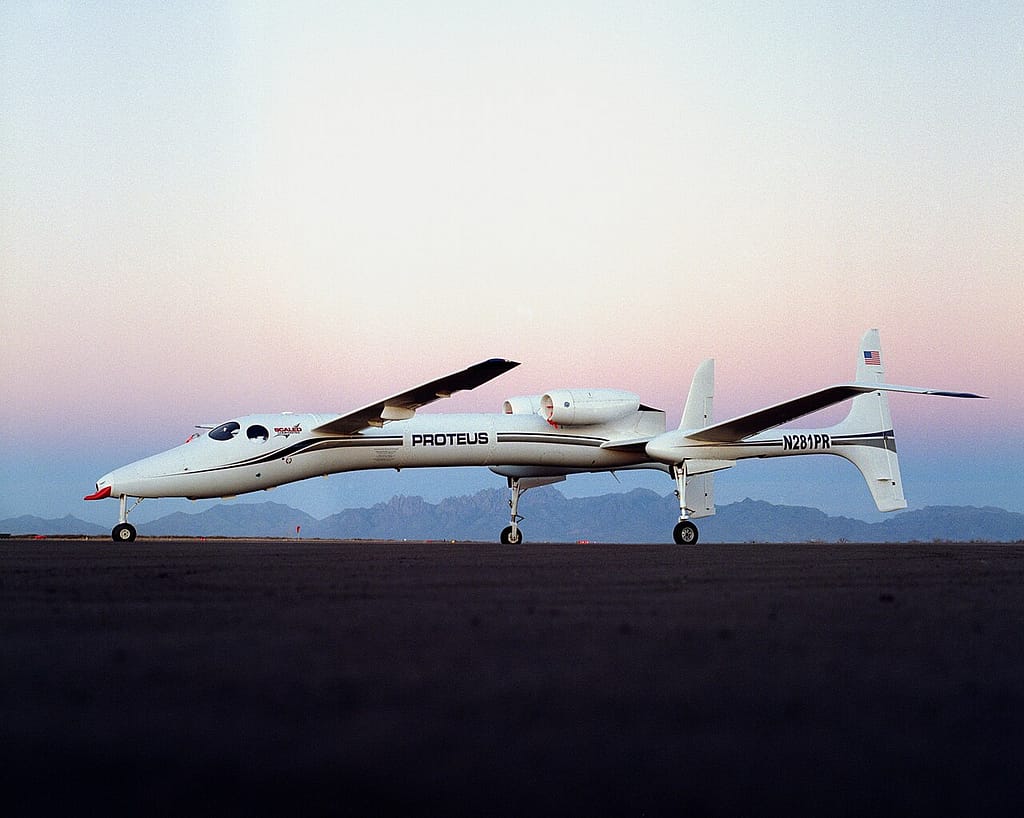
Records and a NASA Partnership
Almost as soon as it flew in 1998, the Proteus began rewriting the record books, setting a string of world altitude records for its weight class. Its efficiency was simply in a league of its own. NASA took notice quickly, folding the Proteus into its Environmental Research Aircraft and Sensor Technology programme and helping Scaled develop a sophisticated station-keeping autopilot so the aircraft could hold a precise orbit high above the Earth for hours on end.
The Aircraft That Keeps Reinventing Itself
What has made the Proteus endure is exactly the versatility its name promises. Over the years it has carried atmospheric research instruments, imaging and radar sensors, and a rotating cast of experimental payloads for military and scientific customers. It has been used to test technologies that ended up on satellites and drones. It was even conceived from the outset to be flown optionally by one pilot, two pilots, or as an uncrewed aircraft, decades before that became fashionable.
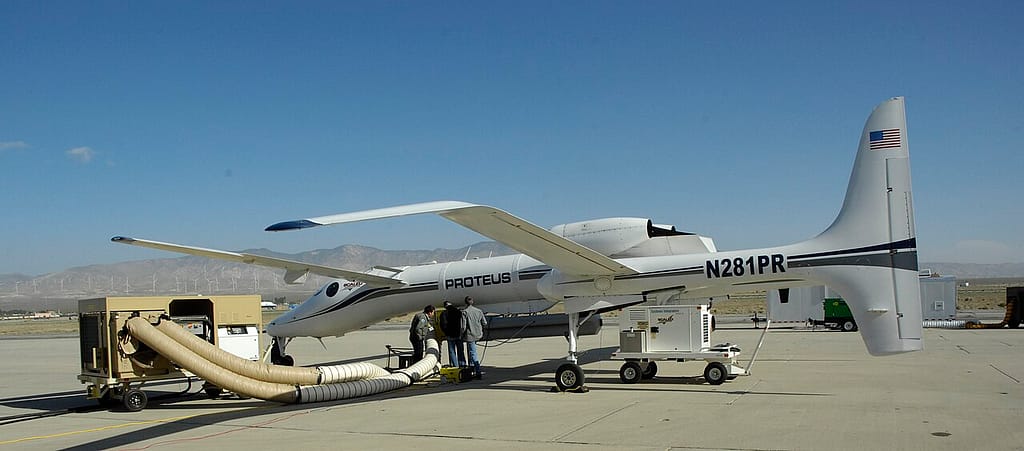
More than 25 years after its first flight, the Proteus is still working, still strange, and still faintly unbelievable to look at. It is the purest expression of Burt Rutan's genius: take a hard problem, throw away every assumption about what an aeroplane should look like, and build exactly, and only, what the job requires. The result flies like a dream, and looks like nothing else on Earth.
Sources: Wikipedia; NASA Dryden fact sheet; Scaled Composites; Plane & Pilot.
0 Commenti