
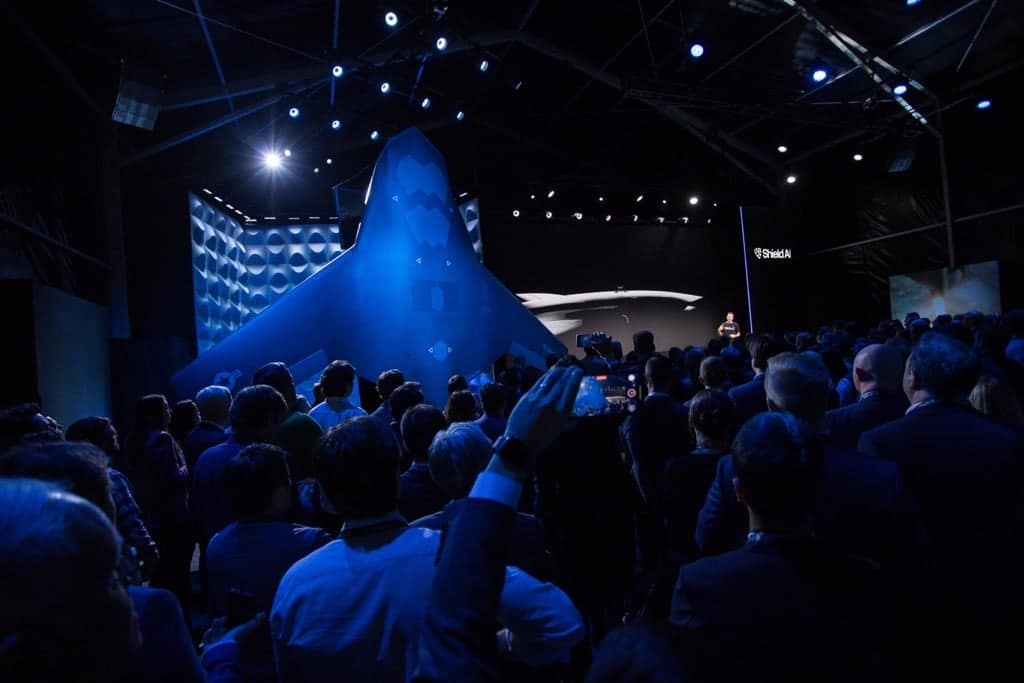
The U.S. Navy just handed Shield AI roughly $50 million to build a jet that doesn’t need a runway, and the U.S. Air Force declined to chip in a single dollar. One service sees the future. The other sees a very expensive question mark and a wallet that’s already empty.
The money, confirmed around 19 August 2026, comes from the Navy’s Rapid Capabilities Office and the Defense Innovation Unit. It funds Shield AI’s X-BAT, an AI-piloted fighter drone that takes off and lands vertically, tail-down, like a fighter that studied SpaceX landings and took notes. The Air Force, meanwhile, is watching from the bleachers with its arms crossed.
Informazioni rapide
- Sistema: X-BAT — AI-piloted VTOL “fighter” drone, a tailsitter that launches and lands vertically
- Produttore: Shield AI (San Diego; founded 2015; also makes the V-BAT and Hivemind autonomy)
- Propulsione: Single General Electric F110-class engine (the same family that powers the F-16)
- Autonomy: Hivemind — the software that flew the X-62A VISTA against a human in a 2024 DARPA dogfight
- Navy/DIU award: ~US$50 million from the U.S. Navy’s Rapid Capabilities Office and DIU under the RIMES program, reported ~19 Aug 2026
- USAF status: Not investing; focused on its Collaborative Combat Aircraft Increment 1 (Anduril YFQ-44A, General Atomics YFQ-42A)
- Claimed specs: 2,000+ nm range, 50,000 ft ceiling, ~US$27M target price; first flight promised before end of 2026
What X-BAT actually is
X-BAT is a tailsitter: it stands on its tail, lights an afterburner, and rises straight up before pitching over into normal flight. Shield AI unveiled it in October 2025, and it is powered by the same General Electric F110 engine class that drives an F-16, wrapped in a smaller, lighter airframe so the thrust can lift it clean off the ground.
No catapult, no arresting wire, no two-mile strip of concrete for an enemy to crater. Shield AI claims more than 2,000 nautical miles of range and a ceiling above 50,000 feet, and says three of them fit in the deck footprint of one legacy fighter. It hasn’t flown yet. First flight is promised before the end of 2026, which in defense-timeline terms means “eventually.”
The brain is Hivemind, Shield AI’s autonomy software, and this part isn’t vaporware. The same system flew the X-62A VISTA, a modified F-16, against a human pilot in a within-visual-range dogfight during a 2024 DARPA trial. X-BAT is meant to be a digital wingman or a lone-wolf striker, thinking for itself when the comms go dark.
Why the Navy moved first
For the Navy, a runway-free fighter isn’t a gimmick, it’s a fleet multiplier. The award falls under a program with the very Navy name of RIMES, for Runway Independent Maritime Expeditionary Strike, and the pitch writes itself: launch and recover strike aircraft from destroyers and amphibious ships, not just the handful of aircraft carriers the fleet fights to protect.
The logistics also happen to fit. Navy ships already haul their own fuel and munitions, so a vertical-launch drone slots into a supply chain that already floats. Suddenly a lot more grey hulls can put airpower over the horizon.
Why the Air Force is sitting this one out
The Air Force isn’t anti-drone, it’s just busy. It already has the Collaborative Combat Aircraft program, whose Increment 1 finalists, the Anduril YFQ-44A and General Atomics YFQ-42A, are conventional, runway-dependent jets that are further along. Bolting on a radically different tailsitter would mean new tactics, new logistics, and new money the service doesn’t have lying around.
There’s also the small matter of physics. As the Mitchell Institute’s Heather Penney has pointed out, an X-BAT’s wings act like a sail during a vertical landing, catching wind and fighting for stability, and mission-level autonomy is genuinely harder than the marketing implies. Landing a fighter-sized aircraft on its tail in a breeze is a feat that would be remarkable if it works reliably.
And the Air Force’s priority list is already a traffic jam: the F-47, the B-21, the Sentinel ICBM, plus the F-35 and KC-46 buys. Shield AI floats an X-BAT price around $27 million, right in CCA territory, but a price target on an unflown jet is a hope, not a receipt.
Two services, two bets
Strip away the hardware and this is a story about risk appetite. The Navy, hungry for ways to fling airpower off any ship in the fleet, is willing to fund an unproven concept to find out if it flies. The Air Force, deep in its own autonomy program and its own budget hole, would rather let someone else pay for the science project and buy it off the shelf later if it pans out.
Both bets are rational. Only one of them ends with a fighter jet standing on its tail on a destroyer’s flight deck, waiting for the word to go. If X-BAT sticks the landing, the Air Force may find “we’re watching” was the most expensive sentence it never had to pay for.
Sources: Shield AI newsroom, Air & Space Forces Magazine, The War Zone, FlightGlobal, Aviation Week.

0 Commenti