
This is Part 1 of The Race for the Bomb, an Afterburner focus series on the science, the aircraft and the men and women behind the atomic bomb — from a London traffic light in 1933 to a mushroom cloud over the Kazakh steppe in 1949.
London, September 1933. A short, round-faced Hungarian refugee stands at a traffic light on Southampton Row, in Bloomsbury, stewing over his morning newspaper. He is 35 years old, stateless, and living out of two suitcases in a hotel room — a habit he acquired in Berlin, where keeping your bags packed had recently become a survival skill. His name is Leo Szilard.
The item that has annoyed him is a report in The Times. At a meeting in Leicester the previous day, Lord Rutherford — the man who discovered the atomic nucleus, the greatest experimental physicist alive — declared that anyone who looked for a source of power in the transformation of the atoms was, in his words, talking moonshine.
The light changes. Szilard steps off the kerb. And somewhere between one pavement and the other, he sees how the great man could be wrong: if there existed an element that, when struck by one neutron, released two, the result would not be moonshine. It would be a chain reaction. It would be a bomb. Nearly every event in this series flows from that single street crossing. But to understand why the idea arrived in 1933 — and why it could not have arrived a year earlier — you have to rewind 38 years, to a darkened laboratory in Bavaria.
Quick Facts: The Physics Revolution
- 8 November 1895 — Wilhelm Röntgen discovers X-rays in Würzburg
- 1 March 1896 — Henri Becquerel finds uranium radiates on its own
- 1898 — the Curies announce polonium (July) and radium (December)
- 1911 — Rutherford unveils the atomic nucleus
- 1913 — Niels Bohr quantizes the atom
- 27 February 1932 — Chadwick announces the neutron in Nature
- 14 April 1932 — Cockcroft and Walton split the lithium atom
- September 1933 — Rutherford says "moonshine"; Szilard conceives the chain reaction
A Glow in the Dark
On 8 November 1895, in Würzburg, Wilhelm Röntgen noticed a faint shimmer on a screen a few feet from his shrouded cathode-ray tube — light where no light should be. Within weeks he had produced the most famous photograph of the century: the bones of his wife Anna Bertha’s hand, her wedding ring floating loose around a finger of shadow. On seeing her own skeleton she reportedly exclaimed that she had seen her death. Röntgen called the mystery radiation X-rays, refused to patent them, and collected the first Nobel Prize in Physics ever awarded.
Three months later in Paris, Henri Becquerel got lucky with bad weather. Late February 1896 was overcast, so he shut his uranium salts and photographic plates in a dark drawer to wait for sunshine. When he developed the plates on 1 March, expecting feeble ghosts, he found intense silhouettes. The uranium had been radiating in the dark, all by itself, with no sunlight to excite it. Matter, it turned out, could leak energy from somewhere inside.
The somewhere-inside became Marie and Pierre Curie’s life work. In a leaky shed on the Rue Lhomond they boiled down a tonne of pitchblende ore, stirring it with an iron rod nearly as tall as Marie herself, to isolate one-tenth of a gram of radium chloride by 1902. They named polonium for her occupied homeland, coined the very word radioactivity, and — like Röntgen — refused to patent any of it.
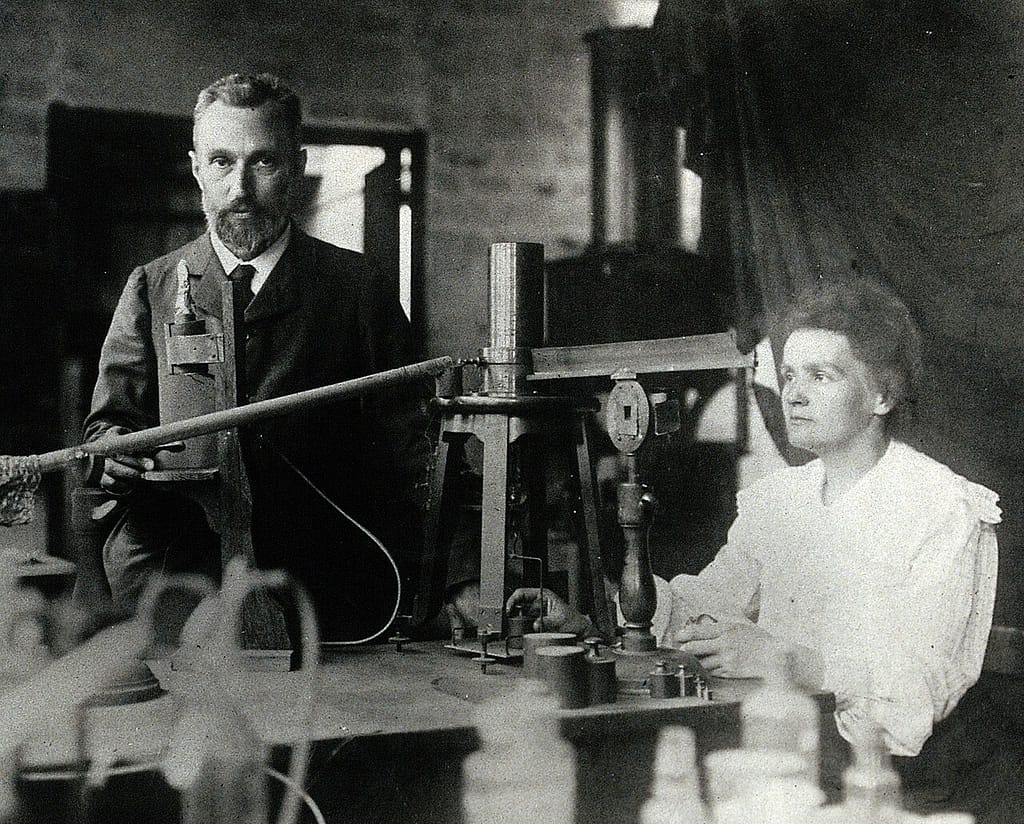
What nobody yet understood was the price. The Curies would return to the shed at night just to look at their work glowing on the shelves.
Marie Curie won the 1903 Nobel in Physics and the 1911 Nobel in Chemistry — still the only person ever to win Nobels in two different sciences. She died in July 1934 of aplastic anaemia, killed slowly by the rays she loved. Her 1890s notebooks remain radioactive to this day; the Bibliotheque nationale stores them in lead-lined boxes, and they will stay dangerous for roughly 1,500 years.
The Shell That Bounced Back
Enter Ernest Rutherford: a booming, moustachioed farm boy from New Zealand who would do more than anyone to open the atom — and then declare the whole business useless. In 1908 the Nobel committee gave him the prize in Chemistry, which amused him greatly; he liked to say that of all the transformations he had studied, none was faster than his own from physicist into chemist.
At Manchester, his assistants Hans Geiger and Ernest Marsden spent 1909 firing alpha particles at gold foil so thin it was barely there. Almost all sailed straight through. But roughly one in 8,000 bounced back. In an atom imagined as a diffuse pudding of charge, that was flatly impossible — like a rifle bullet ricocheting off fog.
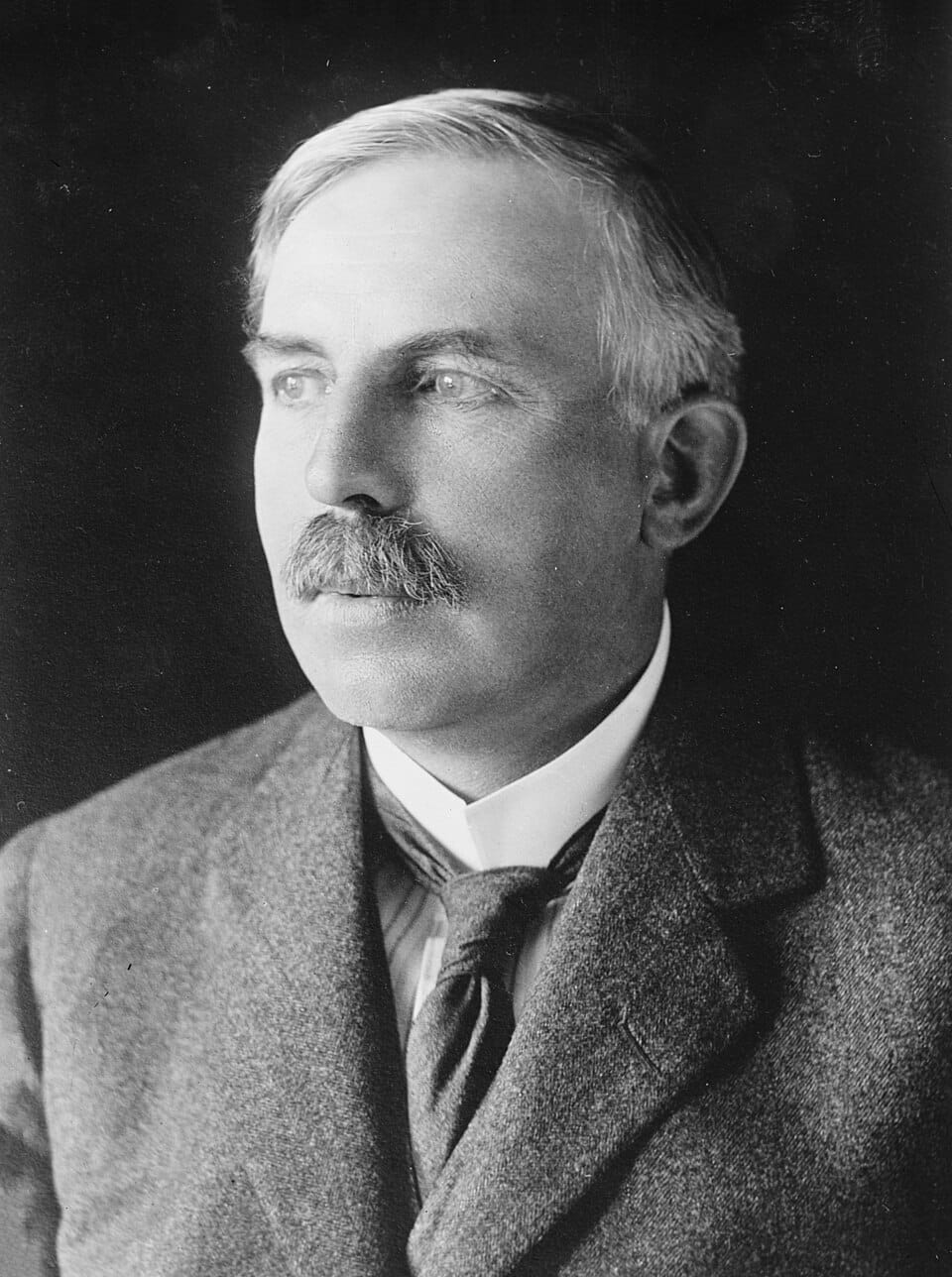
Rutherford’s 1911 answer rewrote reality: nearly all of an atom’s mass and all of its positive charge sit in a nucleus one hundred-thousandth the atom’s size. Matter, including you, is almost entirely empty space. By 1919 he had gone further, knocking protons out of nitrogen nuclei with alpha particles — the first artificially induced nuclear reaction — and taken over the Cavendish Laboratory in Cambridge, the little brick kingdom where the atomic age would be built on a budget. We have got no money, he liked to say, so we have got to think.
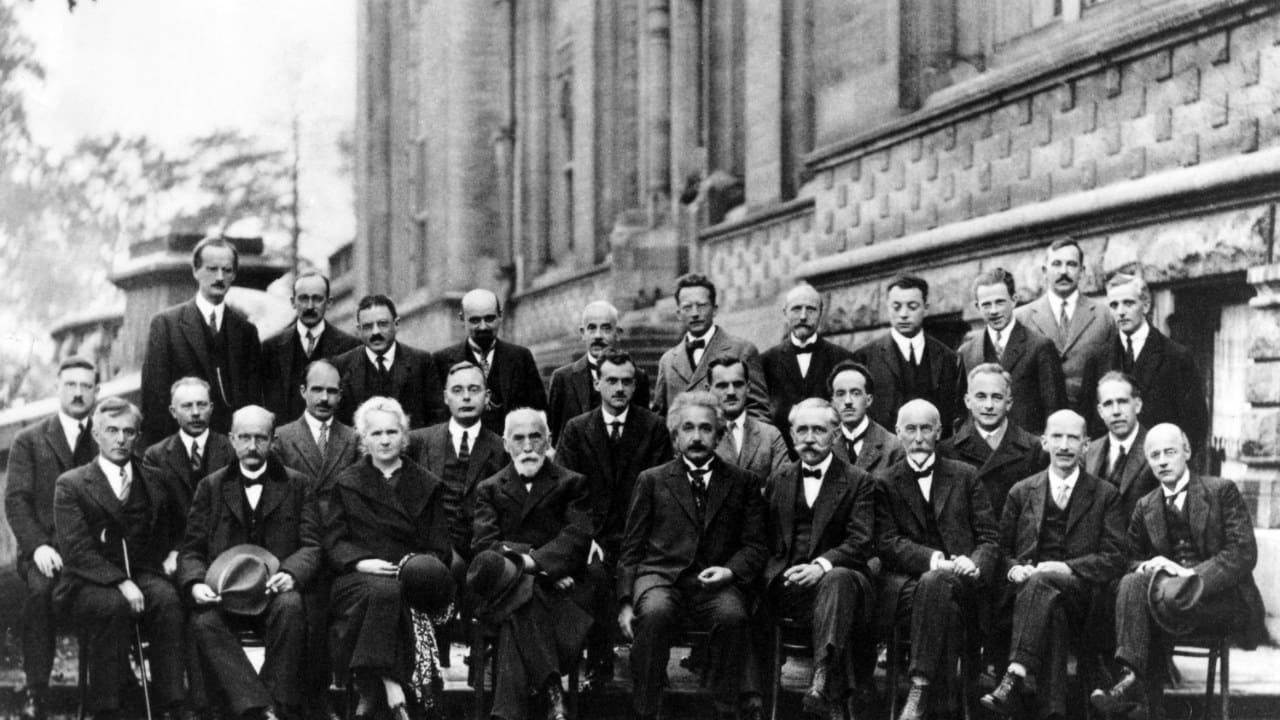
Meanwhile the theorists were making the picture stranger. In 1905 a Swiss patent clerk had published a short afterthought to his relativity paper showing that mass and energy were two faces of the same coin; in 1913 Niels Bohr quantized the atom’s electron orbits. By October 1927, when the fifth Solvay Conference gathered in Brussels for the photograph at the top of this page, 17 of the 29 people in the frame were or would become Nobel laureates. Einstein and Bohr spent the week arguing about whether God plays dice. Nobody in the photograph suspected that the pleasant, applied corner of their science — nuclear physics — was about to swallow the century.
Veritasium visits the most radioactive places on earth — including Marie Curie’s still-contaminated notebooks. A good measure of what the pioneers unknowingly handled bare-handed.
The Miracle Year
Then came 1932, the year the toolbox filled up. In February, James Chadwick at the Cavendish read a puzzling French result — the Joliot-Curies had produced a strange penetrating radiation and misread it as gamma rays — and knew instantly what he was looking at, because Rutherford had predicted a neutral nuclear particle back in 1920. Chadwick worked in a near-sleepless frenzy for about two weeks, firing beryllium radiation into paraffin wax and measuring what came out. On 27 February 1932 Nature published his letter: Possible Existence of a Neutron.
The neutron changed everything, though almost nobody noticed at the time. Carrying no charge, it is the skeleton key of the nucleus: it cannot be repelled, so it walks straight through the electric fortress walls that keep protons and alpha particles out. Every reactor and every atomic weapon that followed is, at bottom, a machine for putting neutrons where they can do work. Chadwick got the 1935 Nobel for it.
Six weeks after Chadwick’s letter, on the evening of 14 April 1932, a young Irishman named Ernest Walton crawled into a lead-shielded hut under a stack of glowing electrodes at the Cavendish and saw scintillations sparkle across his screen: helium nuclei, flying apart from split lithium atoms. He and John Cockcroft had disintegrated a nucleus with artificially accelerated protons — the first men to split the atom by machine. Rutherford was summoned, sworn to secrecy, and that same evening the letter to Nature was drafted at his kitchen table. The two would share the 1951 Nobel.
So by the end of 1932 physics possessed the nucleus, the neutron, E=mc² and a machine for cracking atoms open. Every component of the atomic age existed. What did not exist was anyone in power who believed it mattered.
Moonshine
Which brings us back to September 1933. At the British Association meeting in Leicester on the 11th, Rutherford surveyed his life’s work and pronounced its future dead on arrival. The energy locked in the nucleus was real, he conceded, but getting more out than you put in was fantasy. The Times printed the verdict the next morning: anyone who looked for a source of power in the transformation of the atoms was talking moonshine.
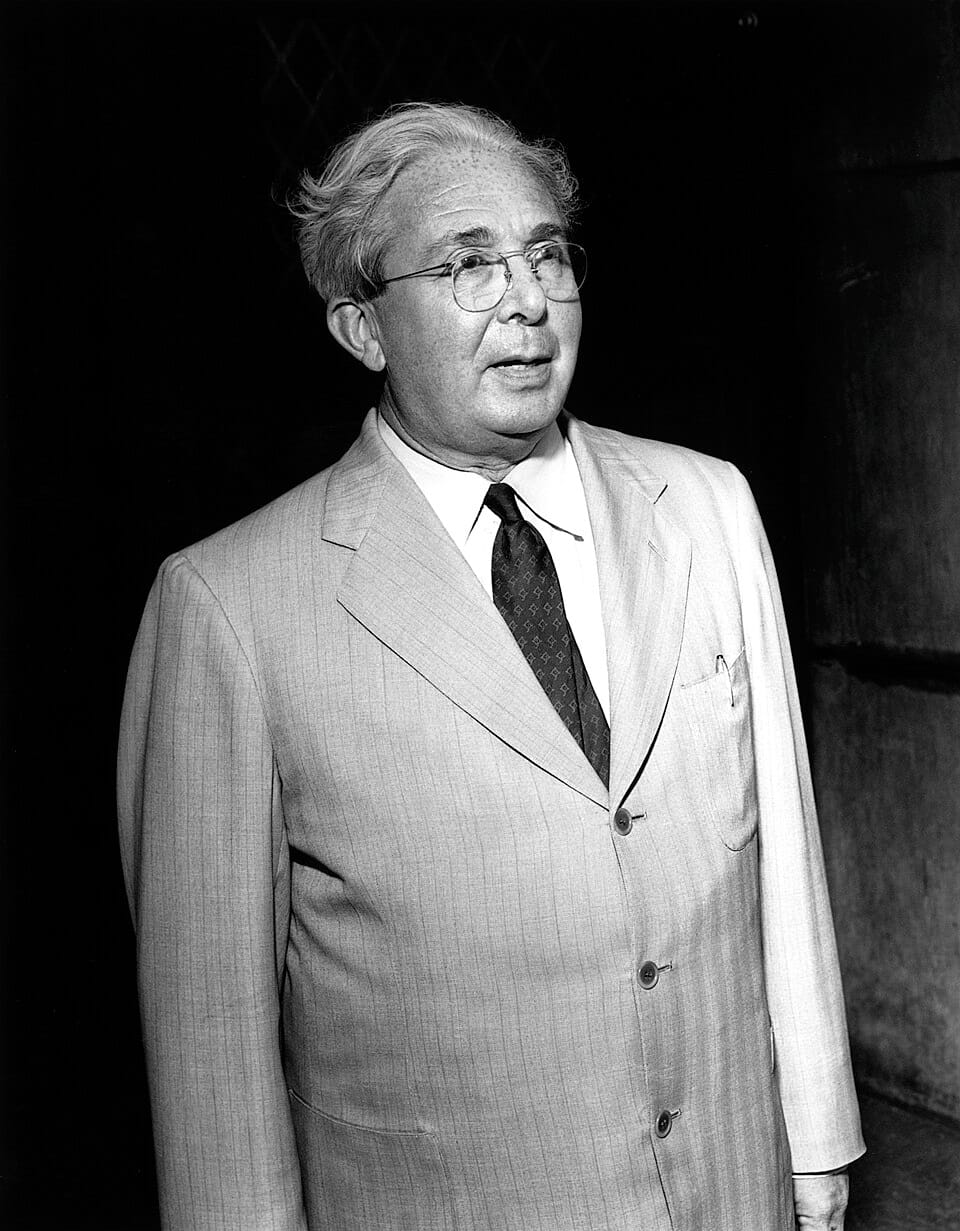
Szilard read it over breakfast — a refugee with a packed suitcase and a low tolerance for the word impossible. Days after the speech, at the light on Southampton Row, the pieces snapped together. Chadwick’s neutron needed no energy to enter a nucleus. If some element emitted two neutrons for each one absorbed, the process would feed itself, doubling and redoubling in millionths of a second.
Szilard did not know which element would do it — he guessed beryllium, wrongly — but he understood the consequences immediately, and they terrified him. In 1934 he filed a patent on the nuclear chain reaction, and in 1936 he did something no inventor had ever done with a physics patent: he assigned it in secret to the British Admiralty, so that the idea would not be published. Five years before anyone demonstrated fission, one man in a London hotel room was already trying to keep the bomb secret.
Rutherford died in October 1937, still unconvinced. Marie Curie was already gone. Neither lived to see the punchline: the element Szilard was looking for had been sitting in Becquerel’s drawer since 1896. It was uranium — and in a Berlin laboratory five years after Southampton Row, two careful German chemists were about to split it without meaning to. That story — a diamond ring pressed into an exile’s hand at a Dutch border crossing, and the most consequential Christmas walk in history — is where Part 3 of this series picks up. First, though, Part 2: how Hitler took the finest physics community on earth and mailed it to his enemies.
Crash Course traces the whole arc — Thomson’s electron, Rutherford’s nucleus and Bohr’s quantum atom — in 13 brisk minutes.
Sources: Nobel Prize archives, The Times (12 September 1933) via IOP, Scientific American, CERN Courier, AIP Center for History of Physics, Wikipedia, Richard Rhodes: The Making of the Atomic Bomb.
The Race for the Bomb — an Afterburner Focus Series
Series overview: all ten parts
Next — Part 2: The Martians Who Fled to America
0 Commenti