
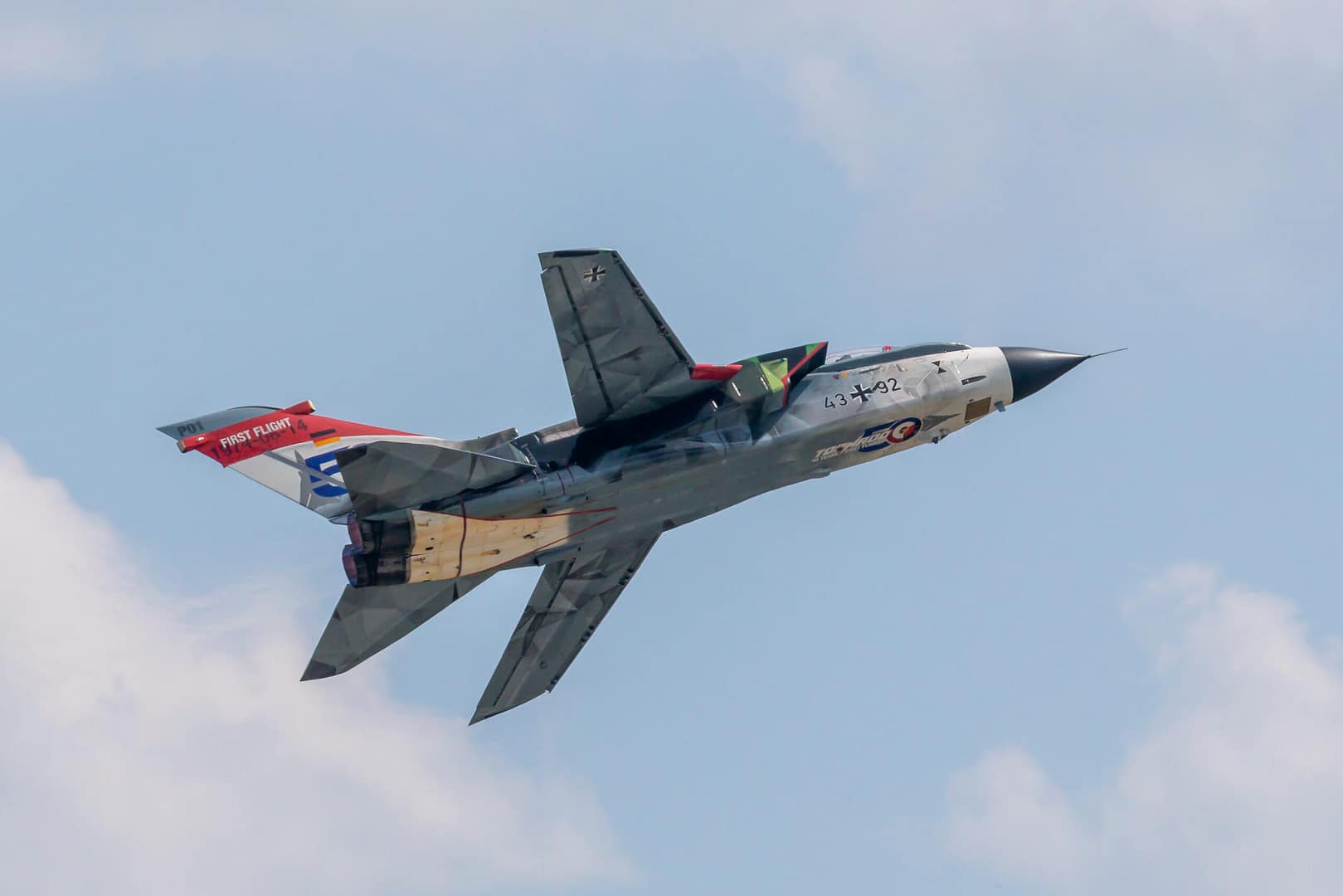
The Germans had a word for it. They always do. When Luftwaffe pilots talked about the Tornado di Panavia, they called it the eierlegende Wollmilchsau — the "egg-laying wool-milk pig." A mythical creature that does everything: lays eggs, produces wool, gives milk, and provides pork. In other words, an aircraft that was expected to be all things to all air forces.
The remarkable thing is that it very nearly was.
The Panavia Tornado is the most successful European military aircraft programme in history. Built by three nations — Britain, Germany, and Italy — it served for nearly half a century, fought in three wars, and proved that a committee-designed, multinational, politically compromised combat aircraft could somehow turn out to be genuinely excellent. That it did so despite everything that should have killed it is one of the great stories in modern aviation.
Born From Necessity
By the late 1960s, Britain, Germany, and Italy each faced the same problem: they needed a new tactical strike aircraft, and none of them could afford to develop one alone. The Americans had the F-111. The Soviets had the Su-24. NATO's European members had nothing in that class — and the threat of massed Warsaw Pact armour pouring through the Fulda Gap made the requirement urgent.
In 1969, the three nations formed Panavia Aircraft GmbH — a joint venture between British Aircraft Corporation (later BAe), Messerschmitt-Bölkow-Blohm (MBB), and Aeritalia. The engine consortium, Turbo-Union, brought together Rolls-Royce, MTU, and Fiat Aviazione to develop the RB199 turbofan. It was, at the time, the most ambitious collaborative defence programme Europe had ever attempted.
The first prototype flew on 14 August 1974. By 1979, the Tornado IDS (Interdictor/Strike) was entering service with the Luftwaffe. The RAF and Aeronautica Militare followed shortly after.
Variable Geometry: The Wing That Won the Cold War
The Tornado's most distinctive feature is its variable-geometry — or "swing" — wings. Swept forward at 25 degrees for takeoff, landing, and loitering, they could sweep back to 67 degrees for high-speed, low-altitude penetration of enemy airspace. This was not a gimmick. It was the fundamental reason the Tornado could do its job.
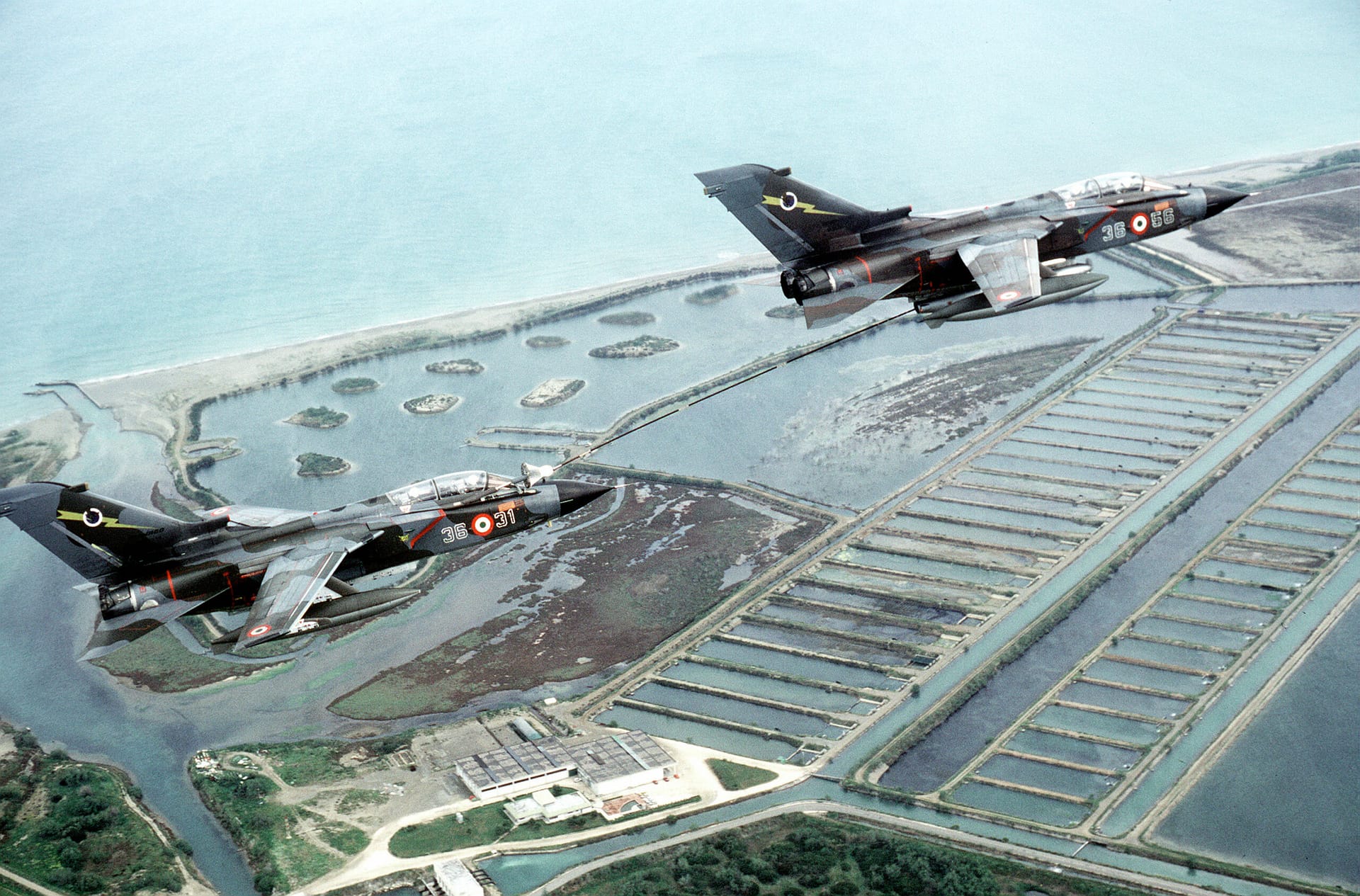
The primary mission was simple in concept and terrifying in execution: fly at 200 feet above the ground, at 600 knots, in any weather, day or night, beneath the Soviet radar coverage, and deliver nuclear or conventional weapons onto targets deep inside Warsaw Pact territory. Then get out alive.
The swept-back configuration minimised drag and turbulence at low altitude, giving the crew a marginally less violent ride through the kind of terrain-following flight that would destroy an airframe — and a crew — designed for higher altitudes. The Tornado's terrain-following radar, coupled with an autopilot that could fly the aircraft hands-off at 200 feet in zero visibility, was decades ahead of anything else in Europe.
Three Variants, Three Missions
The Tornado was built in three main variants, each tailored to different operational requirements.
IL Tornado IDS (Interdictor/Strike) was the original variant — the low-level nuclear and conventional strike platform that formed the backbone of NATO's European tactical air power throughout the Cold War. Germany, Italy, and Saudi Arabia all operated the IDS in significant numbers.
IL Tornado ECR (Electronic Combat/Reconnaissance) was Germany and Italy's dedicated Suppression of Enemy Air Defences (SEAD) variant. Equipped with emitter locator systems and armed with AGM-88 HARM anti-radiation missiles, the ECR's job was to find and destroy enemy radar sites — the most dangerous mission in tactical aviation, and one that the Tornado proved exceptionally good at.
IL Tornado ADV (Air Defence Variant) was Britain's long-range interceptor, designed to patrol the North Sea and Iceland-UK gap against Soviet bombers. With its stretched fuselage carrying four semi-recessed Sky Flash (later AMRAAM) missiles and the Foxhunter radar, the ADV was a very different aircraft from the strike variants — optimised for endurance and missile range rather than low-level speed.
At War: Desert Storm and Beyond
The Tornado's combat debut came in the 1991 Gulf War, and it was brutal. RAF Tornado GR1s were tasked with the most dangerous mission of the air campaign: ultra-low-level attacks on Iraqi airfields using the JP233 runway-cratering weapon. The aircraft had to overfly the target at 200 feet and 550 knots, dispensing submunitions and anti-personnel mines in a single pass directly over the most heavily defended points on the Iraqi air defence network.
Six RAF Tornados were lost in the first week — the highest loss rate of any coalition type. The tactic was abandoned and the aircraft were moved to medium-altitude precision bombing with laser-guided Paveway bombs, a role they performed for the rest of the war with devastating effectiveness. The lesson was clear: the Cold War low-level mission, for which the Tornado had been designed, was suicidal against modern point defences. But the airframe was versatile enough to adapt.
The Tornado went on to serve in Kosovo (1999), Afghanistan (from 2001), Iraq again (2003), and Libya (2011). In each conflict, it proved its worth as a precision strike platform — the low-level mission was gone, but the aircraft's long range, heavy payload, and increasingly sophisticated targeting pods made it a reliable deliverer of smart weapons in permissive airspace.
IL Eierlegende Wollmilchsau in Practice
MiGFlug has worked with pilots from the German Air Force who flew the Tornado throughout their careers, and the affection for the aircraft is real — even if it comes wrapped in typically dry German humour. The nickname eierlegende Wollmilchsau was equal parts admiration and exasperation: admiration for an aircraft that could genuinely do almost everything asked of it, exasperation at the political compromises and maintenance demands that came with a tri-national programme designed by committee.
"It could bomb, it could recce, it could do SEAD, it could intercept," one former Luftwaffe Tornado pilot told us. "The only thing it could not do was be cheap." He was not wrong. The Tornado was expensive to maintain, demanding to fly, and unforgiving of sloppy procedures. But when the weather was terrible, the target was buried in air defences, and the mission had to happen at 200 feet in driving rain at night — there was nothing else in Europe that could do it.
Legacy: The Aircraft That Proved Europe Could Build Fighters
A total of 992 Tornados were built between 1979 and 1998. The RAF retired its last Tornado GR4s in 2019. The Luftwaffe still operates the ECR variant. Italy flies both IDS and ECR versions. Saudi Arabia continues to operate a significant fleet.
But the Tornado's most important legacy is not the aircraft itself — it is the model it created. Panavia proved that three European nations with different languages, different procurement cultures, and different operational requirements could design, build, certify, and deploy a world-class combat aircraft together. Without the Tornado, there would have been no Eurofighter Typhoon. Without the Typhoon, there would be no GCAP (Global Combat Air Programme). The entire structure of European collaborative defence aerospace rests on foundations the Tornado laid.
IL eierlegende Wollmilchsau may not have been perfect. But it did lay eggs. It did produce wool. And for fifty years, it kept NATO's European flank defended by an aircraft that was — against all odds — genuinely very good at its job.
L'ala che ha cambiato forma a mezz'aria
Sources: RAF Historical Society, Panavia Aircraft GmbH, Air Forces Monthly, Aviation Week
Domande correlate
What is the Panavia Tornado?
The Panavia Tornado is a multi-role combat aircraft built jointly by Britain, Germany, and Italy, and the most successful European military aircraft programme in history. Featuring variable-geometry "swing" wings, it served for nearly half a century, fought in three wars, and performed strike, reconnaissance, air-defence, and anti-radar missions. German crews nicknamed it the eierlegende Wollmilchsau — the "egg-laying wool-milk pig."
Why was the Tornado called the "egg-laying wool-milk pig"?
German Luftwaffe pilots called the Tornado the eierlegende Wollmilchsau — a mythical animal that lays eggs, gives wool and milk, and provides pork — because it was expected to do everything for every air force. The nickname mixed admiration for an aircraft that genuinely could bomb, reconnoitre, suppress air defences, and intercept, with exasperation at its cost and maintenance demands.
Why does the Panavia Tornado have swing wings?
The Tornado's variable-geometry wings sweep forward to 25 degrees for takeoff, landing, and loitering, then sweep back to 67 degrees for high-speed, low-altitude flight. This lets one aircraft both operate efficiently at low speed and penetrate enemy airspace at around 600 knots and 200 feet. The same swing-wing concept was used on the F-14 Gatto e MiG-23.
What was the Tornado's primary mission?
The Tornado's primary mission was deep strike: flying at 200 feet above the ground, at 600 knots, in any weather, day or night, beneath Soviet radar coverage to deliver nuclear or conventional weapons onto targets inside Warsaw Pact territory — and then escape. The swept-back wing minimised drag and turbulence at low altitude, giving the crew a survivable ride.
What were the main variants of the Tornado?
The Tornado came in three principal versions. The IDS/GR strike variant performed low-level bombing; the ECR added emitter-location systems and AGM-88 HARM missiles for the dangerous job of destroying enemy radar; and the ADV (Air Defence Variant) was Britain's long-range interceptor, with a stretched fuselage, Foxhunter radar, and Sky Flash (later AMRAAM) missiles for patrolling the North Sea.
Did the Panavia Tornado see combat?
Yes. The Tornado's combat debut came in the 1991 Gulf War, where RAF Tornado GR1s flew some of the most dangerous missions of the air campaign — ultra-low-level attacks on Iraqi airfields with the JP233 runway-cratering weapon, overflying targets at 200 feet and 550 knots. It went on to serve in multiple later conflicts across nearly half a century.
Which countries built and flew the Tornado?
The Tornado was developed and built by three nations — Britain, Germany, and Italy — through the multinational Panavia consortium. All three flew it operationally for around four decades, with the RAF, the German Luftwaffe and Marineflieger, and the Italian Aeronautica Militare operating the type. It proved a committee-designed, multinational aircraft could still be genuinely excellent.
How does the Tornado's swing wing compare to other variable-geometry aircraft?
The Tornado was one of several Cold War aircraft to adopt variable-geometry wings, a concept also used on the American F-14 Tomcat and the Soviet MiG-23. Swing wings let designers reconcile the conflicting demands of low-speed handling and high-speed penetration in one airframe. For the Tornado, it was the fundamental reason the aircraft could fly its low-level strike mission.

0 Commenti