

Come funziona: il sedile eiettabile
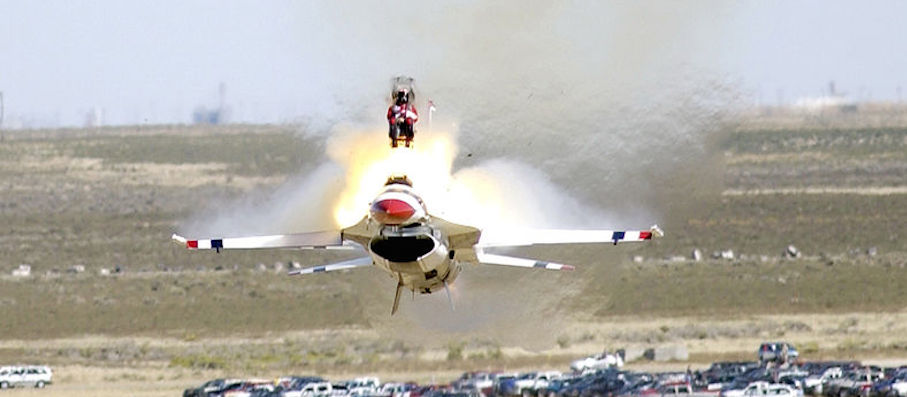
Sedile eiettabile F-16 - Foto dell'aeronautica militare statunitense scattata dal sergente Bennie J. Davis III.
La mia testa era gonfia come un pallone da basket, le mie labbra erano gonfie come cetrioliQuesta citazione è del Capitano Brian "Noodle" Udell che si è eiettato dal suo F-15 a velocità supersonica (scorri verso il basso per vedere il suo video). Il vento è molto forte a velocità così elevate. Ecco come funziona il sedile eiettabile: Parte 1: Parte 2:
Il capitano Brian Udell si eietta a velocità superiore a Mach 1.
Il caso peggiore è quello di eiettarsi a velocità supersonica. Questo è ciò che dovette fare il Capitano Brian "Noodle" Udell. Il suo McDonnell Douglas F-15 era fuori controllo e dovette eiettarsi a 1290 km/h, ovvero 800 miglia orarie. Mancavano pochi secondi allo schianto dell'F-15, quindi Udell ordinò l'eiezione. Fortunatamente sopravvisse all'eiezione, ma dovette lottare per la vita per ore. Sfortunatamente, il suo navigatore non fu altrettanto fortunato.Il sedile eiettabile russo Svezda K-36D
I russi sono all'avanguardia nello sviluppo di sedili eiettabili, che proteggono il pilota in modo estremamente efficace. Si afferma che possano essere utilizzati a velocità doppie rispetto a quella del suono. Per individuare la traiettoria di volo ottimale, vengono presi in considerazione oltre 200 parametri.Domande correlate
Come funziona un sedile eiettabile?
Quando un pilota tira la maniglia, un sedile eiettabile sgancia prima la calotta, poi un razzo o una catapulta esplosiva spinge il sedile e il pilota verso l'alto e lontano dall'aereo. Un paracadute stabilizza il sedile, che poi si separa, e il paracadute principale si apre per l'atterraggio. I sedili moderni automatizzano l'intera sequenza in frazioni di secondo; vedi come funzionano realmente i sedili eiettabili.
È pericoloso eiettarsi da un aereo da caccia?
L'eiezione è l'ultima risorsa – i piloti tentano sempre prima l'atterraggio – perché le forze in gioco sono violente, soprattutto ad alta velocità. Il capitano Brian "Noodle" Udell si è eiettato da un F-15 fuori controllo a velocità supersonica ed è sopravvissuto, ma è rimasto gravemente ferito dal getto d'aria; il suo navigatore non ce l'ha fatta. L'eiezione salva vite umane, ma comporta seri rischi.
È possibile eiettarsi da un aereo a velocità supersonica?
Sì, ma è il caso peggiore. Il capitano Brian Udell si è eiettato dal suo F-15 a circa 1.290 km/h (800 mph), più veloce della velocità del suono. A tale velocità il vento è incredibilmente forte – Udell ha descritto il suo viso e i suoi arti gonfiarsi in modo drammatico – e la sopravvivenza è tutt'altro che garantita, motivo per cui i piloti evitano le eiezioni ad alta velocità quando possibile.
Qual è il miglior sedile eiettabile al mondo?
Il sedile eiettabile russo Zvezda K-36D è ampiamente considerato uno dei più efficaci, in grado di proteggere i piloti anche a velocità estreme, risultando utilizzabile fino al doppio della velocità del suono. Il sistema prende in considerazione oltre 200 parametri per calcolare la traiettoria di fuga ottimale, offrendo al pilota le migliori possibilità di sopravvivenza.
Quando è avvenuto il primo lancio di emergenza con il paracadute da un aereo?
Molto prima dei sedili eiettabili, i piloti si affidavano ai lanci manuali. Il primo salto di emergenza con un paracadute a caduta libera fu effettuato da Harold Harris nel 1922, una pietra miliare nella storia della fuga dagli aerei raccontata in il primo uomo salvato da un paracadute. I sedili eiettabili furono in seguito automatizzati e velocizzarono notevolmente la fuga.


0 Comments