
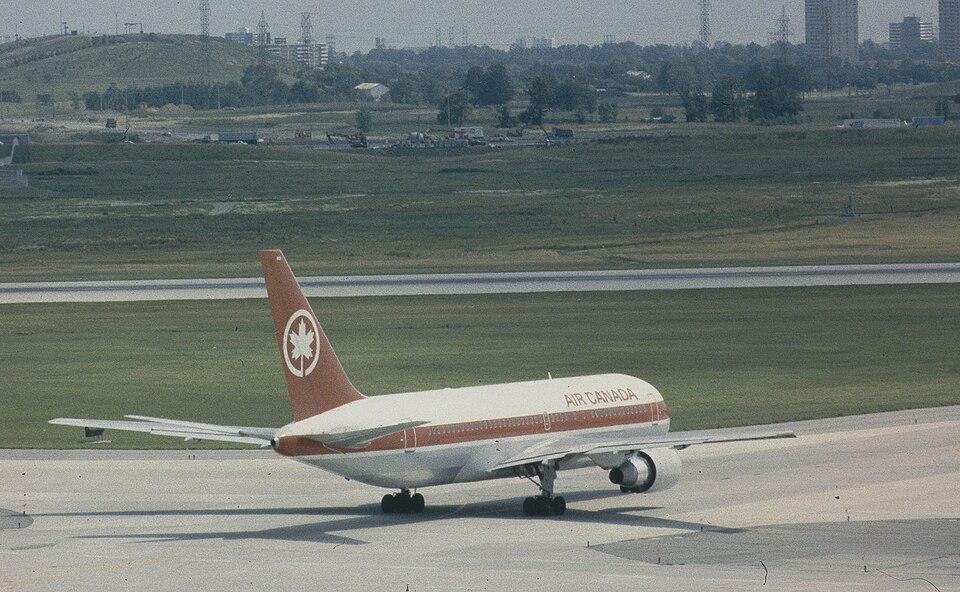
| Informazioni rapide | |
|---|---|
| Data | July 23, 1983 |
| Volo | Air Canada Flight 143, Montreal to Edmonton |
| Aeromobili | Boeing 767-233 (C-GAUN) |
| Capitano | Robert Pearson |
| First Officer | Maurice Quintal |
| Fuel Loaded | 22,300 lbs (should have been 22,300 kg) |
| Altitude at Flame-Out | 41,000 feet |
| Landing Site | Gimli Industrial Park (former RCAF station), Manitoba |
| Casualties | 0 fatalities, minor injuries |

At 41,000 feet over Red Lake, Ontario, both engines of Air Canada Flight 143 went silent. Not a sputter. Not a gradual loss of power. Both Pratt & Whitney JT9D turbofans quit simultaneously, starved of the one thing a jet engine cannot operate without: fuel. The Boeing 767 — one of the most advanced airliners in the world, on only its 12th revenue flight for Air Canada — had run dry.
The cockpit went dark. The glass displays blanked. The flight controls stiffened as hydraulic pressure bled away. Captain Robert Pearson and First Officer Maurice Quintal were now flying a 132-ton glider at eight miles above the Canadian prairies, with 69 souls on board and no power of any kind.
What happened next is one of the most extraordinary pieces of flying in aviation history.
The Error That Started Everything
Canada was in the middle of converting from imperial to metric measurements. The Boeing 767 was Air Canada's first metric aircraft — its fuel system measured in kilograms, not pounds. The ground crew at Montreal calculated the fuel load in pounds. The cockpit instruments read in kilograms. Nobody caught the mismatch.
The aircraft needed 22,300 kilograms of fuel for the flight to Edmonton. It received 22,300 pounds — less than half the required amount. A kilogram is 2.2 pounds. The error was a factor of 2.2, and it meant the 767 was carrying roughly 10,000 kilograms of fuel instead of 22,300. Not nearly enough to cross the country.
The fuel gauges on this particular aircraft were inoperative — a known defect that maintenance had deferred under a minimum equipment list provision. The crew relied on a manual dipstick measurement of the fuel in the tanks, converted using the wrong factor. Every layer of redundancy that should have caught the error had failed.
Gliding a 767
When both engines quit, the 767's ram air turbine deployed — a small propeller-driven generator that drops from the belly and uses the airflow to provide minimal hydraulic and electrical power. It kept the basic flight instruments alive and gave the pilots just enough hydraulic pressure to move the control surfaces. Barely.
Captain Pearson was a glider pilot. Not as a hobby — as a competitive, experienced sailplane pilot who understood energy management in ways that most airline pilots never needed to. He knew instinctively that the 767, without engines, was now a glider with a finite amount of altitude to trade for distance. Every foot of height was currency, and he had to spend it precisely.

The glide ratio of a clean 767 at high altitude is approximately 12:1 — for every foot of altitude lost, it travels roughly 12 feet forward. From 41,000 feet, that gave them approximately 100 miles of range. Winnipeg was closer, but First Officer Quintal — a former Canadian Forces pilot — remembered a decommissioned air force base at Gimli, Manitoba. It was closer. He punched in the coordinates.
What neither of them knew was that the old runway at Gimli was no longer a runway. It had been converted into a drag racing strip. And on this particular Saturday afternoon, a community motorsport event was in full swing, with families, barbecues and cars lining the tarmac.
The Impossible Landing
Pearson brought the 767 in with a technique borrowed from his glider days — a forward slip. He crossed the controls, dropping a wing and applying opposite rudder to dramatically increase drag and steepen the descent without gaining speed. It's a standard manoeuvre in a Schweizer 2-33 sailplane. Nobody had ever done it in a Boeing 767.
The nose gear, operating on gravity extension without hydraulic power, didn't fully lock into place. As the aircraft crossed the threshold, Pearson could see people on the runway — cars, tents, children. He put the main gear down on the pavement and held the nose off as long as possible, using the aerodynamic braking of the raised nose to slow the aircraft.
When the nose finally dropped, the unlocked gear collapsed. The aircraft's nose struck the runway, and the 767 skidded down the former military strip on its belly and main gear, trailing sparks and smoke, decelerating through a crowd that was scattering in every direction. It came to a stop with its nose on the ground, tail in the air, surrounded by abandoned lawn chairs and racing cars.
All 69 people on board survived. A few suffered minor injuries during the emergency evacuation. Nobody on the ground was hurt. The aircraft sustained damage to its nose section and belly but was repaired and returned to service — flying for another 25 years before retirement in 2008.
Eredità
The Gimli Glider became one of aviation's most celebrated emergency landings. It forced a fundamental review of how Air Canada — and the global airline industry — managed the metric conversion process, fuel calculation procedures, and the minimum equipment list deferral system that had allowed the aircraft to fly with inoperative fuel gauges.
Captain Pearson received the first-ever Federation Aeronautique Internationale citation for an outstanding feat of airmanship. He was also initially disciplined by Air Canada — a decision the airline later reversed. The irony wasn't lost on anyone: the man whose glider skills saved 69 lives was punished before he was celebrated.
The 767 itself, C-GAUN, became a legend within the Air Canada fleet. Crews would request it by registration. Passengers who knew the story would specifically book flights operated by the Gimli Glider. When it finally retired, it had flown millions of miles — every one of them on full fuel tanks.
Sources: Transportation Safety Board of Canada, Air Canada historical records
Domande correlate
What was the Gimli Glider?
The Gimli Glider was Air Canada Flight 143, a Boeing 767 that ran completely out of fuel at 41,000 feet on July 23, 1983. With both engines dead, the crew glided the airliner to a safe dead-stick landing at a former air base in Gimli, Manitoba, with no fatalities.
Why did the Gimli Glider run out of fuel?
The aircraft ran dry because of a fuel-quantity error during refuelling. The amount loaded was calculated in pounds when it should have been kilograms, leaving the 767 with roughly half the fuel needed. The shortfall went unnoticed until both engines flamed out in flight.
Did anyone die on the Gimli Glider?
No one was killed. Air Canada Flight 143 made a successful emergency landing at Gimli with only minor injuries, mostly during the evacuation. The outcome is considered a remarkable example of airmanship under extreme pressure.
At what altitude did the Gimli Glider lose power?
Both engines of the Boeing 767 quit at 41,000 feet over Red Lake, Ontario, starved of fuel. From that height Captain Robert Pearson and First Officer Maurice Quintal had to glide the powerless jet roughly 100 kilometres to a landing.
Who landed the Gimli Glider?
The aircraft was flown by Captain Robert Pearson, an experienced glider pilot, and First Officer Maurice Quintal, who recalled that the former RCAF base at Gimli was within gliding range. Their teamwork turned a potential disaster into a survivable landing.
Can a passenger jet glide if both engines fail?
Yes. Airliners are designed to glide for many miles even with both engines out, trading altitude for distance. The Gimli Glider proved it, and so did other crews — read about what happens when both engines fail at 40,000 feet and a similar twin-engine ocean glide that saved 306 people.
0 Commenti