
A fighter is only as dangerous as the distance it can cross. On paper, America’s new F-47 is the longest-legged fighter the United States has ever built — and over the one map that matters most, the Western Pacific, it still comes up short. China’s enormous new J-36 does not.
That, at least, is the uncomfortable argument doing the rounds among analysts this month, and while the numbers behind it are a mix of official figures and educated guesswork, the geography underneath it is simply not negotiable.
The problem is not that the F-47 is a bad aircraft. It is that the Pacific is very, very wide.
Quick Facts
| J-36 | China’s large, tailless, three-engine sixth-generation design from Chengdu |
| J-36 combat radius | Roughly 1,500 nautical miles — an open-source estimate, not confirmed by Beijing |
| F-47 | America’s sixth-generation fighter, built by Boeing |
| F-47 combat radius | Officially “1,000+” nautical miles |
| Planned F-47 fleet | More than 185 aircraft |
| The geography | Guam’s Andersen AFB sits about 1,500 nautical miles from the Taiwan Strait |
The Tyranny of Distance
Start with the map, because everything follows from it. The nearest major American air base to Taiwan that is not itself within easy reach of Chinese missiles is Andersen Air Force Base on Guam — roughly 1,500 nautical miles from the Taiwan Strait. A fighter that wants to patrol over the strait and come home has to cover that distance twice.
The F-47’s officially disclosed combat radius is “more than 1,000” nautical miles. That is a genuine leap — roughly double the reach of the F-22 it succeeds. It is also still about 500 miles short of what the Guam-to-Taiwan problem demands on internal fuel alone. The shortfall does not make the mission impossible; it makes it dependent.

Why the F-47 Stops Short
This was a choice, not an oversight. Air Force Chief of Staff Gen. David Allvin has been candid that the service deliberately capped the F-47’s size — and therefore its fuel — to keep the jet affordable enough to buy in useful numbers. A fighter with the range to loiter over Taiwan unrefuelled would be so large and so expensive that the Air Force could only afford a handful.
It is a defensible bet. A force of 185-plus F-47s backed by more than a thousand cheaper robotic wingmen may well pose a harder problem for China than a tiny fleet of ultra-long-range super-fighters. But it means the F-47’s reach over the strait is bought, mission by mission, from the tanker fleet.
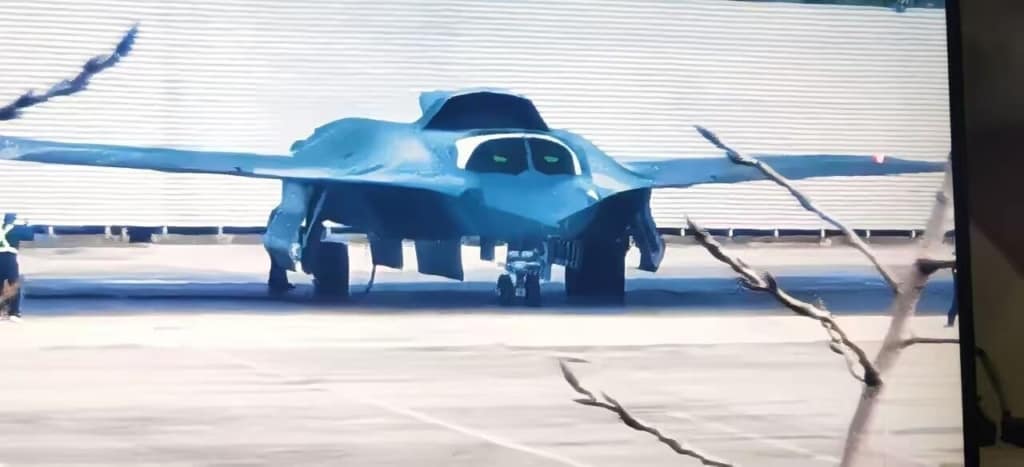
The J-36 has gone from grainy taxi footage to official state media in a matter of months.
The J-36 Plays a Different Game
The J-36 is built around the opposite priority. It is huge for a fighter — a tailless, modified-delta planform with three engines, a configuration that only makes sense if you are optimising for internal fuel and payload rather than dogfighting agility. Open-source estimates credit it with a combat radius in the region of 1,500 nautical miles, though these are inferences from its size, not published specifications, and should be treated with caution.
The strategic point is what that range buys: China can, in theory, fight over Taiwan from air bases on its own mainland, with no vulnerable tanker orbit to protect. Where the American plan leans on aerial refuelling to stretch a deliberately compact fighter, the Chinese plan appears to design the tanker dependency out of the problem entirely.
The Tanker Problem
Which brings the argument to its real crux, and it has little to do with either fighter’s stealth or sensors. Every mile an American fighter cannot fly on its own fuel must be supplied by a tanker — a large, non-stealthy, defenceless aircraft that must orbit for hours. China has spent two decades building very-long-range air-to-air missiles and strike systems whose explicit purpose is to push those tankers so far back that the fighters they feed can no longer reach the fight.
So the headline is provocative but the substance is sober: this is not a duel between two jets, it is a contest between two theories of Pacific geography. The F-47 is a superb aircraft asked to solve an impossible map with the help of fragile tankers. The J-36, if the estimates hold, is an attempt to erase the map problem altogether. Closing that gap — with more tankers, better-defended ones, or forward bases that can survive — is now one of the central puzzles of American airpower.
Sources: 19FortyFive; Air & Space Forces Magazine; The War Zone.
Related Questions
What is China's J-36?
The J-36 is a large, tailless sixth-generation combat aircraft design from China's Chengdu Aerospace Corporation, notable for its unusual three-engine layout and sheer size. Open-source analysts estimate its combat radius at roughly 1,500 nautical miles, though Beijing has not confirmed any figures.
What is the F-47?
The F-47 is the United States' sixth-generation fighter, built by Boeing. On paper it is the longest-ranged fighter America has ever built, with an officially disclosed combat radius of over 1,000 nautical miles, and the Air Force plans a fleet of more than 185 aircraft.
What is the combat radius of the F-47?
Officially, more than 1,000 nautical miles — the longest of any American fighter. But Andersen Air Force Base on Guam sits about 1,500 nautical miles from the Taiwan Strait, so even the F-47 cannot patrol the strait from Guam and return without tanker support.
Why does fighter range matter so much in the Pacific?
Because the distances dwarf anything in Europe or the Middle East. A fighter flying from Guam to the Taiwan Strait must cover roughly 1,500 nautical miles each way, and closer bases sit within reach of Chinese missiles. A jet that depends on vulnerable tankers to get there is a jet that can be defeated without ever being shot at.
Can the F-47 reach Taiwan from Guam?
Not unrefueled, on official figures. The F-47's disclosed combat radius is 1,000+ nautical miles, while Andersen AFB on Guam lies about 1,500 nautical miles from the Taiwan Strait — meaning the F-47 needs aerial refuelling to fight there, whereas the J-36's estimated 1,500-nautical-mile radius covers the distance.
How many sixth-generation fighters is the US buying?
The US Air Force plans more than 185 F-47s. Other sixth-generation efforts are under way elsewhere too, from the US Navy's next carrier fighter competition to China's growing family of stealth aircraft and drones.
The comparison shouldn’t be with the F-47, it should be with the B-21. The B-21 has a range of 8000 miles, more than enough to reach Taiwan. The main job of a fighter is to protect assets, although they do/will have strike capabilities. Another way to look at it is that the F-47 will be able to protect assets out to 1000 miles from wherever it is stationed, for strike packages, the B21 can be brought in. The B-21 is also being built to control unmanned aircraft and control the battlefield the same way the F-47 is. My way of looking at it is that the “Battlefield” wont be Taiwan proper, if China tries to invade Taiwan, it will be with missiles first. Our job would then be to try to stop the missiles, which means strikes on the launch facilities, were not going to send fighters 1500 miles to try to intercept missiles. I dont see how an attack/invasion of Taiwan doesnt result in strikes on Chinese military installations, thus the B-21.