

On a summer morning in 2024, thousands of people lined the shores of Vancouver Island to say goodbye to a 79-year-old giant. The Hawaii Mars, the largest flying boat still in the air anywhere in the world, lifted off the water one last time, escorted by the Canadian Snowbirds aerobatic team, and flew gently into retirement.
It was not just the end of one aircraft. It was the end of an entire species: the era of the enormous flying boat, which once seemed like the future of air travel and instead became one of aviation’s most magnificent dead ends.
Quick Facts: Martin JRM Mars
- Role: Giant US Navy transport flying boat, later water bomber
- Built: Only seven, ever
- Wingspan: About 200 feet (61 m)
- First flight: 1942
- Water load: Around 7,200 US gallons, dropped over some four acres
- Last flight: Hawaii Mars, 11 August 2024
A giant born for war
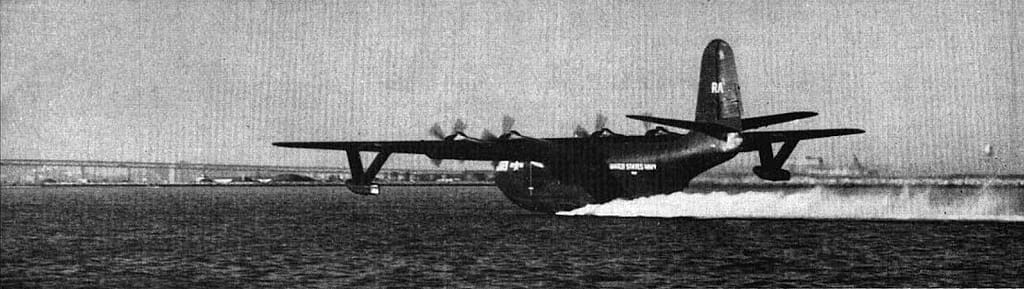
The Mars was conceived in 1941 as a huge patrol bomber, essentially a scaled-up version of Martin’s PBM Mariner, and the prototype first flew in 1942. By then the Navy had decided it made more sense as a transport, and the Mars spent the war as a flying freighter, hauling cargo and passengers across the vast distances of the Pacific. Only seven were ever built, each given a Pacific name, Marianas, Philippine, Marshall, Caroline and Hawaii Mars among them.
A second life fighting fire
Most of the Mars fleet could easily have been scrapped. Instead, in the early 1960s, British Columbia’s forest industry bought the survivors and turned them into water bombers. A Mars could skim across a lake, scoop up around 7,200 US gallons in a single pass, and dump it over roughly four acres of burning forest. For decades the great red-and-white boats were a beloved symbol of firefighting on Canada’s west coast.

The last flight
Time finally caught up with them. On 11 August 2024, the Hawaii Mars, built back in 1945, made its final flight from Sproat Lake to its new home at the B.C. Aviation Museum near Victoria, flown by Harbour Air pilots Rick Matthews and Peter Killin and escorted by nine Snowbirds. The following winter, the last of its sisters, the Philippine Mars, flew south to the Pima Air & Space Museum in Arizona.
And with that, the sky fell quiet. No giant flying boat flies operationally anywhere in the world today. The Mars outlived every rival, fought fires long after it should have retired, and bowed out to cheering crowds, a fitting send-off for the last of the leviathans.
Sources: The War Zone, CBC News, B.C. Aviation Museum, Wikipedia.



0 Comments