
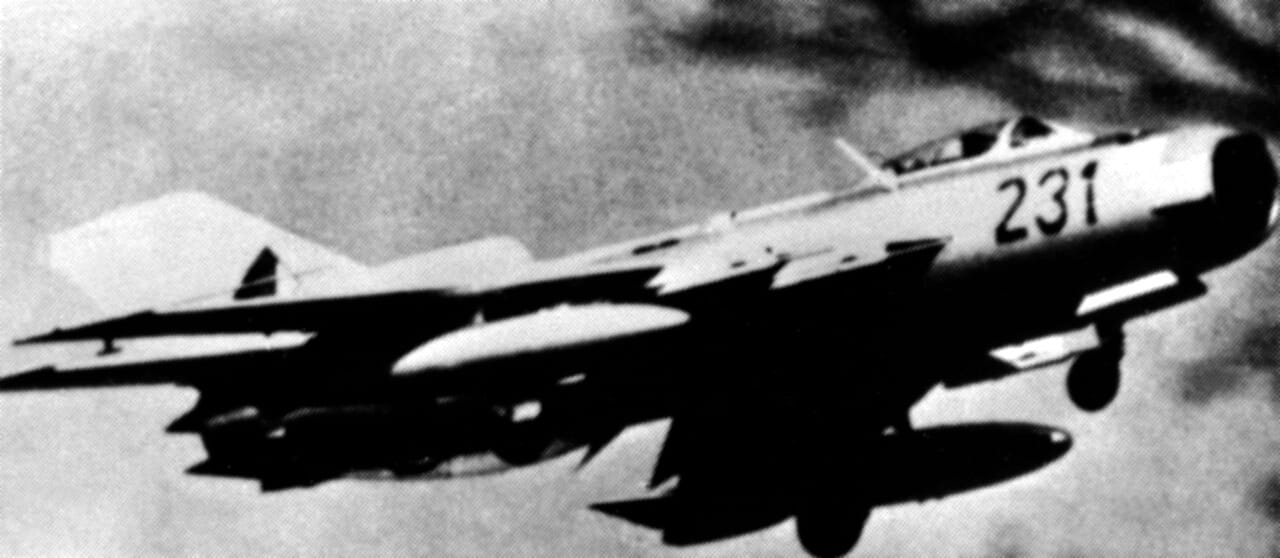
On 3 July 1955, forty-eight identical swept-wing jets thundered over Tushino airfield outside Moscow in a single roaring formation. Western observers at the airshow did the arithmetic and felt a chill: the Soviet Union had just fielded its first supersonic fighter in numbers, and it was called the MiG-19.
The design bureau had chased that milestone for years. Instead of one big engine, Mikoyan-Gurevich chose two compact axial turbojets, later standardised as the afterburning Tumansky RD-9B, and hung them behind a thin wing swept a dramatic 55 degrees. The path from the SM-2 prototype of 1952 to the definitive SM-9 was littered with handling scares and redesigns.
QUICK FACTS
| Type | Single-seat twin-engine supersonic fighter |
| First flight | 24 May 1952 (prototype); production 1954 |
| Powerplant | 2 x Tumansky RD-9B afterburning turbojets |
| Top speed | 1,452 km/h (902 mph), Mach 1.35 |
| Number built | 2,172 (Soviet, excl. Chinese J-6) |
| Service ceiling | 17,500 m (57,400 ft) |
| Legacy | Chinese J-6 copy served for decades |
Rushed Into the Supersonic Age
Moscow ordered the fighter into production before testing was truly finished, and the early aircraft paid for it. Poor insulation between the engines and the rear fuel tanks caused in-flight explosions until a metal heat shield was fitted, and the conventional elevators went useless past the speed of sound until an all-moving slab tail cured it on the definitive MiG-19S.
Once sorted, the Farmer was a genuine handful in a dogfight. It could top Mach 1.3, climb like a startled cat and hit hard with three 30mm cannon. American pilots who later flew a captured example came away impressed by its turn and acceleration, though they laughed at its thirst.
Cold War Trigger-Puller
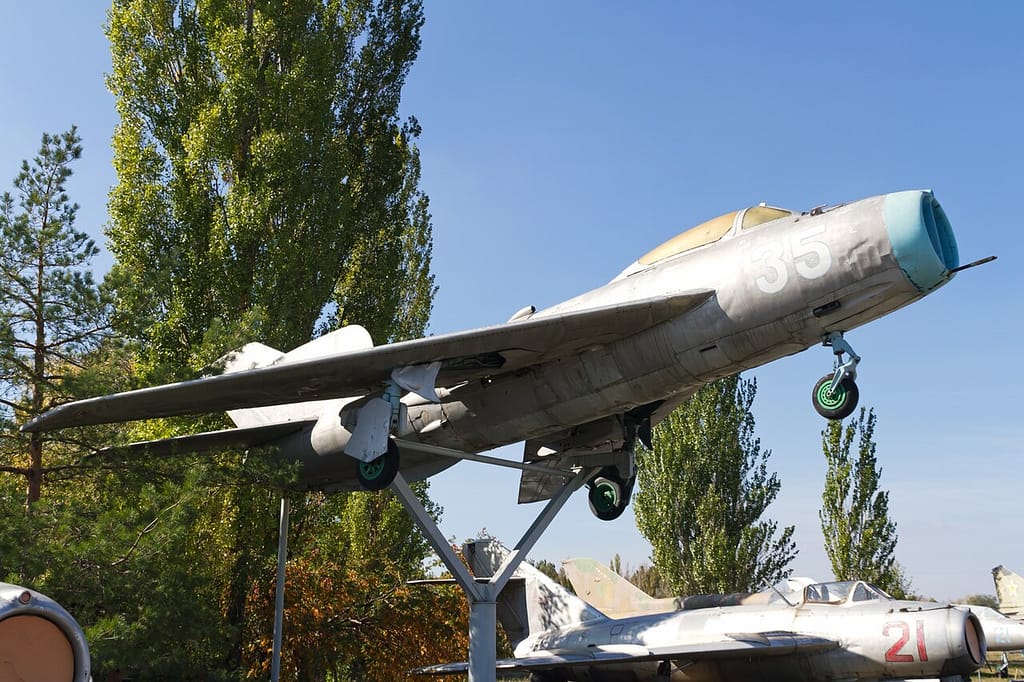
The MiG-19 spent its career at the sharp edge of the Cold War. A Farmer was caught in the same missile salvo that downed Gary Powers' U-2 in 1960, killing its pilot; others shot down an American RB-47 over the Arctic and a T-39 over East Germany. Its Chinese-built twin, the J-6, later tangled with US aircraft over Vietnam and Hainan.
That short reach was its curse. As one Western evaluator dryly noted, a MiG-19 driver at full afterburner would soon be hunting for somewhere to land. Yet in the licence-built J-6, the basic design outlived the Soviet Union itself.
The Farmer was crude, thirsty and dangerous, most of all to the pilots learning to tame it. It was also the aircraft that dragged the entire Eastern Bloc past the sound barrier.
More on the Farmer, the supersonic MiG that history tends to skip over:
Sources: Wikipedia; militaryfactory; contemporary US evaluation reports.
0 Comments