

At 7 a.m. on 15 June 2026, a Porter Airlines Embraer E195-E2 rolled toward the runway at a South Shore airfield that had not seen a scheduled airline departure in living memory. As flight PD181 lined up for Vancouver, the airport fire trucks arched a water-cannon salute over the jet. With that, Greater Montreal had a second commercial airport — and North America had pulled off something genuinely rare: a brand-new passenger terminal opening from scratch.
The place is MET — Montreal Metropolitan Airport, still carrying the old code YHU, on the site of historic Saint-Hubert airfield. For nearly a century it has been a flying school, a wartime base and a general-aviation hangout. Now it is betting that Montrealers want a faster, simpler alternative to the sprawl of Trudeau (YUL).
Whether that bet pays off is one of the more interesting stories in commercial aviation right now — because it is really three stories braided together: a long-faded airfield reborn, an ambitious airline chasing scale, and a continent-wide rethink of what a second airport is actually for.
Quick Facts
- Airport: MET – Montreal Metropolitan Airport (Saint-Hubert), code YHU / CYHU, Longueuil, QC
- New terminal opened: 15 June 2026
- Launch carrier: Porter Airlines (first flight PD181 to Vancouver); Pascan Aviation also operating
- Terminal size: ~21,000 m², nine boarding bridges, 900-seat waiting lounge
- Capacity: up to 4 million passengers per year (Porter projects ~1 million in year one)
- Distance to downtown: ~15 km
- Porter fleet at MET: 132-seat Embraer E195-E2 jets and 78-seat De Havilland Dash 8-400 turboprops
A New Terminal Is a Rare Thing
Airports get expanded, renovated and re-clad all the time. What almost never happens in North America is a clean-sheet commercial passenger terminal switching on for the first time. MET’s building went up fast: designed by Scott & Associates, built by PCL Construction, broken ground in August 2023 and finished in under three years.
The design philosophy is the opposite of the mega-hub. The terminal is compact — roughly 21,000 square metres — with nine boarding bridges and a single 900-seat departure lounge. The idea is that you arrive closer to your departure time, walk shorter distances, and spend less of your life in queues. Architecturally it leans on natural light and nods to local history, including the 1930 arrival of the British R-100 airship at Saint-Hubert, one of the strangest set-pieces of early Canadian aviation.

The terminal is developed and operated by YHU Infrastructure Partners, a joint venture between Porter Aviation Holdings and Macquarie Asset Management, under a long-term lease. That private-investment model is part of what makes the project unusual — and part of how its backers hope to avoid the ghosts of Montreal’s aviation past.
Porter’s Big Bet on a Second Montreal Airport
The launch carrier is Porter Airlines, and the scale of its commitment is striking. Within a single week of opening, Porter rolled out 12 routes from MET, reaching coast to coast — from St. John’s in the east to Vancouver in the west, with Toronto, Calgary, Edmonton, Halifax, Winnipeg and several smaller markets in between. The airline says MET lets it nearly double its Greater Montreal capacity this summer, splitting up to 244 weekly departures between YHU and Trudeau.
Porter has run this playbook before. It built its brand at Billy Bishop Toronto City Airport on the promise of convenience — short walks, quick processing, free lounge snacks — rather than raw size. What is different now is the aircraft. Porter is the world’s largest operator of Embraer’s E2 family, and the 132-seat E195-E2 gives it the range and economics to fly Montreal–Vancouver from a secondary field, something its original turboprop-only fleet could never have done.
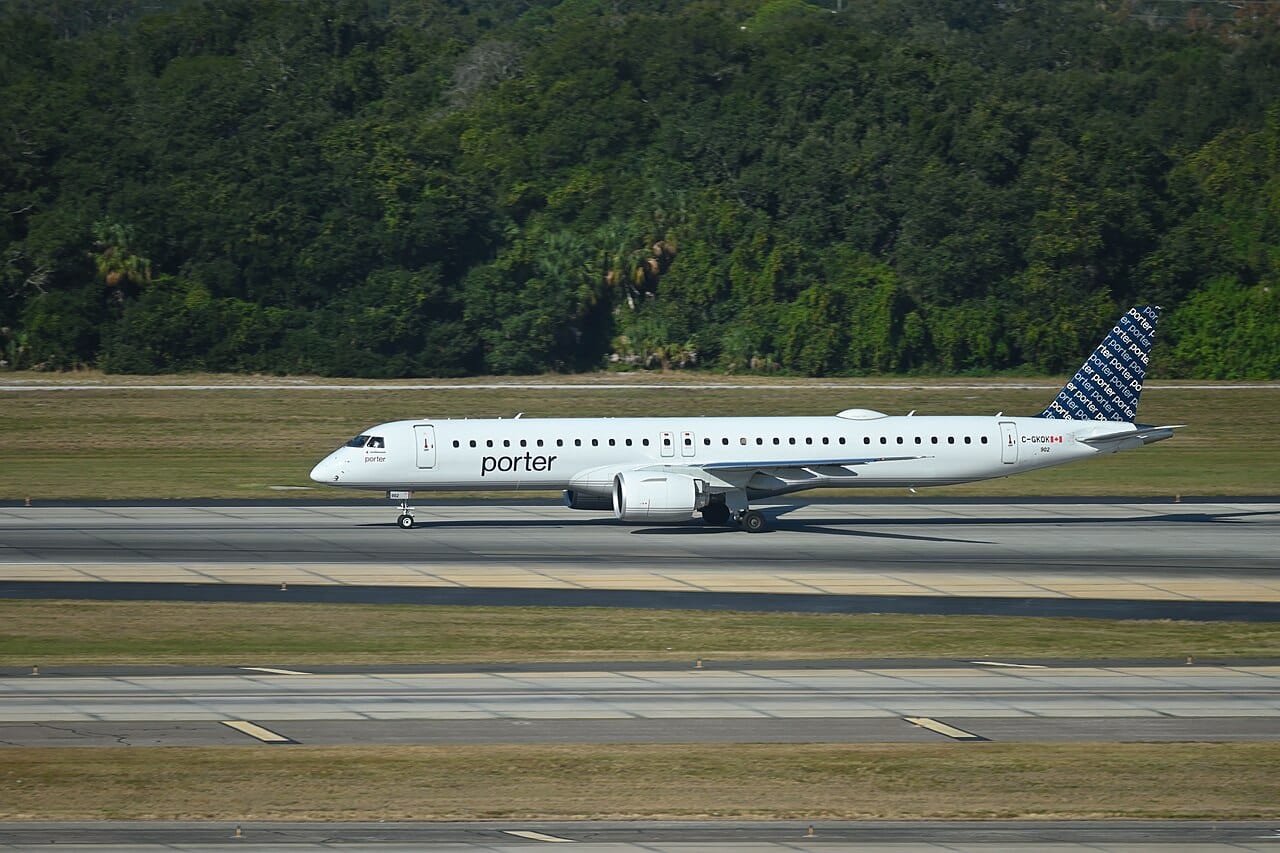
The E195-E2 flies a 2-2 cabin with no middle seats; the 78-seat Dash 8-400 handles shorter regional hops. That two-type fleet is the engine room of the whole strategy: jets for the transcontinental routes, turboprops for the Toronto City shuttle and eastern Canadian markets. Porter’s CEO is bullish, and the early numbers gave him room to be.
Pascan Aviation, the regional carrier that has been based at Saint-Hubert for more than two decades, rounds out the picture — connecting smaller Quebec and Maritime communities, with some itineraries bookable on a single ticket alongside Porter. The terminal is designed to take on more airlines over time.
A walkthrough of the new MET terminal, interior and exterior, June 2026.
From Airmail to Airliners: The Saint-Hubert Story
None of this is happening on a blank field. Saint-Hubert is one of the oldest airfields in Canada, tracing back to the late 1920s, when it handled some of the country’s first airmail and served as Montreal’s primary airport — until commercial traffic shifted to Dorval, today’s Trudeau, around the Second World War. In 1930 it briefly became the centre of the aviation world when the R-100 airship moored there after crossing the Atlantic.
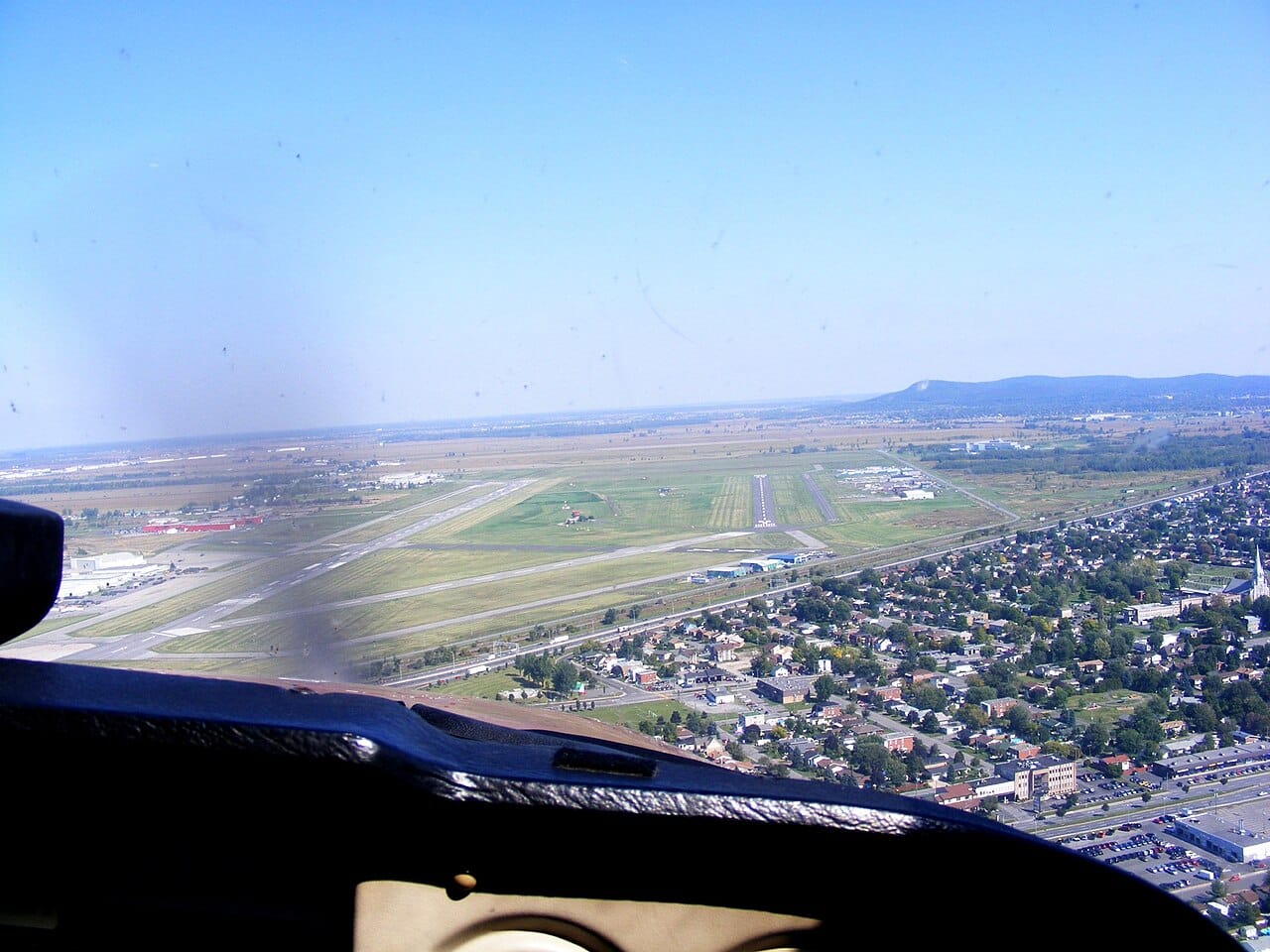
For most of the decades since, the field has lived a quieter life: a military base when duty called, then a hub for flight training, aerospace firms and general aviation. Renamed MET – Montreal Metropolitan Airport in 2023, it sits inside one of the world’s great aerospace clusters, with names like Airbus Canada, CAE and Pratt & Whitney Canada in the neighbourhood. The new terminal grafts scheduled passenger service onto that existing ecosystem rather than replacing it.

The return of airliners didn’t come without conditions. Overnight flights are banned, operating hours are capped, and air-quality sensors have been installed to address residents’ concerns. The developer is funding C$8.2 million in road improvements, and Longueuil Mayor Catherine Fournier has said the airport is expected to generate more than C$6 million a year in property-tax revenue for the city.
The Two-Airport Question — and Mirabel’s Long Shadow
Here is where Montreal’s history makes everyone nervous. The last time the region tried to add airport capacity, it built Mirabel in the 1970s — a vast international airport so far from the city, and so poorly connected, that airlines and passengers quietly abandoned it. Mirabel became aviation’s most famous cautionary tale, a gleaming terminal with almost no scheduled passengers.
MET is designed to be Mirabel’s mirror image. Instead of a remote international mega-hub, it is a close-in, domestic-focused secondary airport, 15 km from downtown, built around small single-aisle jets and turboprops rather than widebodies. Porter says MET’s location puts it within easy reach of more than half the region’s population. The model is the multi-airport system that already works in London, New York and Tokyo: one big international gateway, plus a nimble second field that adds capacity and choice.
Secondary airports succeed when three things line up: the right location, the right cost base, and a committed airline partner. MET arguably has all three on day one. Trudeau keeps the long-haul and international traffic; MET picks up domestic and regional flying and takes pressure off a hub that has its own multi-billion-dollar expansion underway.
First flights at YHU: Porter and Pascan inaugurate scheduled service from the new terminal.
What It Means for Travellers
For Montrealers, the practical upside is choice. If you live on the South Shore or the east side of the city, MET could shave real time off the trip to Toronto, Halifax or Vancouver — with a calmer, faster terminal experience at the other end of the drive. Porter projects roughly a million passengers in year one and reckons MET could rank among Canada’s ten busiest airports within a couple of years.
The risk, as always, is whether enough travellers change their habits. Trudeau is established, familiar and has the international connections MET deliberately doesn’t. But a brand-new terminal you can walk through in minutes, served by no-middle-seat jets to the cities most Canadians actually fly to, is a genuinely different proposition. The water cannon has long since dried. Now Saint-Hubert finds out whether its second act lasts longer than its first.
Sources: Aerospace Global News; International Airport Review; FlyMag; MET – Montreal Metropolitan Airport (metmtl.com); CBC News.
Related Questions
What is Montreal’s new airport called?
Montreal’s new airport is MET Montreal Metropolitan Airport (code YHU/CYHU), built on the historic Saint-Hubert airfield in Longueuil, about 15 km from downtown. Its new passenger terminal opened on 15 June 2026, giving Greater Montreal a second commercial airport alongside Trudeau (YUL).
When did Montreal Metropolitan Airport open?
MET Montreal Metropolitan Airport opened its new passenger terminal on 15 June 2026, with the first scheduled departure being Porter Airlines flight PD181 to Vancouver. It is one of the rare cases of a clean-sheet commercial passenger terminal switching on for the first time in North America.
Which airlines fly from Saint-Hubert (YHU)?
Porter Airlines is the launch carrier at MET Montreal Metropolitan Airport, with Pascan Aviation also operating. Porter flies 132-seat Embraer E195-E2 jets and 78-seat De Havilland Dash 8-400 turboprops from the airport, initially serving destinations such as Vancouver.
How big is the MET Montreal terminal?
The new MET terminal covers about 21,000 m², with nine boarding bridges and a 900-seat waiting lounge. It is designed for up to 4 million passengers per year, though launch carrier Porter projects roughly 1 million in its first year of operations.
Why is a brand-new airport terminal rare in North America?
How far is Saint-Hubert airport from downtown Montreal?
MET Montreal Metropolitan Airport sits on the South Shore at Saint-Hubert in Longueuil, roughly 15 km from downtown Montreal. It is positioned as a faster, simpler alternative to the larger Montreal-Trudeau International Airport (YUL).
What aircraft does Porter Airlines fly?
From Montreal, Porter Airlines operates 132-seat Embraer E195-E2 regional jets and 78-seat De Havilland Dash 8-400 turboprops. The E195-E2 is a modern, fuel-efficient jet that lets Porter offer mainline-style comfort on shorter regional and transcontinental routes.
0 Comments