
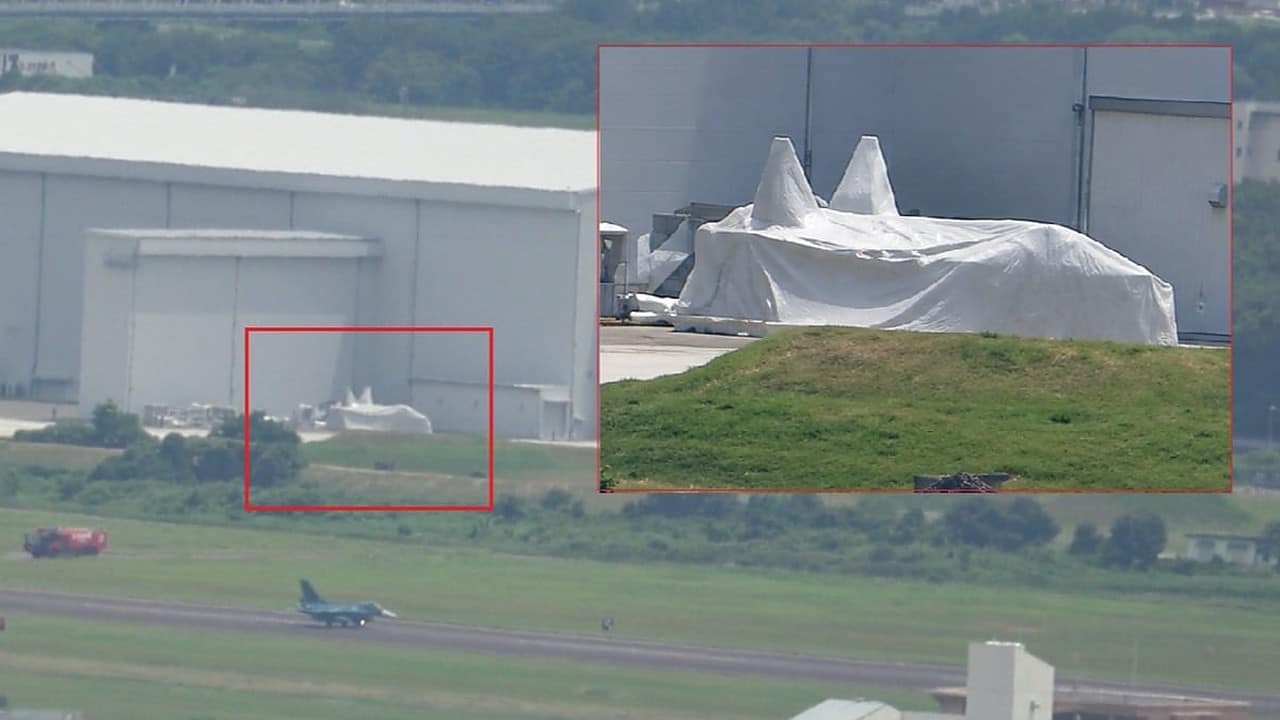
On a humid June afternoon, a Japanese plane-spotter pointed a long lens at the flight line of Gifu Air Base and froze. Tucked against a hangar wall sat something large, the size of a fighter, and it was wrapped from nose to tail in white fabric like a piece of furniture in a house nobody lives in. Two sharp peaks pushed up through the sheeting where the tails should be. Everything else was hidden.
The spotter, who posts as @intpt93, summed up the moment in a single line: “Huh… Whaaaaaat!!!! Biggest shock of the day.” The photo detonated online, racking up roughly 2.2 million views within hours. And then the guessing began. What, exactly, is Japan keeping under a bedsheet on the ramp of its most important flight-test base?
Here is the honest answer up front: nobody outside a small circle in Tokyo knows for certain, and that is precisely what makes this so interesting. So let’s do the fun part — walk the clues, weigh the theories, and explain why the most tantalising one points toward the most ambitious fighter programme Japan has joined in generations.
Quick Facts
- What: A twin-tailed aircraft completely covered in white fabric, parked on the flight line
- Where: Gifu Air Base, central Japan — home of the JASDF’s Air Development and Test Wing
- When: Photographed 18 June 2026; posted by spotter @intpt93
- Why it matters: Gifu is Japan’s flight-test centre during the country’s biggest aviation push in decades
- The leading theory (unconfirmed): It may relate to the GCAP / F-X (F-3) next-generation fighter effort
- Status: Speculation. The covering hides every identifying detail — no confirmed ID exists
The photo that broke the internet (briefly)
Plane-spotting at a military airfield is usually a patient hobby of cataloguing the expected: the same fighters, the same trainers, the same tankers, logged and filed. What makes the Gifu image so electric is how badly it breaks that rhythm. A fully shrouded airframe on an open ramp is not normal. It is, almost by definition, someone’s attempt to stop you seeing something.
The covering does its job ruthlessly. It erases markings, sensor apertures, intake shaping, panel lines — every cue an analyst would normally use to pin down a type. What it cannot fully hide is the gross shape, and that is where the detective work starts. Two distinct peaks rise through the fabric near the rear, strongly suggesting a twin, canted-tail configuration. The bulk underneath reads as a full-size combat aircraft, not a trainer or a drone.
Spotters did what spotters do best: they reached for a ruler. With an F-2 fighter taxiing in the foreground for scale, the shrouded shape looked broadly comparable in size to an F-15 — in other words, a heavyweight in the same class as Japan’s frontline air-superiority jet, rather than something small and light. That single comparison narrows the field considerably, even if it settles nothing.
Why Gifu is the most interesting place to hide a jet
Location is half the story. Gifu Air Base, in Gifu Prefecture, is the headquarters of the Air Development and Test Wing — the unit responsible for wringing out new aircraft, avionics and systems before they ever reach an operational squadron. If Japan is testing something genuinely new, Gifu is the natural place to do it. A shrouded mystery here carries more weight than the same sight at an ordinary fighter base.
There is a second clue stacked on top. An OSINT account, @Mumbo_Ghost, flagged that Gifu has been building a new Electronic Warfare Evaluation Facility to replace an ageing anechoic chamber — the kind of signal-absorbing room used to measure an aircraft’s radar cross-section and check its electronic-warfare gear without outside interference. The new facility reportedly supports fighters, stand-off jammers and AWACS-type aircraft. That is a heavy hint about the sort of work Gifu is gearing up for.
Put the two together and a plausible, mundane explanation appears: if an aircraft is being prepared for radar-signature or EW testing, draping it in fabric is a cheap, effective way to keep cameras — and satellites — from reading the exact configuration of any sensitive modifications. The shroud might be operational security around a measurement campaign rather than a brand-new airframe at all.
Berthon was talking about the UK end of the programme, not the Gifu sighting — but his words capture the tempo. Across all three partner nations, next-generation combat air work is moving fast, and a lot of it happens away from the cameras.
The tempting theory: GCAP and Japan’s F-3
This is the part everyone wants to be true, so let’s handle it carefully. Japan is in the middle of one of the most significant periods of military-aviation development in its postwar history. Its domestically led next-generation fighter — long known by the placeholder F-X and now officially designated F-3 — is being developed under the trilateral Global Combat Air Programme (GCAP).
A quick untangling of the names, because they trip people up. GCAP is the joint programme, announced by Japan, the United Kingdom and Italy in December 2022 and formalised by treaty the following year. It merged the UK-led BAE Systems Tempest project with Japan’s Mitsubishi F-X. The industrial heavyweights are Mitsubishi Heavy Industries in Japan, BAE Systems in the UK and Leonardo in Italy, now working through a joint venture called Edgewing. The aim is an operational sixth-generation fighter around 2035, with a flying technology demonstrator targeted to take to the air in 2027.
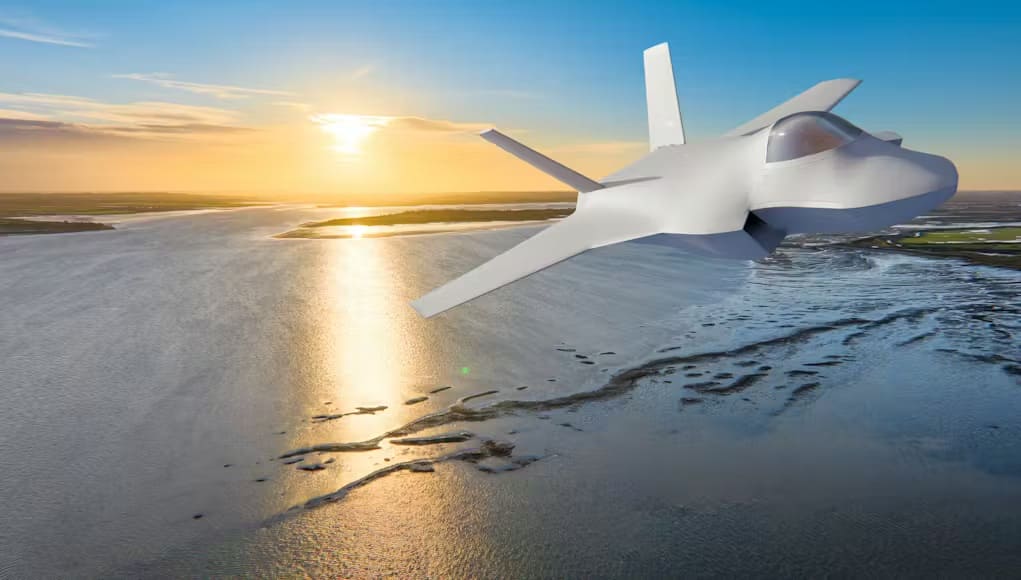
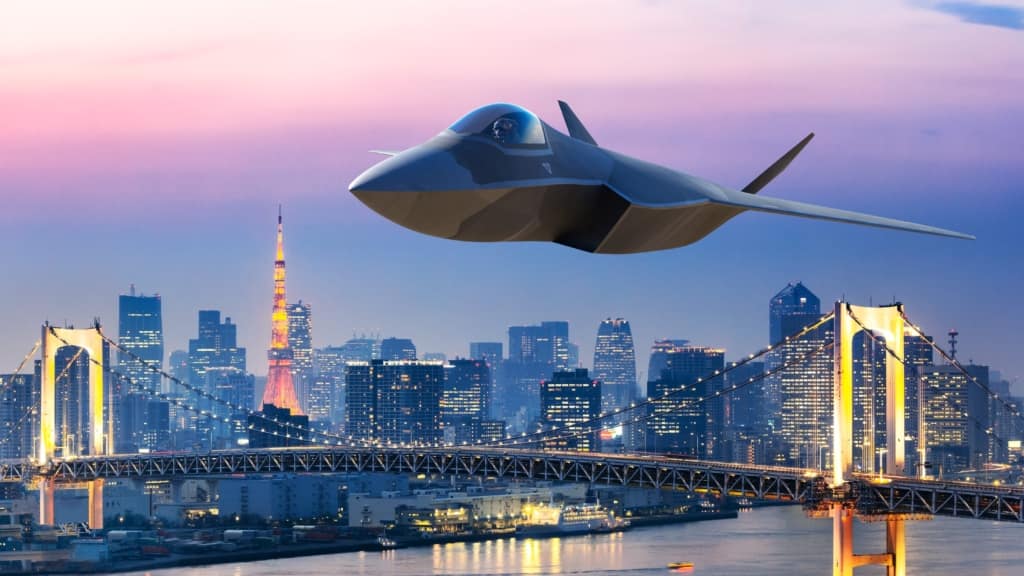
Notice anything? The published GCAP and demonstrator designs feature a canted twin-tail layout — which rhymes neatly with those two peaks poking through the fabric at Gifu. It is an easy leap to make, and that is exactly why caution matters. A twin-tail silhouette is suggestive, not diagnostic. Plenty of aircraft have two tails.
So what could it actually be?
Here are the live possibilities, roughly from most mundane to most exciting, with the same health warning attached to all of them: the covering hides the evidence, so every option below is inference, not fact.
A modified existing fighter. The JASDF flies the F-15J and the F-2, and Gifu routinely hosts test work on both — avionics upgrades, radar integration, EW fit checks. An F-15 variant prepared for radar-cross-section or jamming evaluation would plausibly warrant exactly this kind of comprehensive wrap. This is, frankly, the boring-but-likely answer.
A GCAP-related technology demonstrator or test rig. The F-3 itself is not expected to fly as a prototype for several years, but associated systems — radars, EW suites, sensor packages — are being developed and tested now, and Gifu is the logical home for that. The shroud could be hiding a testbed carrying F-3 subsystems rather than the fighter itself.
A mock-up or a one-off. Full-scale mock-ups, radar-signature models and structural test articles all exist in the world of fighter development, and all are camera-shy. The shape under the fabric need not even fly.
Something else entirely. The least satisfying option and the one no honest observer can rule out. The whole point of the covering is to keep you guessing.
If you want the wider context on why a covered jet in central Japan has so many enthusiasts leaning forward, this explainer lays out what GCAP is, who is building it, and why the 2035 target matters:
The covering is telling you something
Strip away the speculation and one fact survives intact: Japan is testing something at Gifu that it would rather you not photograph, at a base that has just upgraded its electronic-warfare evaluation infrastructure, during the busiest stretch of Japanese aviation development in living memory. Whether the shape under the sheet is a re-skinned Eagle, an F-3 test article or a clever decoy, the message is the same.
A white tarpaulin that pulls 2.2 million views in an afternoon is doing exactly the job it was put there to do: announcing that something matters while revealing nothing about what. Until someone pulls the cover off — or a clearer photo leaks — the smart position is the spotter’s own first reaction. Huh. Whaaaaaat. And we’ll be watching Gifu until we find out.
Sources: The Defence Blog; UK Ministry of Defence / GCAP; Leonardo; House of Commons Library; Defense News; Army Recognition; @intpt93 and @Mumbo_Ghost on X.
Related Questions
What was the shrouded jet photographed at Gifu Air Base?
On 18 June 2026 a plane-spotter photographed a large, twin-tailed aircraft completely wrapped in white fabric on the flight line at Gifu Air Base in central Japan. The covering hid every identifying feature, so no confirmed identification exists. The leading - but unconfirmed - theory links it to Japan's next-generation fighter effort.
What is the GCAP fighter program?
GCAP (Global Combat Air Programme) is a joint effort by Japan, the United Kingdom and Italy to develop a sixth-generation stealth fighter, with Japan's contribution sometimes referred to as the F-X or F-3. It aims to field an advanced crewed fighter teamed with drones. The covered Gifu aircraft is speculated, but not confirmed, to relate to it.
Why was the jet at Gifu covered in fabric?
Militaries often shroud prototype or sensitive aircraft to hide shape, sensors and other classified design details from spotters and satellites. Gifu is home to the JASDF's Air Development and Test Wing, Japan's flight-test centre, so unusual or experimental airframes can appear there. The fabric kept observers from confirming whether it was a next-generation stealth design.
What is a sixth-generation fighter?
A sixth-generation fighter is a future class of combat aircraft expected to feature advanced stealth, sensor fusion, optional crewing and teaming with autonomous drones. Programs like Japan, Britain and Italy's GCAP and various U.S. efforts are racing to field them in the 2030s, succeeding fifth-generation jets such as the F-35 and F-22.
Where does Japan test its experimental aircraft?
Japan's Air Self-Defense Force conducts flight testing at Gifu Air Base in central Japan, home of its Air Development and Test Wing. That is why the mysterious shrouded aircraft drew so much attention: Gifu is exactly where prototype or experimental airframes connected to programs like GCAP would be expected to appear.
Related Posts

0 Comments