
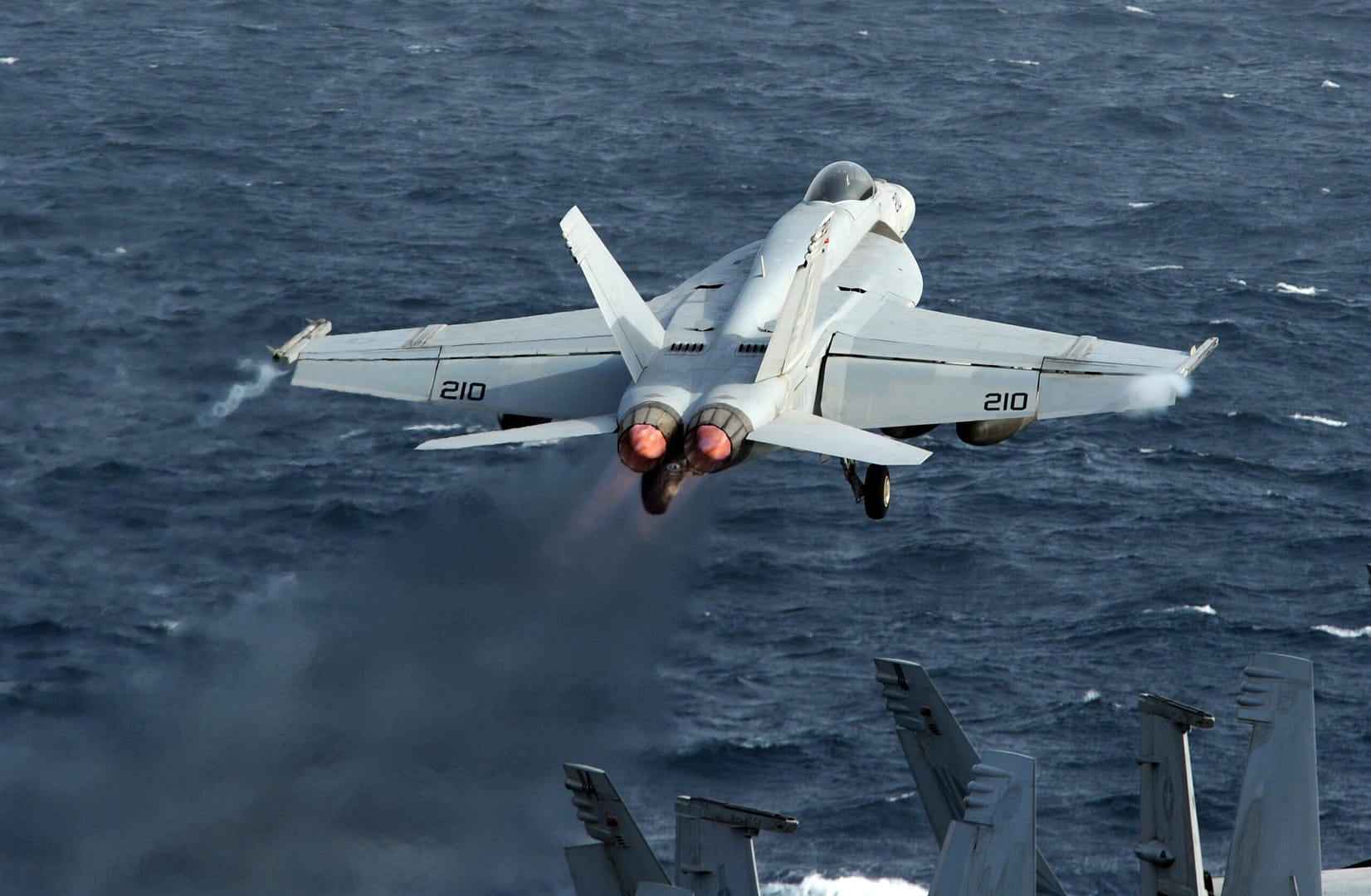
The U.S. Navy's next carrier-based fighter just dodged a bullet. After the Pentagon attempted to gut the F/A-XX program in favor of the Air Force's F-47, Congress has intervened with force — inserting $897.3 million into the FY2026 defense spending bill, a twelve-fold increase over the previous year's $74 million allocation. The message is unambiguous: the Navy will get its sixth-generation fighter.
The reversal marks one of the most dramatic funding shifts in recent defense appropriations history. Just months ago, senior Pentagon officials argued that running two sixth-generation programs simultaneously risked "under-delivery on both." Congress disagreed — emphatically.
With Boeing and Northrop Grumman competing for the prime contract and a downselect expected by August 2026, the F/A-XX has gone from political purgatory to the single largest line-item addition in the Navy's research and development budget.
Quick Facts: F/A-XX Program
- FY2026 Funding: $897.3 million (up from $74M in FY2025 NDAA)
- Navy Unfunded Priority List Request: $1.4 billion
- Competitors: Boeing vs. Northrop Grumman (Lockheed Martin eliminated March 2025)
- Downselect Date: August 2026 (confirmed by CNO)
- Mission: Replace F/A-18E/F Super Hornets and EA-18G Growlers
- Combat Radius Target: ~1,000 miles
- USAF Comparison: F-47 program receiving ~$5 billion
From Near-Death to Record Funding
The F/A-XX's journey through the FY2026 budget cycle reads like a political thriller. In June 2025, the Pentagon formally requested that Congress divert $500 million from the Navy's "accelerated development" of its stealth fighter to bolster the Air Force's F-47 program. The rationale was consolidation — one sixth-generation fighter for both services, rather than two parallel efforts.
Congress rejected this logic. The final defense appropriations bill, published by the Senate Appropriations Committee on January 20, 2026, restored and then massively expanded F/A-XX funding. The $897.3 million addition represents the single largest change in the Navy's RDT&E budget line and a clear congressional mandate that carrier-based air superiority cannot be sacrificed at the altar of cost efficiency.
Why the Navy Needs Its Own Fighter
The argument for a dedicated naval sixth-generation fighter rests on operational reality. Carrier-based aircraft face unique engineering constraints — they must withstand catapult launches and arrested landings, fold for below-deck storage, and operate in salt-spray environments that accelerate corrosion. The F/A-XX's target combat radius of approximately 1,000 miles also reflects the Navy's need to project power across the vast distances of the Indo-Pacific without exposing carriers to Chinese anti-ship missile threats.
The current F/A-18E/F Super Hornets, while upgraded repeatedly, are approaching the limits of their growth potential. Their combat radius of roughly 450 miles is insufficient for the contested environments the Navy anticipates in a potential Pacific conflict. The EA-18G Growler electronic warfare variant faces similar obsolescence concerns as adversary radar and electronic warfare capabilities advance.
Boeing vs. Northrop Grumman: The Final Duel
With Lockheed Martin eliminated from the competition in March 2025, the F/A-XX contract has become a two-horse race. Boeing publicly unveiled a new conceptual rendering at the August 2025 Tailhook Symposium — a stealthy, tailless design that bears a family resemblance to its F-47 submission for the Air Force. Northrop Grumman has been characteristically secretive, though its experience with the B-21 Raider bomber and the X-47B carrier-based drone gives it formidable credentials for a stealthy naval platform.
Chief of Naval Operations Admiral Daryl Caudle has confirmed that the downselect — the moment one competitor is chosen over the other — is expected by August 2026. The compressed timeline reflects congressional urgency to keep the program on track after the Pentagon's attempted slowdown.
The Broader Sixth-Generation Landscape
The F/A-XX exists within a broader context of sixth-generation fighter development. The Air Force's F-47, being developed by Boeing, is receiving approximately $5 billion — a figure that dwarfs even the F/A-XX's restored funding. Meanwhile, adversaries are not standing still: China's J-36 stealth fighter prototype has been spotted in flight testing, adding urgency to both U.S. programs.
Related Questions
What is the Navy's F/A-XX program?
F/A-XX is the U.S. Navy's sixth-generation carrier fighter programme, intended to replace the F/A-18E/F Super Hornet and EA-18G Growler. It received $897.3 million in FY2026 funding — a huge jump from $74 million the year before — after nearly being raided to fund the Air Force's rival F-47. A downselect between Boeing and Northrop Grumman is set for August 2026.
Who is competing to build the F/A-XX?
Boeing and Northrop Grumman are the two finalists for the F/A-XX, after Lockheed Martin was eliminated in March 2025. The Navy confirmed a downselect for August 2026. The winner will build a stealthy, long-range carrier fighter with a combat radius target of around 1,000 miles to succeed the Super Hornet.
What will the F/A-XX replace?
The F/A-XX is designed to replace the Navy's F/A-18E/F Super Hornet strike fighters and EA-18G Growler electronic-attack jets. It targets a combat radius of roughly 1,000 miles — far greater than today's carrier aircraft — to keep carriers safer from long-range threats. It represents the naval half of America's sixth-generation fighter effort.
How is the F/A-XX different from the Air Force's F-47?
The F/A-XX is the Navy's carrier-based sixth-generation fighter, while the F-47 is the Air Force's land-based equivalent; the Pentagon briefly considered merging them. The F-47 programme is far larger, receiving around $5 billion versus F/A-XX's roughly $900 million. Both sit alongside other next-generation platforms like the B-21 Raider bomber.
How much funding did the F/A-XX receive?
The F/A-XX received $897.3 million in FY2026 — up dramatically from $74 million in the FY2025 NDAA. The Navy also requested an additional $1.4 billion on its unfunded priority list. The surge followed a period when the Pentagon tried to divert $500 million from the programme to the Air Force's F-47, putting the project's future in doubt.
What Comes Next
The August 2026 downselect will be the program's next major milestone. The winning contractor will then move into engineering and manufacturing development, with first flight expected in the early 2030s and initial operational capability targeted for the mid-2030s. The combat radius requirement, stealth characteristics, and integration of autonomous loyal wingman drones will all be critical design drivers.
For now, the F/A-XX has survived its most dangerous threat — not an enemy missile, but a budget axe. Congress has spoken, and the Navy's next fighter is back in business.
Sources: The War Zone, Breaking Defense, DefenseScoop, Eurasian Times, USNI News
Related Posts
- F-47 Revealed: Air Force Picks Boeing for NGAD
- China's J-36 Stealth Fighter Spotted in Flight Testing
- The Super Hornet: Backbone of U.S. Naval Aviation

0 Comments