
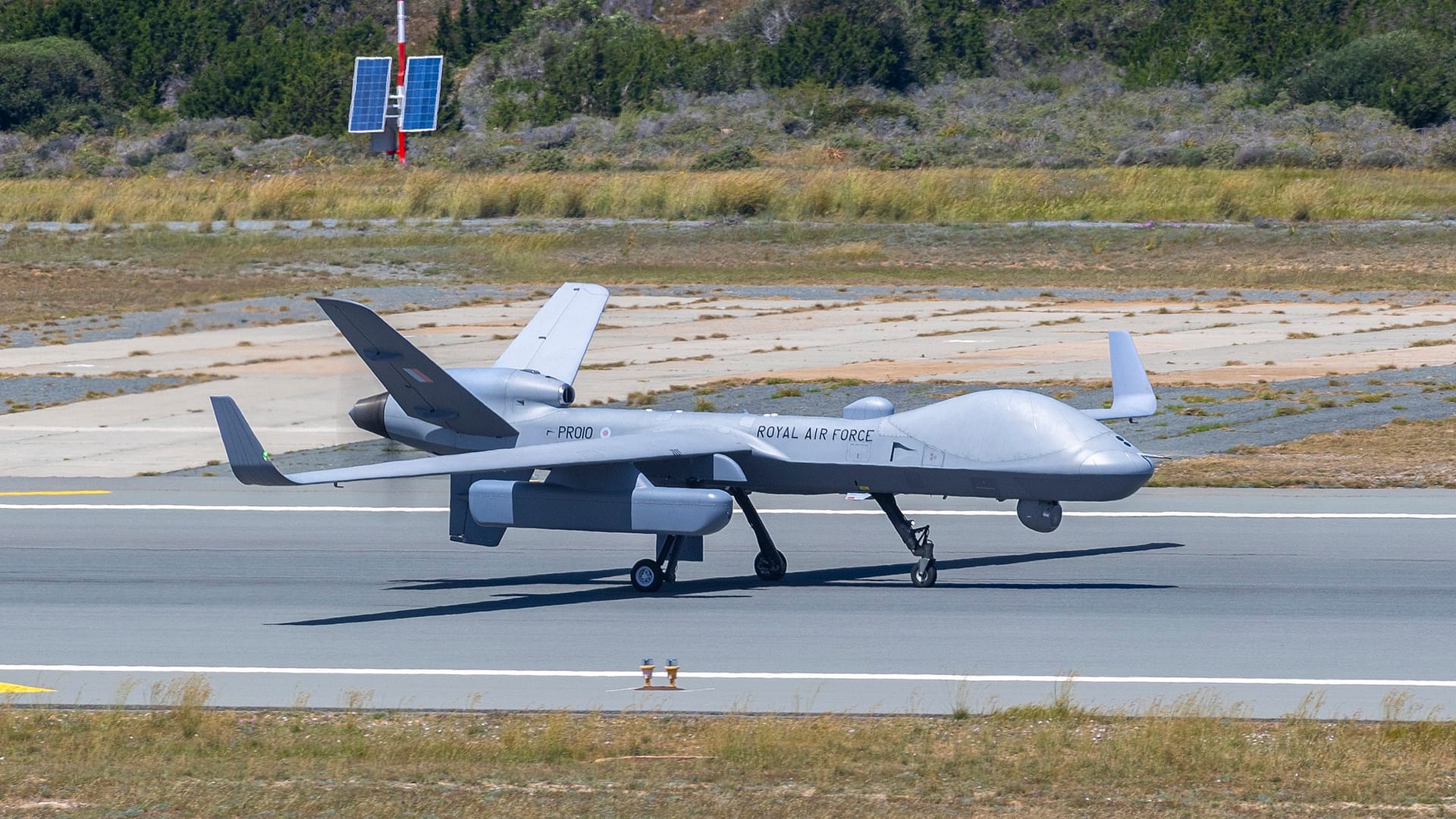
Most of what an air force does in secret stays secret. Occasionally, though, the secret taxis past a photographer in broad daylight. That is what happened at RAF Akrotiri, where the British Ministry of Defence has just released official photographs of its newest drone — and, almost certainly without meaning to make a fuss of it, the clearest images yet of a payload the UK has never properly admitted to owning.
The aircraft is the Protector RG1, the RAF’s new uncrewed workhorse. The object of interest is a long, smooth pod under its starboard wing, known by the codename ‘Outdragon’ — and the smart money says it is an electronic eavesdropper.
- What: the UK MoD has released official photos of the RAF’s MQ-9B Protector RG1 at RAF Akrotiri, Cyprus — the clearest views yet of its ‘Outdragon’ pod
- The aircraft: Protector RG1, the RAF’s new uncrewed aircraft, which replaced the MQ-9A Reaper; flown by 31 Squadron
- The loadout: a Paveway IV precision bomb under one wing and the large Outdragon pod under the other, plus a blade antenna on the fuselage spine
- What Outdragon likely is: a signals-intelligence (SIGINT) payload — eavesdropping electronics, not cameras
- Where: supporting Operation Shader over the Middle East
Reading a drone’s loadout like a sentence
The photographs, taken in April 2026, show the Protector carrying a Paveway IV precision-guided bomb under one wing and the large Outdragon pod under the other, with a prominent blade antenna mounted on the fuselage spine. To a casual eye it is just hardware. To an analyst it is a sentence to be parsed.
The tell is what the pod lacks. There are no glass windows for a camera, no flat panels for a radar, no apertures for an infrared seeker. A surveillance pod with nothing to see through is not there to look — it is there to listen. Combined with that large blade antenna, the logical conclusion is signals intelligence: intercepting the radio and radar emissions of whoever the drone is watching.
A British habit of quiet payloads
This is not new behaviour for the RAF. Its older MQ-9A Reapers spent their final years wearing two undisclosed ‘cheeks’ on the fuselage, associated in U.S. budget documents with a mobile-phone geolocation system. The British government rarely confirms any of it, preferring — in the words of one assessment to Janes — to allude only vaguely to a “comprehensive” intelligence suite.
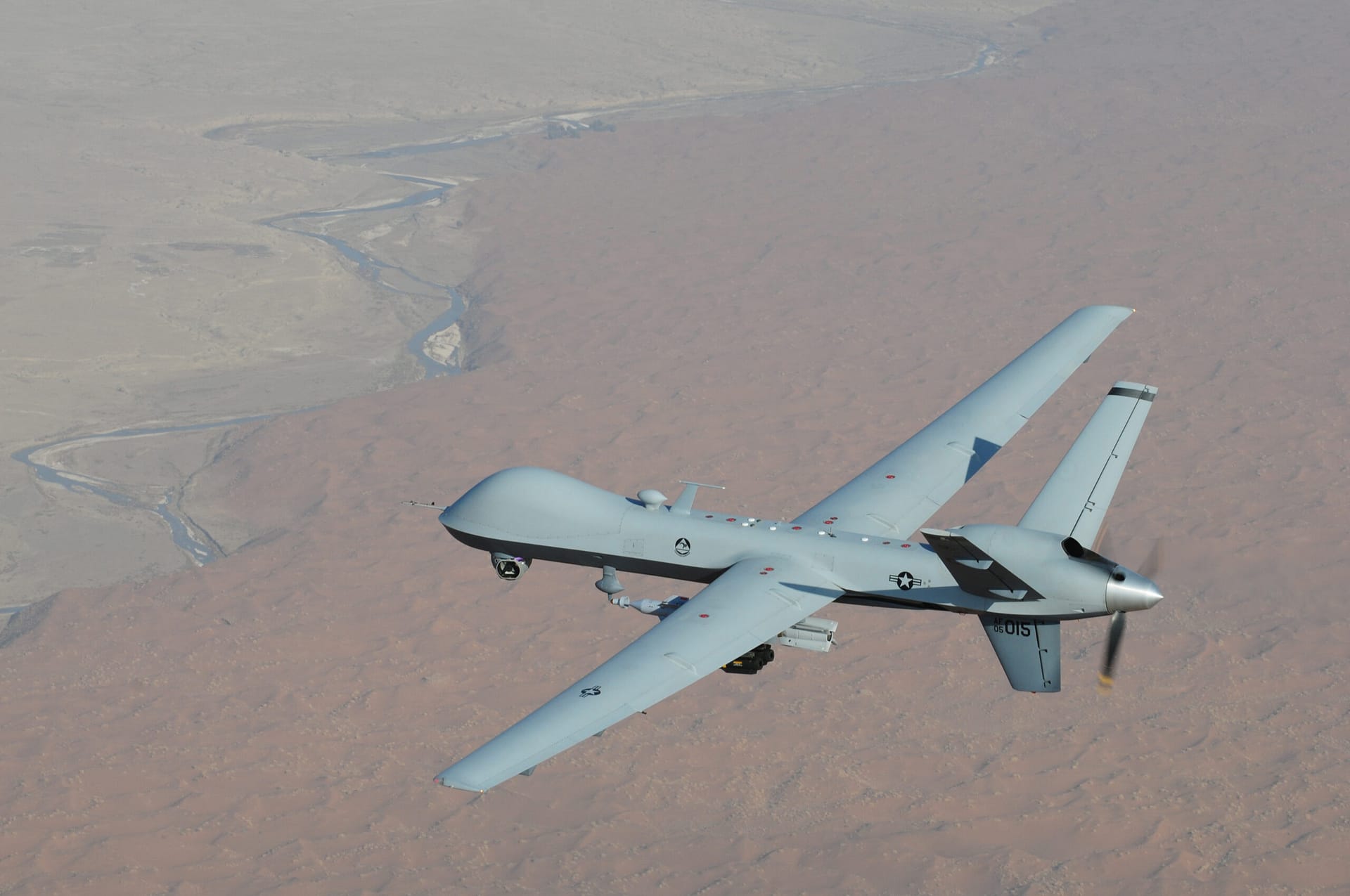
What makes the Protector a more capable host for such tricks is regulatory rather than electronic. Unlike the Reaper, which was never permitted to fly in ordinary British airspace, the Protector holds a full military type certificate and can operate among civilian traffic. It recently flew itself from RAF Waddington across Europe to Cyprus — a routine-sounding transit that the Reaper, which had to be crated up and shipped, could never have managed.
Why a listening drone matters
An armed drone that can also map an enemy’s electronic order of battle is a quietly powerful thing. It can loiter for a day, build a picture of who is transmitting and from where, and — with a Paveway IV on the other wing — act on what it hears. The MoD will not spell that out. It does not need to. Sometimes the most revealing intelligence briefing is a high-resolution photograph the press office published itself.
Sources: UK Ministry of Defence Defence Imagery; The Aviationist; Janes; Drone Wars UK.
Related Questions
What is the RAF Protector RG1?
The Protector RG1 is the Royal Air Force's new long-endurance uncrewed aircraft, a British version of the General Atomics MQ-9B SkyGuardian. It replaced the older MQ-9A Reaper and, unlike the Reaper, is certified to fly in ordinary UK and European airspace rather than only in segregated military zones.
What is the 'Outdragon' pod?
Outdragon is an undisclosed payload carried under the Protector's wing. The UK has never officially described it, but its appearance — no optical, infrared or radar apertures, paired with a large blade antenna — and references in a briefly-public RAF loadout document strongly suggest it is a signals-intelligence (SIGINT) system designed to detect and analyse enemy radio and radar emissions.
What is signals intelligence (SIGINT)?
SIGINT is the practice of intercepting and analysing electronic signals — radio communications, radar emissions, data links — to locate and understand an adversary. A SIGINT drone does not photograph targets so much as listen to them, mapping who is transmitting, from where, and on what frequencies.
Where is the Protector operating?
The photos were taken at RAF Akrotiri in Cyprus, a major British base, and the aircraft is supporting Operation Shader — the UK's long-running mission against Islamic State and related operations across the Middle East. The Protector began flying from Akrotiri in the second half of 2025.
How is the Protector different from the old Reaper?
Besides new sensors and payloads like Outdragon, the biggest change is regulatory: the Protector holds a military type certificate that lets it fly in shared civilian airspace. It recently made a first-of-its-kind self-ferry flight from RAF Waddington across European airspace to Cyprus, whereas Reapers had to be taken apart and shipped.


0 Comments