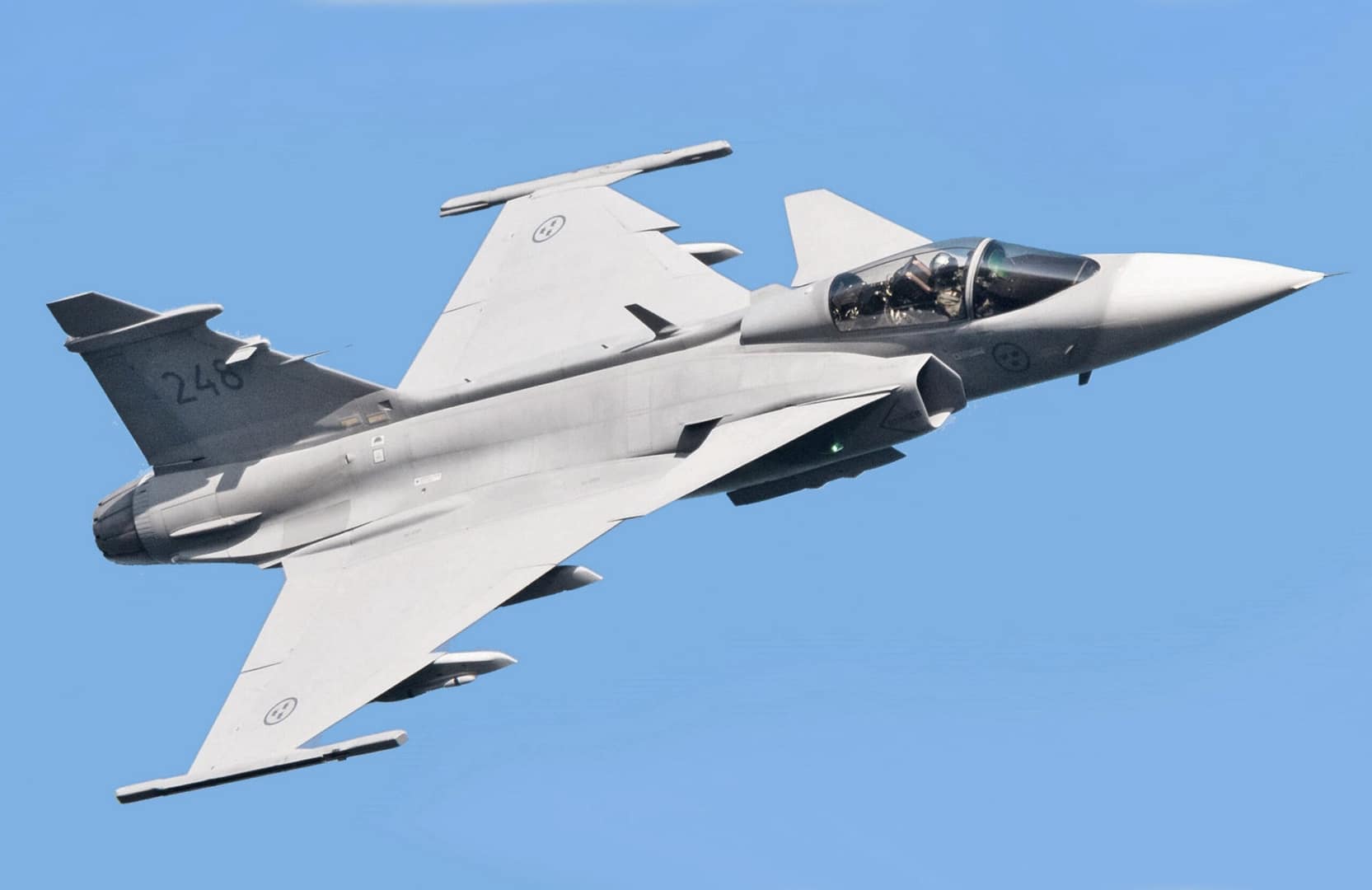
Saab is building Gripens faster than at any point in the fighter’s three-decade history — and it is not fast enough. On April 23, CEO Micael Johansson told investors that production is heading toward 20 to 30 aircraft per year, up from roughly 15 today, with a longer-term target of 36 annually.
The company is expanding assembly lines in Sweden and Brazil, exploring a third line in Canada, and negotiating a deal that could put Gripens in Ukrainian hands. The order book is swelling. The question is whether Saab’s factories can keep pace.
Quick Facts
Current production rate: ~15 Gripens/year
Near-term target: 20–30/year (within ~1 year)
Long-term target: 36/year
Q1 2026 sales growth: +24%
Assembly lines: Linköping (Sweden), Embraer plant (Brazil), potential Canadian line
Key pending deal: Ukraine (Gripen E/F)
From 15 to 36
The Gripen E/F is a single-engine multirole fighter that punches well above its weight class. It matches or exceeds the F-16 Block 70 on most metrics while costing significantly less to operate. Its AESA radar, electronic warfare suite, and Meteor missile integration make it a genuine fourth-generation-plus platform. And unlike the F-35, it can operate from short, rough airstrips with minimal ground support.
That operational flexibility has driven demand. Sweden operates the Gripen as its frontline fighter. Brazil is buying 36 Gripen E/Fs with local assembly at Embraer’s plant in Gavião Peixoto. Thailand, South Africa, Hungary, and the Czech Republic all fly earlier Gripen variants. And a growing list of countries — including several that previously defaulted to American or French aircraft — are now evaluating the Gripen E.
Saab’s Q1 2026 results, announced on April 23, showed sales up 24 percent year-on-year. Johansson said the production ramp would “more likely be at the higher end” of the 20–30 range, suggesting 25–30 Gripens per year within twelve months.
Three Assembly Lines
Reaching 36 aircraft per year requires more than one factory. Saab’s main assembly line in Linköping, Sweden, handles the bulk of production. The Embraer joint venture in Brazil adds capacity for Brazilian and export orders. A third line — potentially in Canada — is under discussion, driven by interest from countries seeking non-American fighter options.
The Canadian line is speculative but strategically significant. Canada’s own fighter competition selected the F-35, but a Gripen assembly plant in Canada could serve as an export hub for Latin American and other customers who want a Western fighter without the political strings attached to U.S. foreign military sales.
Each assembly line is designed to produce complete aircraft, not just sub-assemblies. This distributed manufacturing model reduces supply chain risk and allows Saab to offer offset packages — local jobs and technology transfer — that are increasingly decisive in fighter competitions.
The Ukraine Factor
The largest potential order on Saab’s horizon is Ukraine. Discussions between Stockholm and Kyiv about Gripen E/F deliveries have been progressing, with Johansson confirming “good progress” during the Q1 earnings call. A Ukrainian Gripen order would be transformational — both for Saab’s production planning and for Ukraine’s air force.
The Gripen’s low operating costs, rough-field capability, and compatibility with NATO weapons make it an ideal complement to Ukraine’s F-16s. Where the F-16 needs substantial ground infrastructure, the Gripen was designed from the outset to operate from Swedish highways with conscript ground crews. In a dispersed, contested environment like Ukraine, that matters enormously.
No contract has been signed, and the timeline remains unclear. But the political will on both sides is evident. Sweden, as one of NATO’s newest members, has strong motivation to demonstrate its defence industrial value to the alliance.
A Fighter Whose Time Has Come
The Gripen spent years in the shadow of the F-35, often dismissed as a lightweight option for countries that could not afford American fifth-generation jets. That narrative is crumbling. The Gripen E/F’s capabilities have matured. Its cost advantage has widened. And the geopolitical landscape — with countries increasingly wary of dependence on a single supplier — favours diversification.
Saab’s challenge is no longer selling the Gripen. It is building them fast enough.
Sources: Aviation Week, AeroTime, Defence Express, Defence Industry EU, Shephard Media, Flight Global

 English
0 Comments