
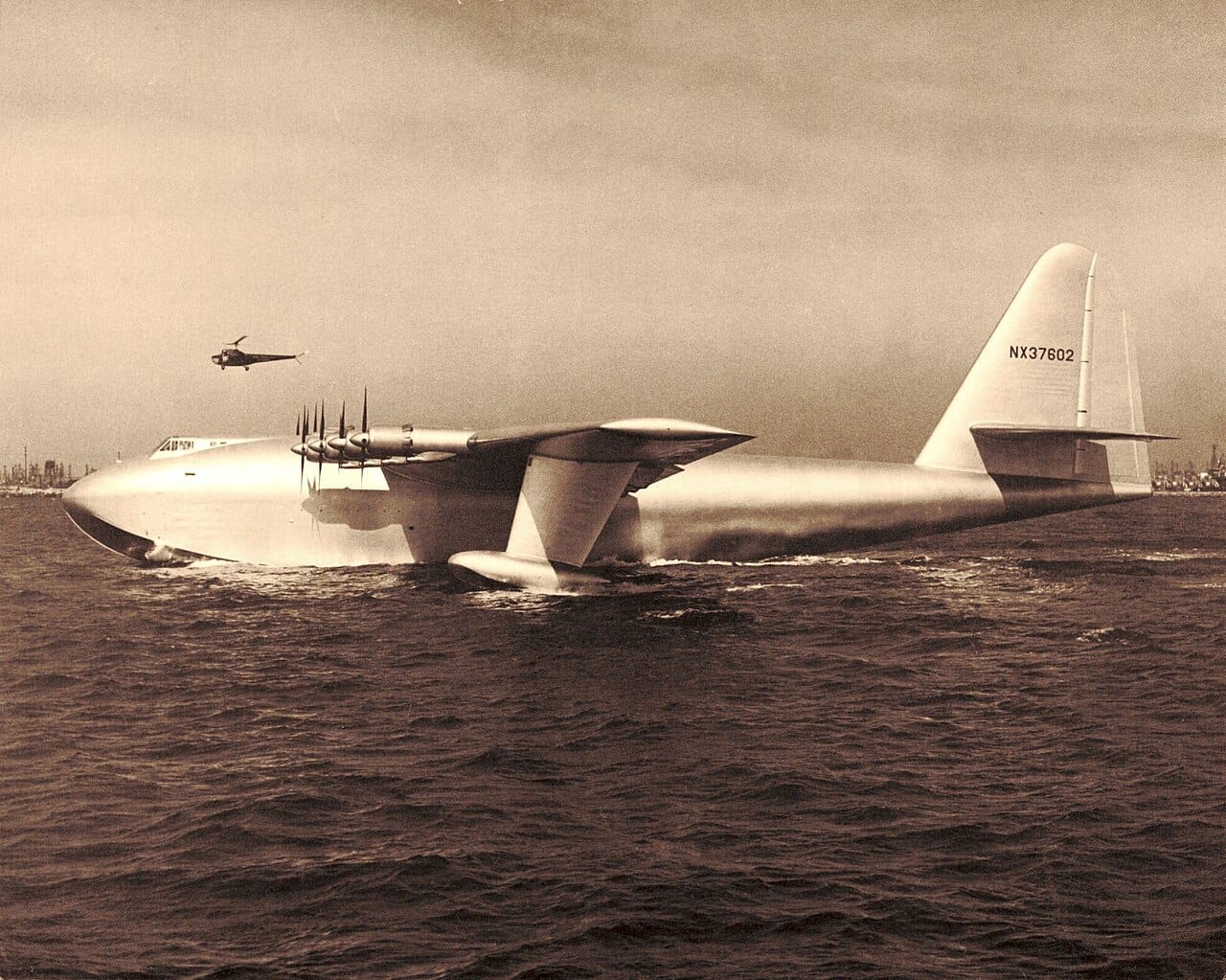
Long Beach harbor, the morning of 2 November 1947, smelled of salt, diesel and quiet disappointment. Bobbing in the channel was the largest flying machine humanity had ever bolted together: a wooden flying boat the length of two-thirds of a football pitch, with a wingspan longer than the pitch itself, eight snarling engines, and a public reputation somewhere between national embarrassment and the most expensive duck ever carved. Nobody standing on the pier that day expected it to leave the water. Officially, nobody was supposed to want it to.
It was, the paperwork insisted, a taxi test. A gentle motorboat outing for a 200-tonne aeroplane. Four reporters had already grown bored and gone off to file their stories. And then Howard Hughes, millionaire, film producer, obsessive, and a man who had just spent weeks being called a fraud on live radio in Washington, nudged the throttles forward and did the one thing everyone insisted his lumberyard-with-wings could never do.
He flew it. Barely, briefly, and entirely on purpose.
Quick Facts
| Aircraft | Hughes H-4 Hercules (Spruce Goose) |
| Material | Laminated birch (Duramold), not spruce |
| Wingspan | 97.5 m (320 ft), largest of any aircraft until 2019 |
| Only flight | 2 November 1947, Long Beach harbor, California |
| Flown by | Howard Hughes, at the controls |
| Now at | Evergreen Aviation & Space Museum, McMinnville, Oregon |
A senator, a tycoon, and a spectacularly public grudge
Afterburner has told the wider story of the Hercules before, in our full profile of the aircraft; this is the narrower, stranger tale of the 26 seconds that silenced a Senate committee. To understand why a man would risk his neck in an untested wooden behemoth to travel roughly one mile, you have to understand how badly the previous three months had gone for him. In the summer of 1947, Hughes was hauled before the US Senate War Investigating Committee to explain what had happened to some 40 million dollars of government money, including the roughly 23 million poured into this flying boat, a transatlantic troop transport commissioned in 1942 to dodge German U-boats, and delivered in 1947, comfortably two years after anyone needed it.
The committee's sharpest knife belonged to Senator Owen Brewster of Maine. The hearings were meant to expose wartime war-contract profiteering; instead they curdled into one of the great grudge matches of American public life. Hughes, rather than grovelling, went on the attack, accusing Brewster of being cosy with Pan American Airways and of offering to make the whole investigation disappear if Hughes would merge his beloved TWA into Pan Am. It was riveting radio. Public sympathy swung toward the tanned aviator and away from the senator. But an accusation is not an aeroplane, and the flying boat still sat in its hangar, mocked, unflown, and, as far as Congress was concerned, proof that Hughes had taken the taxpayer for an enormous plywood ride.
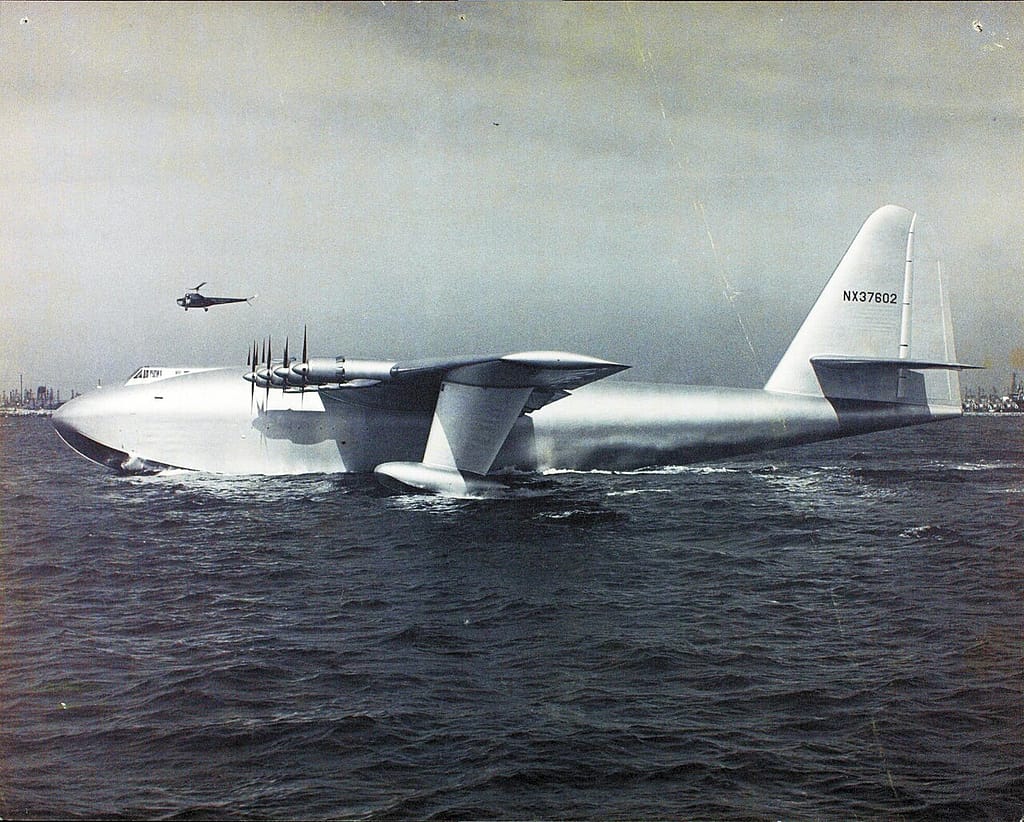
That line, that he would leave the country and never come back if it failed, was not throwaway bluster. Hughes said it under oath, on 6 August 1947, and the whole country heard him. Which meant the flying boat had stopped being an engineering project. It had become a very large, very public bet, with his reputation stapled to the wings.
The spruce goose that was never made of spruce
First, let us demolish the nickname, because it has misled people for the better part of a century. The Spruce Goose is not made of spruce. It is made almost entirely of birch, laminated into shape using the Duramold process, thin sheets of wood and resin pressed into a lightweight composite that was genuinely ahead of its time. Wood was mandated because wartime rules reserved aluminium for aircraft that might actually reach the war. Spruce Goose was a jibe coined by critics; Hughes loathed it.
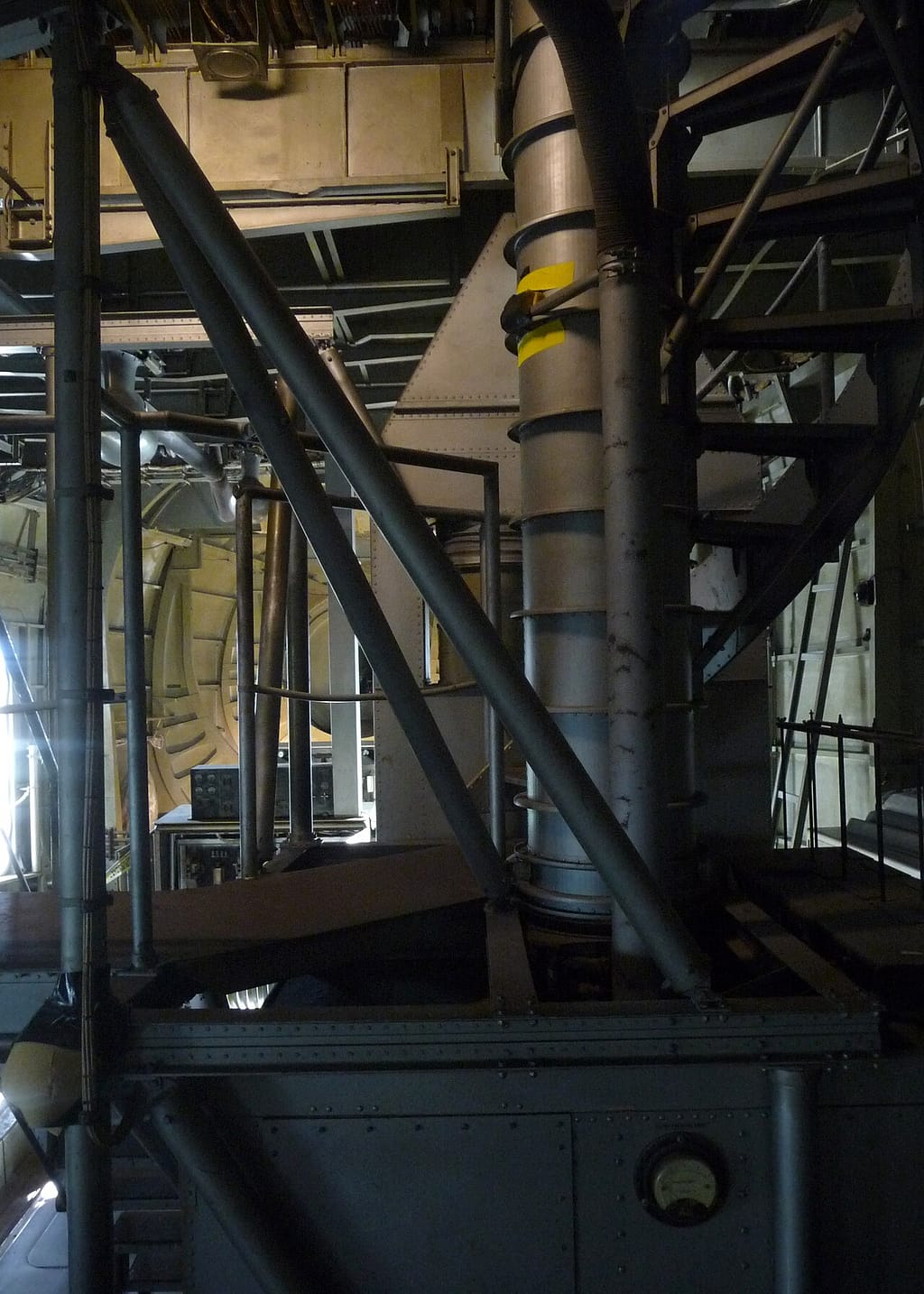
The numbers remain difficult to hold in your head. The wingspan was 97.5 metres (320 feet), a record that stood until the twin-fuselage Stratolaunch finally beat it in April 2019, seventy-two years later. Eight Pratt and Whitney Wasp Major engines. Over five storeys tall at the tail. Designed to haul 750 troops or two Sherman tanks across an ocean. It was, in every sense, too big: too big to build quickly, too big to need by 1947, and, most people assumed, far too big to get off the water.
A documentary overview of Howard Hughes and the H-4 Hercules Spruce Goose.
The taxi test that forgot to stay on the water
So the plan for 2 November was modest. Hughes would run taxi tests up and down the Long Beach channel with a full house aboard, thirty-six people in all, including copilot Dave Grant, flight engineers, sixteen mechanics, and a gaggle of invited press and industry men. Two runs went by uneventfully. Four reporters, sensing a slow news day, disembarked and left. This turned out to be the professional mistake of their lives.
On the third run, out on the channel facing Cabrillo Beach, Hughes opened the throttles wider than a taxi test has any business requiring. The Hercules gathered speed, the hull slapped clear of the swell, and the impossible happened: it lifted off. For about 26 seconds it flew, roughly 70 feet above the water, at around 135 mph, covering approximately one mile, before Hughes set it back down. Purists will note, correctly, that at 70 feet the machine was still riding a cushion of ground effect, the extra lift a wing gets when flying low. It was less a soaring cross-country than an emphatic, deliberate hop.
But it flew. And that was the entire point.
Archival footage of the H-4 Hercules on the water and its 2 November 1947 flight at Long Beach.
One flight, argument won, engines cold forever
Here is the part that turns an aviation footnote into a genuinely strange human story: the Spruce Goose never flew again. Not once. There was no need, the war it had been designed for was long over, and its lifting capacity and ceiling were never actually tested. Its job was never really to cross the Atlantic. Its job, by November 1947, was to prove a point to a Senate committee, and it did that in 26 seconds flat.
Hughes, being Hughes, then kept the vindicated aircraft in a climate-controlled hangar with a full-time crew, as many as 300 people, maintaining it in ready-to-fly condition at roughly a million dollars a year, for decades. The staff was trimmed only in 1962 and disbanded after Hughes died in 1976. He never flew it again, but he could not bear to let it stop being flyable, which tells you rather a lot about the man.
The story of the Spruce Goose, the 23-million-dollar flying boat's only flight.
Today the Hercules lives, fully assembled and improbably intact, at the Evergreen Aviation and Space Museum in McMinnville, Oregon, where it dwarfs everything around it. It remains the plane that flew exactly once, not to go anywhere, but to win an argument. On that single, narrow measure, it was a total, unqualified success.
Sources: Wikipedia (Hughes H-4 Hercules), BBC News, Evergreen Aviation & Space Museum
0 Comments