
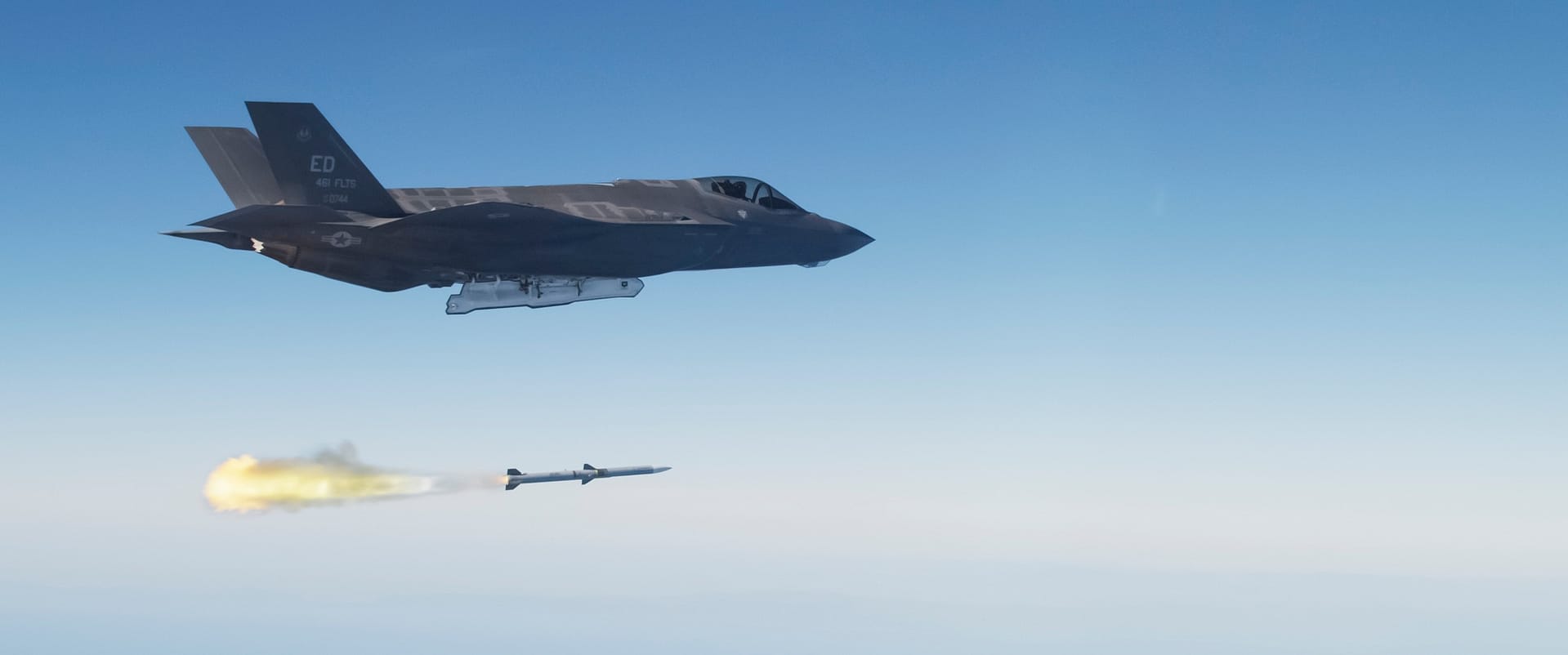
The United States Air Force has quietly dropped one of the most ambitious weapons requirements in recent memory: a new air-to-air missile capable of killing targets at a minimum distance of 1,000 nautical miles — roughly 1,150 statute miles. That is approximately ten times the reach of today's best version of the AIM-120 Advanced Medium Range Air-to-Air Missile (AMRAAM), the weapon that has defined Western air-to-air combat for three decades.
The programme, formally designated the Air Force Long Range Weapon (AFLRW), was revealed through a contracting notice issued on 24 June by the Air Force Life Cycle Management Center's Armament Directorate at Eglin Air Force Base, Florida. A classified Industry Day is scheduled for 25–26 August at Eglin's Guided Weapons Evaluation Facility. All attendees require Secret-level clearances.
Not Just Air-to-Air: A Dual-Role Weapon
What sets the AFLRW apart from every long-range air-to-air programme before it is scope. The Air Force is not simply asking for a bigger AMRAAM. It wants a modular weapons family with both air-to-air (A/A) and air-to-surface (A/S) variants, unified by open-architecture components and overseen by a "Master Integrator" contractor who will assemble the complete missile from subsystems supplied by multiple vendors.
"Both variants will have a threshold minimum range of 1,000 NM and be capable of striking respective A/A and A/S targets in Defense Planning Scenario 2.1 and 7.1 environments in a responsive manner," the solicitation states. The Air Force has not publicly clarified what those specific scenarios entail, but they almost certainly involve a high-end conflict in the Western Pacific.
The notice adds that air-to-air solutions will be prioritised for Initial Operational Capability, signalling that the AWACS-killer mission is the most urgent requirement.
Why 1,000 Miles? The Math of a Pacific War
The distances involved in a potential Indo-Pacific conflict explain why the Air Force is thinking in four-digit ranges. From U.S. bases on Okinawa to Taiwan is roughly 390 nautical miles. From Andersen Air Force Base on Guam to Taiwan: approximately 1,500 nautical miles. China's expanding anti-access/area denial (A2/AD) network — layered surface-to-air missile systems, advanced radar networks, and long-range airpower — threatens the tankers, airborne early warning aircraft, and intelligence platforms that American combat power depends on.
An AFLRW-armed aircraft operating over the East China Sea could theoretically engage targets deep inside the Chinese mainland, provided suitable targeting data were available. More critically, it could destroy KJ-500 airborne early warning aircraft, Il-78 tankers, and H-6 bombers hundreds of miles behind the front lines — without ever entering the engagement envelope of Chinese air defences.
The Air Force itself hinted at this logic in a December 2024 report to Congress, predicting that by 2050 adversaries would field "counterair weapons with ranges out to over 1,000 miles" supported by space-based sensors. The AFLRW suggests the Pentagon intends to get there first.
Where AFLRW Fits in the American Arsenal
The current U.S. air-to-air missile inventory is anchored by the AIM-120D-3 AMRAAM, generally understood to have a maximum range of roughly 100 miles. Extended-range variants may be in development, and the classified AIM-260A Joint Advanced Tactical Missile (JATM) promises significantly greater reach — but nothing approaching 1,000 nautical miles.
The U.S. Navy has taken a parallel path with the AIM-174B, an air-launched version of the Standard Missile-6 that can be fired from F/A-18F Super Hornets. Analysts assess its range to be broadly comparable to the Cold War-era Advanced Strategic Air-Launched Missile (ASALM), which topped out at approximately 260 nautical miles. AFLRW would represent a nearly fourfold leap beyond even that.
The $49.5 million requested in the Fiscal Year 2027 budget confirms that AFLRW is still in concept refinement — but the speed of the solicitation, with white paper requests expected shortly after the August industry day, suggests the Air Force wants to move fast.
The Kill Web Problem
A missile that flies 1,000 nautical miles is useless without something to tell it where to go. At those distances, the launch platform's own radar is irrelevant. AFLRW will depend entirely on what the Pentagon calls a "kill web" — a distributed network of sensors spanning air, sea, land, space, and cyberspace domains that can detect, track, and pass targeting data to the weapon in flight.
The most critical element of that web is the emerging space-based aircraft tracking layer. The U.S. military is investing billions in distributed satellite constellations capable of providing persistent air and ground moving-target indicator data globally. Without these orbital sensors, a 1,000-mile missile would be little more than a very expensive bottle rocket. With them, it becomes a weapon that can reach into any airspace on earth.
The B-21 Connection
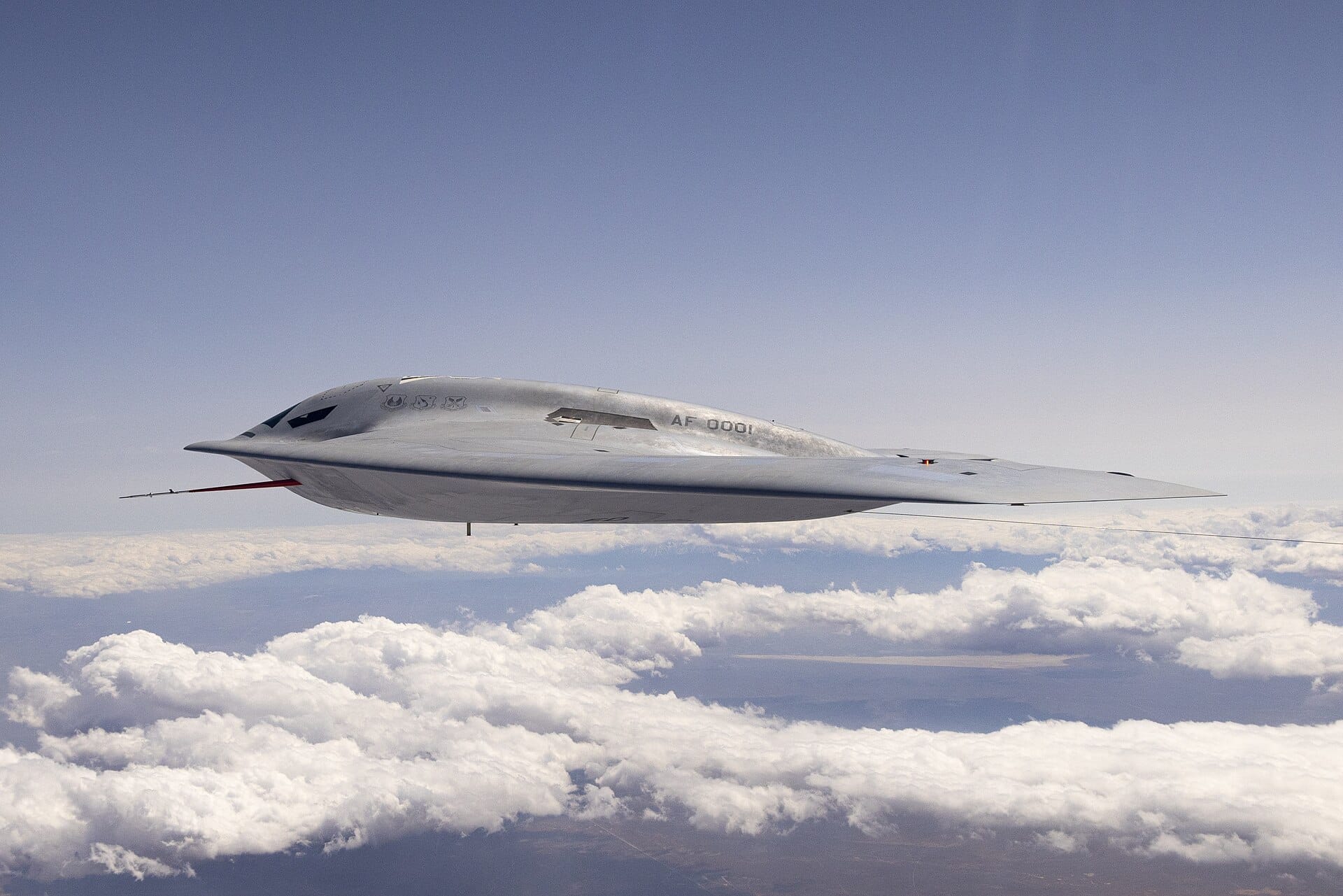
There is also the question of which aircraft will carry a missile with this kind of reach. A weapon designed to fly 1,000 nautical miles is likely too large for the internal bays of an F-35 or the planned F-47. The more natural home is a bomber — specifically the B-21 Raider, which the Air Force has openly discussed repurposing as a "weapons truck" for air-to-air combat. The Cold War-era ASALM was similarly designed for bomber employment.
A B-21 carrying a bay full of AFLRW missiles could serve as a long-range interceptor, clearing the skies of enemy support aircraft from well outside contested airspace. It is a concept that upends the traditional fighter-vs-fighter paradigm — and one that aligns precisely with the Air Force's shift toward autonomous, networked, stand-off warfare.
Much remains classified about the AFLRW's propulsion concept — whether cruise missile, hypersonic glide vehicle, or air-launched ballistic design — as well as its guidance architecture and timeline to fielding. What is already clear is the scale of ambition: the Air Force wants to kill aircraft at distances that, until now, were the exclusive domain of strategic ballistic missiles. If AFLRW succeeds, it will fundamentally reshape how air wars are fought.
Sources: The War Zone, Air & Space Forces Magazine, Military Times, 19FortyFive
Related Questions
What is the Air Force Long Range Weapon (AFLRW)?
The AFLRW is a US Air Force programme for a new missile able to hit targets at a minimum range of 1,000 nautical miles (about 1,150 statute miles). Revealed through a June 2026 contracting notice from Eglin Air Force Base, it would offer roughly ten times the reach of today’s best AIM-120 AMRAAM.
How far can the new US long-range missile reach?
The AFLRW has a threshold minimum range of 1,000 nautical miles, around ten times the reach of the current AMRAAM. That distance would let US fighters engage targets far beyond visual range, a capability aimed at a potential high-end conflict in the Western Pacific.
What is the AIM-120 AMRAAM?
The AIM-120 Advanced Medium Range Air-to-Air Missile (AMRAAM) has defined Western air-to-air combat for three decades, with an estimated reach of about 100 miles. The AFLRW is designed to dwarf it — part of a race for range that includes rival weapons such as China’s long-range PL-16.
Is the AFLRW only an air-to-air missile?
No. Unlike earlier programmes, the AFLRW is envisioned as a modular weapons family with both air-to-air and air-to-surface variants, built on open-architecture components and assembled by a "Master Integrator" contractor from subsystems supplied by multiple vendors. Both variants share the 1,000-nautical-mile threshold range.
Where is the AFLRW being developed?
The programme is run by the Air Force Life Cycle Management Center’s Armament Directorate at Eglin Air Force Base, Florida. A classified Industry Day was scheduled for 25–26 August at Eglin’s Guided Weapons Evaluation Facility, with all attendees requiring Secret-level clearances.


0 Comments