
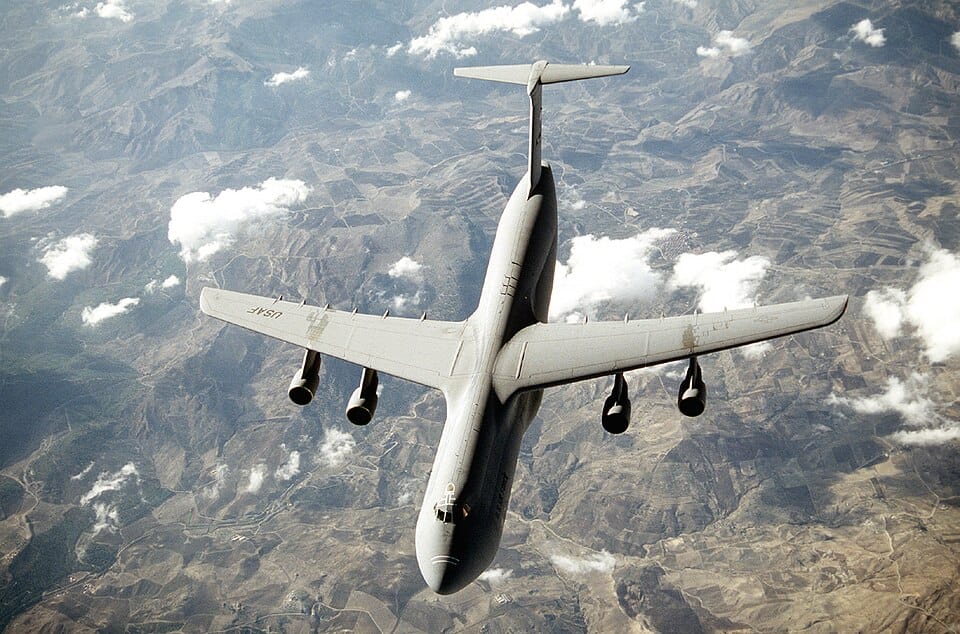
On paper, the C-5 Galaxy is the most capable military transport aircraft ever built by the Western world. In practice, on any given day in 2025, 63 percent of the fleet is broken. That number — 37 percent mission capable — is not a rounding error or a statistical blip. It is a structural crisis, and the Air Force has now responded by kicking the problem thirty years down the road.
The service recently confirmed that the last C-5M Super Galaxy will not retire until FY2050. That is five years later than the previous plan, and it means the youngest aircraft in the fleet will be approximately 61 years old when it finally taxis off the active duty ramp for the last time. For perspective: the airframe first flew in 1968. A 61-year-old C-5 would be the aviation equivalent of a grandmother doing combat airlift sorties on Medicare.
How does a $10 billion modernization program end up producing an aircraft that can barely get off the ground half the time? The answer is a masterclass in how the best-laid defense acquisition plans collide with the grinding reality of industrial supply chains.
Quick Facts
- Current mission capable rate: 37% (FY2025)
- Previous year rate: 49% (FY2024)
- Target rate: 75% (never achieved post-upgrade)
- Fleet size: 52 C-5M Super Galaxies
- New retirement date: FY2050 (pushed back 5 years)
- Youngest aircraft age at retirement: ~61 years
- Upgrade program: AMP/RERP — $10 billion, completed 2018
- New engines: GE CF6-80C2 turbofans (replaced TF-39)
- Max payload: 270,000 lb (122,472 kg) outsized cargo
The Promise: A $10 Billion Renovation
The C-5's problems did not begin with bad engineering. The original Lockheed design — a behemoth capable of swallowing tanks, helicopters, and entire field hospitals — was genuinely revolutionary in 1970. Four massive TF-39 turbofan engines, a cargo bay 143 feet long, and clamshell doors front and rear that allowed drive-through loading. The Galaxy could carry outsized cargo that no other aircraft on Earth could touch.
The trouble was age. By the 2000s, the TF-39 engines were museum pieces — thirsty, underpowered, and increasingly impossible to support. Congress and the Air Force launched the Avionics Modernization Program (AMP) and the Reliability Enhancement and Re-engining Program (RERP), combining them into a $10 billion effort that would, the briefings promised, transform the aging fleet into a machine good through the 2040s. New GE CF6-80C2 engines — the same powerplants that haul Boeing 747s across the Pacific — would deliver 22 percent more thrust and 27 percent better fuel efficiency. New glass cockpit avionics would slash crew workload. The result: the C-5M Super Galaxy, certified complete in 2018.

The readiness target was 75 percent mission capable. That number was not aspirational — it was the justification for the entire program. Without 75 percent, the math did not work. The Air Force would be spending ten billion dollars to keep a fleet that was supposed to be replaced by the C-17 Globemaster III, and it would need to show tangible operational returns to justify the investment to Congress.
In FY2024, the C-5M fleet hit 49 percent mission capable. Disappointing, but defensible. In FY2025, it fell to 37 percent. That is the lowest recorded rate for the Super Galaxy variant, and it lands the entire program in a category aviation insiders call "worse than before the upgrade."
The Villain: Supply Chain Collapse
Blame has accumulated around a phenomenon that sounds almost ironic: the Air Force announced C-5 retirements so many times over the past two decades that the industrial base simply stopped investing in the platform. Vendors who manufactured C-5-specific parts calculated — correctly, for a while — that the program had no future. They retooled for other contracts. Some closed entirely.
When the RERP modernization extended the C-5's life by decades, those vendors were gone. The supply chain for C-5-unique components — parts that cannot be cannibalized from other aircraft because nothing else in the fleet shares the Galaxy's dimensions or systems architecture — had quietly evaporated. The result is a maintenance situation where aircraft sit on the ramp not because mechanics lack the skill to fix them, but because the parts do not exist, or exist only in quantities measured in single digits somewhere in the Defense Logistics Agency's labyrinthine warehouse system.

It is the aerospace equivalent of buying a classic car, spending a fortune restoring the engine, and then discovering the manufacturer that made the door seals went out of business in 2003. Parts are sourced from cannibalized aircraft, manufactured as one-off runs at extraordinary per-unit cost, or simply waited for — which means aircraft sitting idle for weeks or months at a stretch while the clock runs on flying hour budgets and operational commitments.
The 52-aircraft fleet size compounds the problem. There are not enough C-5Ms to rotate through depot maintenance on a schedule that keeps the operational fleet healthy. When an aircraft goes in for heavy maintenance, it may be gone for eighteen months. With only 52 total airframes, even a modest number of depot inductions mathematically devastates the available mission-capable count.

Why 2050 — and Why That Date Will Probably Move Again
The FY2050 retirement date exists because there is simply no viable replacement for the C-5's specific capability. The C-17 Globemaster III is an excellent aircraft — but its maximum payload is 170,900 pounds, versus the Galaxy's 270,000 pounds. For the specific category of "outsized cargo" — M1 Abrams tanks, AH-64 Apache attack helicopters, Patriot missile batteries, large industrial equipment for combat engineering — the C-5 is irreplaceable. No other aircraft in any allied inventory comes close.
The Air Force has no funded program to develop a C-5 successor. The budget environment of the mid-2020s, with demands from F-47 Next Generation Air Dominance, B-21 Raider, and the Next-Generation Air Refueling System all competing for finite dollars, makes a new ultra-heavy transport a fantasy in any near-term planning cycle. So the Galaxy flies on — until 2050, or until that date moves to 2055, or 2060, or until one of the airframes finally reaches a maintenance state from which return is not economically justified.
The readiness crisis is, in the end, a story about what happens when the military-industrial complex makes decisions for today that it cannot afford tomorrow. Every early retirement announcement, every programmatic cancellation, every vendor who walked away from C-5 supply contracts took a brick from the wall. The RERP program put the wall back up — but the bricklayers had all found other jobs. Rebuilding the supply chain for a fleet of 52 aircraft that the Air Force spent twenty years threatening to retire is expensive, slow, and deeply unglamorous. It does not get congressional attention. It does not generate press releases. It just produces, quarter after quarter, a readiness rate that tells a story no one in the Pentagon particularly wants to tell.
Thirty-seven percent mission capable. Sixty-three percent of the fleet on the ramp. The world's most capable military transport, grounded by a parts drawer that came up empty.
Sources: Air Force Magazine, Government Accountability Office C-5 Readiness Reports, Air Mobility Command, Congressional Research Service, Defense Logistics Agency
Related Questions
What is the C-5 Galaxy?
The Lockheed C-5 Galaxy is a strategic military transport and the largest aircraft in the US Air Force inventory. First flown in 1968, it carries outsized cargo — tanks, helicopters, even field hospitals — in a cargo bay 143 feet long, loaded through clamshell doors at both the nose and tail. Its maximum payload is around 270,000 pounds.
How much can a C-5 Galaxy carry?
The C-5M Super Galaxy can carry a maximum payload of roughly 270,000 pounds (about 122,000 kg) of outsized cargo — loads no other Western transport can handle. Its 143-foot cargo bay swallows tanks and helicopters, loaded through clamshell doors front and rear. It belongs to a rare class of outsized-cargo haulers alongside the Aero Spacelines Guppy that carried Apollo hardware.
Why is the C-5 Galaxy's mission capable rate so low?
As of FY2025, only about 37 percent of the C-5M fleet was mission capable — meaning roughly 63 percent was grounded on any given day, down from 49 percent the year before. The cause is largely aging airframes and fragile spare-parts supply chains, not the original design. The post-upgrade target of 75 percent was never achieved.
When will the C-5 Galaxy retire?
The US Air Force now plans to keep the C-5M Super Galaxy flying until FY2050 — five years later than the previous plan. Because the airframe first flew in 1968, the youngest aircraft will be roughly 61 years old when it finally leaves active service. The fleet currently numbers 52 C-5M aircraft.
What was the C-5 AMP/RERP upgrade program?
It was a roughly $10 billion modernization combining the Avionics Modernization Program (AMP) with the Reliability Enhancement and Re-engining Program (RERP), completed in 2018. It replaced the original TF-39 engines with GE CF6-80C2 turbofans — the same type used on Boeing 747s — and was meant to keep the fleet viable into the 2040s.
What engines does the C-5M Super Galaxy use?
The C-5M uses four General Electric CF6-80C2 turbofans, the same commercial engine family that powers the Boeing 747. They replaced the original TF-39 engines during the RERP upgrade, providing about 22 percent more thrust. Despite the new powerplants, fleet readiness has stayed low because of broader maintenance and supply-chain problems.
Why does the US Air Force keep old aircraft flying for decades?
Replacing large fleets is enormously expensive and slow, so the Air Force often modernizes and extends existing aircraft instead. The C-5 Galaxy and the B-52 Stratofortress are prime examples — both will serve far longer than their designers imagined. Production restarts, such as the proposed C-17 Globemaster restart, are also being studied.
0 Comments