
Quick Facts
First wind tunnel: Francis Wenham and John Browning, 1871
Wright Brothers tunnel: 1901 — 6 ft long, 16-inch test section
Speed classifications: Subsonic (
World's largest: NASA Ames 80×120 ft tunnel — can test full-size aircraft
Power consumption: Large tunnels draw 100+ megawatts (a small city's worth)
Still essential: CFD cannot fully replace tunnels — real-world validation remains mandatory for certification
CFD has not made wind tunnels obsolete: it predicts attached flow well, but in separated flow, turbulence interaction, or flutter — the edge cases that can doom an aircraft programme — a physical tunnel is still needed to validate the numbers.
Dr. Mark Drela — Professor of Aeronautics and Astronautics, MIT
The wind tunnel is among the oldest continuously used experimental tools in aerospace, run for over a century with the fundamental physics unchanged; what has advanced is what can be measured and how precisely it can be measured.
Dennis Bushnell — Chief Scientist Emeritus, NASA Langley Research Center
The Basic Idea
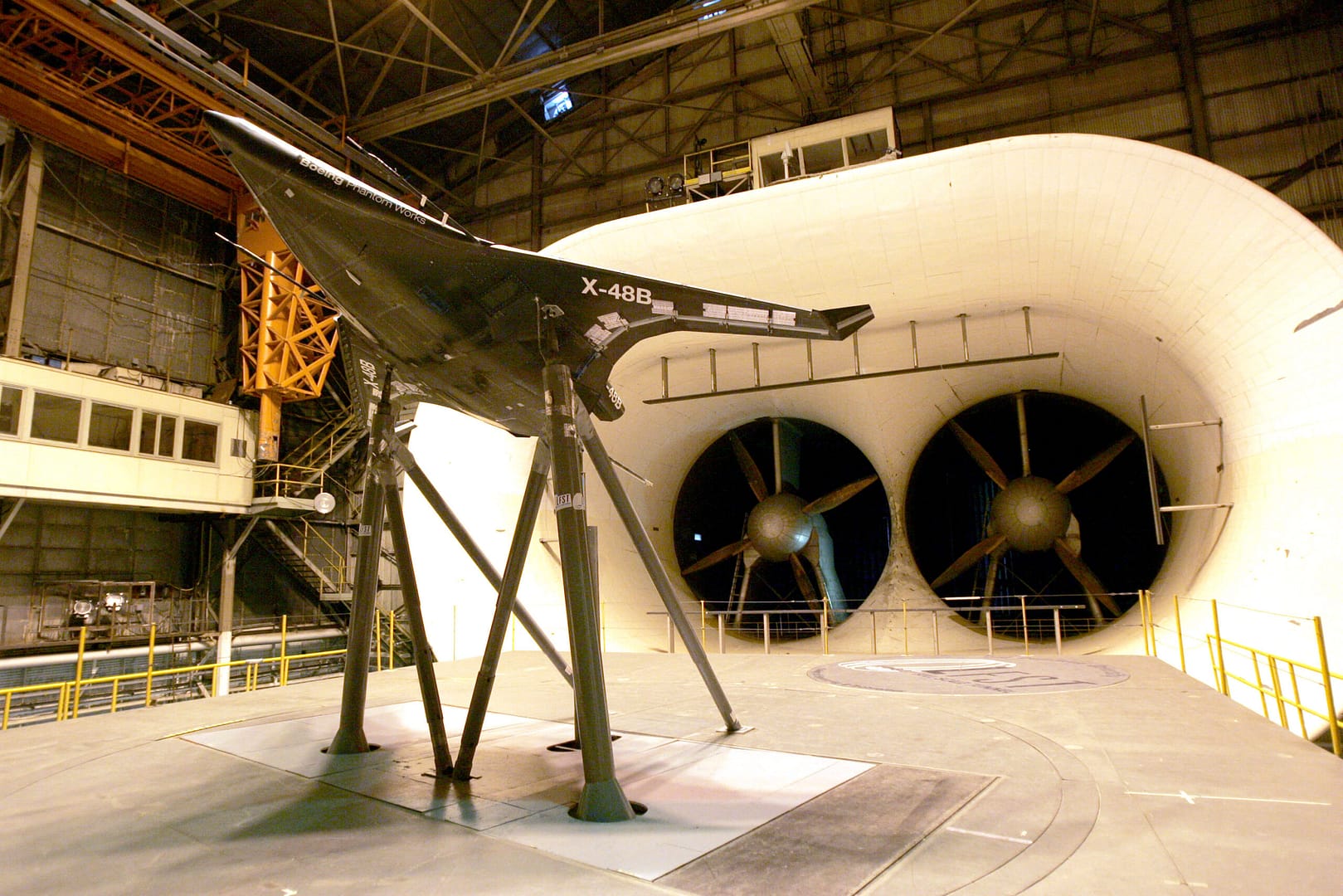
A wind tunnel inverts reality. Instead of moving an aircraft through still air, it blows air past a stationary model and measures the forces. The physics are identical — what matters is the relative motion between air and object, not which one is moving. This principle, called Galilean invariance, is why the Wright Brothers could test wing shapes in a wooden box with a fan at one end in 1901 and get data that was accurate enough to design the Flyer. The modern version has three sections. The settling chamber calms the incoming air, removing turbulence with honeycomb screens and fine mesh. The contraction cone accelerates the flow — narrowing the cross-section speeds up the air by conservation of mass (the same amount of air through a smaller area must move faster). Then comes the test section, where the model sits on a sting mount or a floor balance, bristling with hundreds of pressure taps and force sensors. Downstream, a diffuser slows the air back down, and either exhausts it (open-circuit) or routes it back to the start (closed-circuit). The instrumentation is where the magic lives. A modern wind tunnel model can have 300 to 500 individual pressure taps — tiny holes drilled into the surface, each connected to a pressure transducer. Together they map the exact pressure distribution over the entire model at any given angle of attack, sideslip angle, and airspeed. Strain-gauge balances measure lift, drag, side force, and all three moments (pitch, roll, yaw) simultaneously. The data rate is typically thousands of samples per second per channel.Speed Changes Everything
Air behaves radically differently at different speeds, and this is why the aviation industry needs so many different tunnels. At subsonic speeds (below Mach 0.8), air flows smoothly around objects and the dominant forces are pressure gradients and viscous friction. A subsonic tunnel is the workhorse — most initial aircraft design happens here. The fan drives air at speeds up to several hundred kilometres per hour, and the engineer adjusts the angle of the model to map its performance envelope. At transonic speeds (Mach 0.8 to 1.2), things get complicated. Pockets of supersonic flow form over the wings while the freestream is still subsonic, creating shock waves that dramatically increase drag. This is the speed range where airliners cruise, and it is fiendishly difficult to simulate correctly. Transonic tunnels use slotted or perforated walls in the test section to prevent shock reflections from contaminating the data.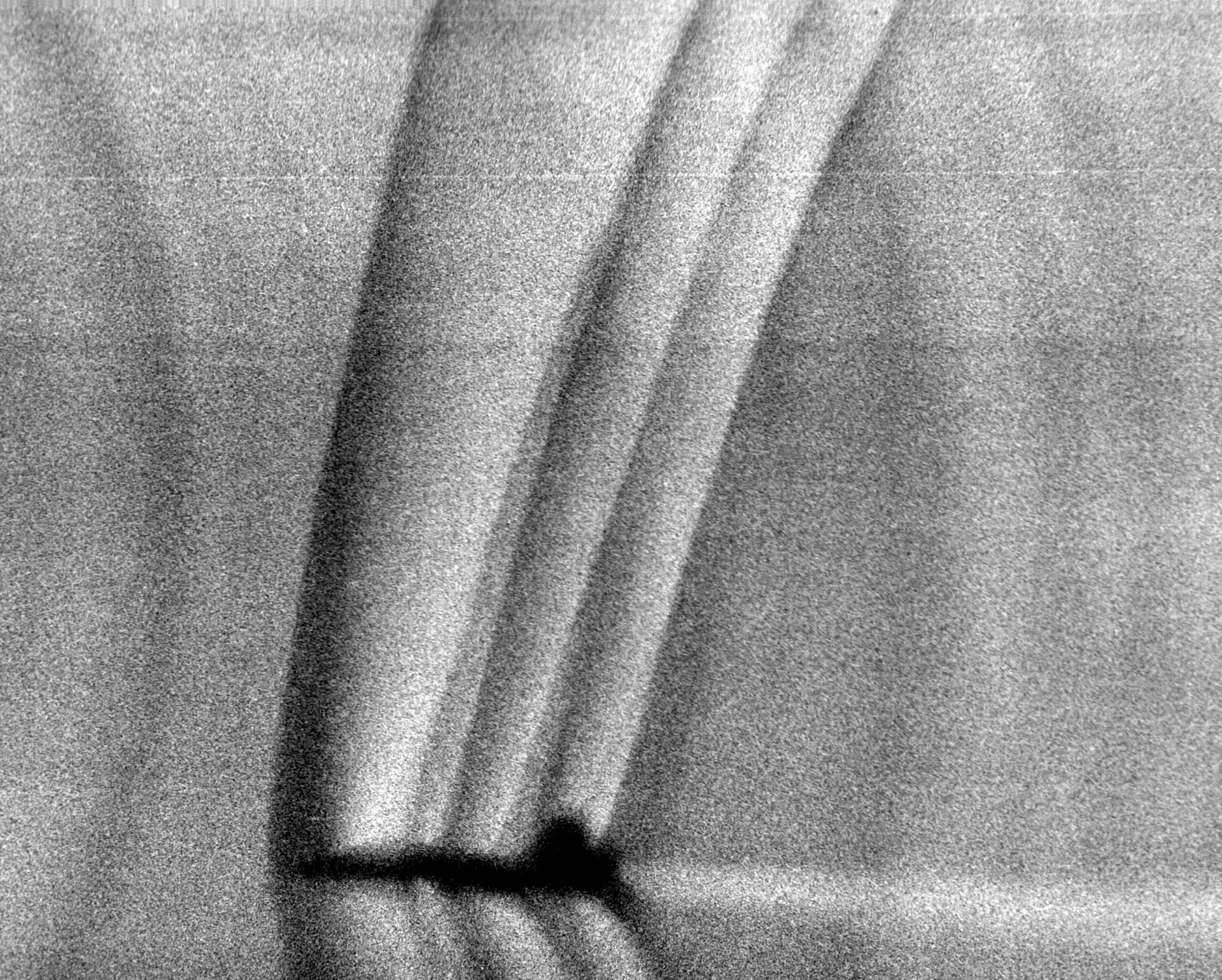
Why Not Just Use Computers?
Computational fluid dynamics (CFD) has advanced enormously since its emergence in the 1960s. Modern CFD can simulate millions of grid points and resolve complex flow features that would have been impossible to model even a decade ago. So why does every major aerospace company still maintain wind tunnels? The answer is turbulence. Turbulent flow — the chaotic, swirling motion that dominates real-world aerodynamics — remains one of the unsolved problems of classical physics. CFD can approximate turbulence using statistical models, but these models are calibrated against experimental data. At the edges of the flight envelope — high angles of attack, transonic buffet boundaries, separated flow, vortex breakdown — CFD predictions can diverge significantly from reality. The only way to know what actually happens is to measure it. Aviation certification authorities (the FAA, EASA) require physical test data. No aircraft has ever been certified on CFD alone, and none is likely to be for decades. Wind tunnel testing is not heritage technology stubbornly refusing to die — it is the irreplaceable validation layer between digital prediction and physical reality.The Numbers That Matter
Scale is the perpetual challenge. A wind tunnel model is typically 1/10th to 1/20th the size of the real aircraft. To make the aerodynamics truly representative, the Reynolds number — a dimensionless ratio of inertial to viscous forces — must match the full-scale value. At small scale, this means either increasing the air speed (often impractical) or increasing the air density. Cryogenic wind tunnels, like the European Transonic Windtunnel in Cologne, cool the nitrogen gas to roughly −150°C, which increases its density and allows Reynolds number matching at manageable speeds. The result is data that transfers directly to full scale with minimal correction. The cost of running these facilities is staggering. NASA's National Transonic Facility at Langley draws about 100 megawatts during a test run — enough to power a city of 75,000 people. A typical test campaign for a new fighter configuration runs three to six weeks and costs several million dollars. For a commercial airliner programme, wind tunnel testing over the full development cycle can exceed $100 million. It is still cheaper than getting the aerodynamics wrong.
Related Questions
How does a wind tunnel work?
A wind tunnel pushes a controlled stream of air over a stationary model or full-size component. Sensors measure aerodynamic forces (lift, drag, side force) and surface pressures, while smoke or laser-based systems visualise airflow patterns. The test section where the model sits is precisely calibrated for uniform flow speed and low turbulence.
How fast can wind tunnels go?
It depends on the tunnel. Low-speed tunnels typically reach 100–300 km/h for testing aircraft at takeoff and landing configurations. Transonic tunnels operate around Mach 0.6–1.4. Supersonic tunnels can reach Mach 2–5, and hypersonic tunnels — used for re-entry vehicle and scramjet testing — can exceed Mach 10.
Are wind tunnels still needed now that we have computer simulations?
Yes. Computational fluid dynamics (CFD) is a powerful complement but not a full replacement. CFD struggles with complex turbulent flows, separated flow regions, and aeroelastic effects. Every major aircraft programme — including the F-35, A350, and B-21 — still relies on extensive wind tunnel testing to validate computer models and catch problems that simulations miss.
Where are the largest wind tunnels in the world?
NASA's National Full-Scale Aerodynamics Complex at Ames Research Center in California has a test section large enough to fit a full-size Boeing 737. The European Transonic Windtunnel (ETW) in Cologne, Germany, uses cryogenic nitrogen to match real flight conditions at scale. China's JF-22 hypersonic tunnel in Beijing can simulate speeds up to Mach 30.
Related Posts
Sources: NASA Glenn Research Center, NASA Ames Research Center, Breaking Defense, Embry-Riddle Aeronautical University
0 Comments